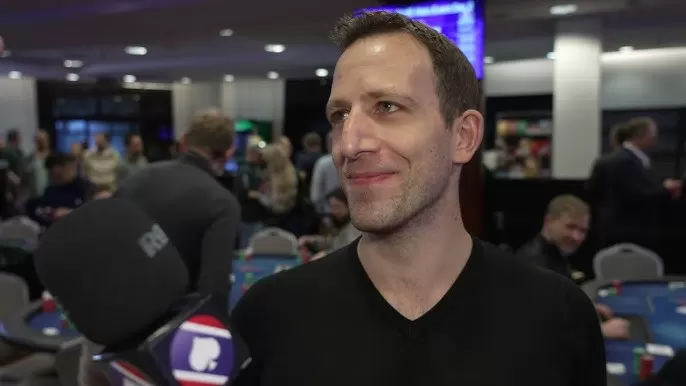

Benny Glaser already had a résumé most players would trade a kidney for. After taking down the 2026 World Series of Poker $50,000 Poker Players Championship, he has the kind that gets your name carved into the sport's permanent record.
The win is worth over $1.3 million and, more importantly to Glaser, his ninth career WSOP bracelet. In the hierarchy of WSOP prestige, the PPC sits second only to the Main Event, and for a mixed-game specialist it's the summit.
Here's why that matters, and why this particular trophy is the one serious players actually covet. The Main Event is a no-limit hold'em tournament. One game. You can be a genuinely world-class hold'em player and a complete tourist everywhere else, and the Main Event will never expose you for it. The PPC won't allow that. It rotates through eight games — typically Limit 2-7 Triple Draw, Limit Hold'em, Omaha 8, Razz, Stud, Stud 8, No-Limit Hold'em, and Pot-Limit Omaha. The format is built specifically to find the leak in your game, because everyone has one. Your edge in Stud gets handed back at the Razz table. The guy crushing you in PLO is bleeding chips in triple draw. Over a long enough rotation, the field doesn't reward the best specialist. It rewards the player with the fewest weaknesses.
That's the whole point of the trophy. It's named for the players because the players decided, years ago, that this was the test that mattered. When Chip Reese won the inaugural one in 2006, the bracelet was literally renamed in his honor after he passed. This is the room where reputations are settled.
Glaser walked in with no leaks to settle.
"It does feel like a bit of a dream right now. I'm so happy," he told PokerNews afterward, visibly emotional. He called it "the pinnacle of mixed games achievement," and for someone who has built an entire career in the disciplines most pros quietly avoid, that's not hyperbole.
The company he now keeps
Nine bracelets in eleven years is absurd pacing. Only six players in history have matched or exceeded his count: Phil Hellmuth (17), Phil Ivey (11), Doyle Brunson (10), Johnny Chan (10), Erik Seidel (9), and Johnny Moss (9). That's not a leaderboard, it's a Hall of Fame ballot. Glaser becomes eligible for induction in three years, and barring something strange, the vote should be a formality.
But raw count undersells what's happening here. Most of the names above won a big chunk of their bracelets during a different era of poker, when fields were smaller, the player pool was softer, and a strong reg could run deep through a fraction of today's competition. Brunson and Moss were winning bracelets when a $10K event might draw a couple hundred entrants, most of whom learned the game in the back of a Texas pool hall. Glaser is winning his against modern fields full of solver-trained, GTO-literate pros who have studied every street of every game. The bracelets are not equivalent currency. His are harder.
And look at where they came from:
- 2015 — $1,500 Limit 2-7 Triple Draw Lowball
- 2016 — $1,500 Omaha Hi-Lo 8 or Better
- 2016 — $10,000 Omaha Hi-Lo 8 or Better Championship
- 2021 — $10,000 Razz Championship
- 2023 — $10,000 Limit 2-7 Triple Draw Championship
- 2025 — $1,500 Dealer's Choice
- 2025 — $1,500 Mixed Omaha
- 2025 — $2,500 Mixed Triple Draw Lowball
- 2026 — $50,000 Poker Players Championship
Notice what's almost entirely missing: no-limit hold'em. The game that made poker famous, the game on every televised final table, the game every kid learns first. Glaser built a legendary career largely by ignoring it and going deep into the games nobody streams. There's a lesson buried in that for anyone grinding the same tired NLHE pools online — the soft money has been migrating toward mixed games for years, precisely because most regs refuse to learn them. Glaser figured that out a decade ago.
The 2025 line deserves its own moment. Three bracelets in a single Series made him just the seventh player ever to do it, joining a list that includes Hellmuth, Ivey, and Brunson. Most pros chase one bracelet for a career. He won three in a summer, then came back the next year and took the hardest tournament on the calendar. That's not a hot streak. That's a peak.
The final table
Glaser carried a commanding stack into Thursday's six-handed final table, sitting on more than 50 percent more than second-place Maxx Coleman. A chip lead like that at a PPC final table is worth more than the raw numbers suggest. In a fixed-limit rotation, you can't simply ship it all in and gamble your way back; the betting structure caps how fast anyone can double through you. A leader who avoids spew can grind shorter stacks down methodically, and Glaser is not a player who spews.
By heads-up against Josh Arieh, the counts had leveled out and the match looked like a real fight on paper. It wasn't.
"I wasn't expecting it to be quite that one-sided," Glaser said. "I honestly did think I would have an edge, but I did just also run very well in heads-up in a lot of spots. It was a quicker battle than I expected given how deep we were, but I'm pretty happy with how I played."
That's the polite version. Beating Arieh heads-up is no small thing either. Arieh is a three-time bracelet winner and one of the more dangerous tournament players of his generation, the kind of opponent who makes you earn every pot. Glaser made it look like a formality.
The bigger picture
The WSOP bracelets are only half the story. Glaser is one of the most decorated online tournament players who has ever logged in, with 11 PokerStars SCOOP titles and 16 WCOOP crowns to his name. For context, plenty of respected online pros grind for a decade chasing a single SCOOP or WCOOP title. Glaser has 27 between the two series. The crossover is what's genuinely rare. Live mixed-game mastery and online tournament dominance pull on completely different skill sets and schedules, and almost nobody operates at the elite tier of both. Most pros pick a lane and stay in it. Glaser refused.
The win also reshuffles the 2026 WSOP Player of the Year race. Glaser jumps to third with 2,407 points, sitting just 50 behind Arieh, the man he just eliminated, and roughly 300 behind leader William Foxen. There's a nice symmetry to that. By busting Arieh he didn't just win the title, he closed most of the gap on the guy ahead of him in the standings, a quiet two-for-one that could matter a lot when the Series wraps. POY races are won in margins this thin.
For now, Glaser gets the trophy that mattered most to him. The Hall of Fame can wait three years. It's not going anywhere, and neither, apparently, is he.