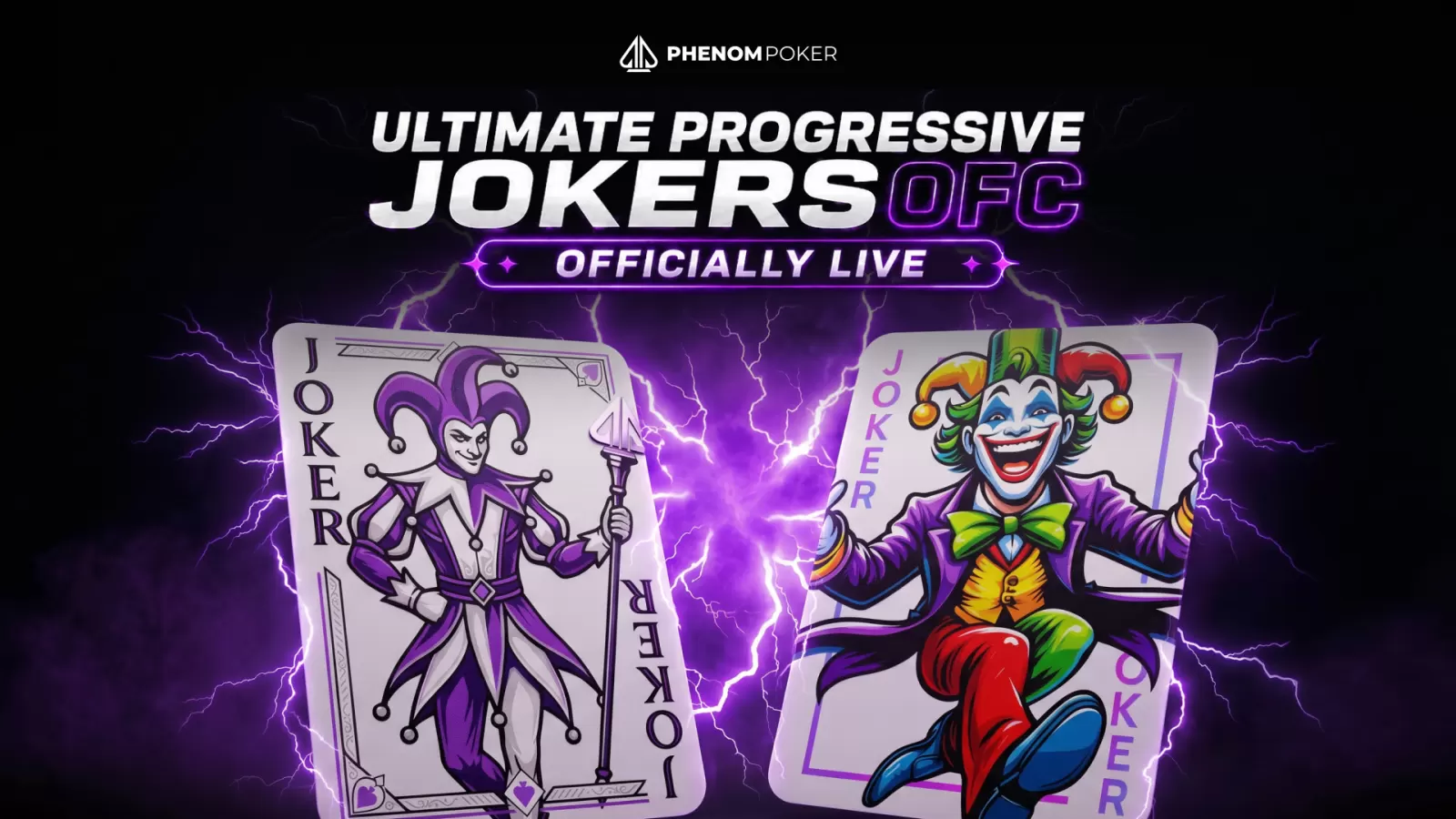

Open-Face Chinese has always been a game of managing chaos. You set thirteen cards across three rows, pray the board cooperates, and try not to foul your way into a point bloodbath. Now Phenom Poker has thrown a grenade into that delicate math: Ultimate Progressive Jokers OFC is live, and fully wild cards are in the deck.
This changes everything. Monster hands get easier to build. Fouls get easier to dodge. And Fantasyland, already the most valuable real estate in the game, just got a lot more crowded. Whether you're splashing around the $0.10 micros or taking shots in the $200 USDT high roller games, the tables are open right now.

But before you sit down and start slinging wilds, understand what you're actually doing. Streamer Scott Kenyon has been grinding OFC on Phenom for weeks, and his read on the fundamentals (plus how Jokers warp them) is the difference between printing in Fantasyland and bleeding points one fouled board at a time.
The OFC fundamentals, fast
If you're new, the structure is simple even if the decisions aren't. You build three hands at once: a five-card Bottom (your strongest), a five-card Middle (second strongest), and a three-card Top (your weakest). The one ironclad rule: Bottom beats Middle beats Top. Break it and you foul, which torches your whole board and hands free points to everyone at the table.
Everything in OFC flows from that constraint. Here's how to stop fighting it.
Don't foul. Ever, if you can help it. The single most common way beginners light money on fire is building an invalid board. If your Middle accidentally outranks your Bottom, you're done. A safe, valid hand beats a greedy gamble that craters the entire setup almost every time. When in doubt, play it clean.
Build from the bottom up. Your Bottom row has five cards and the most room to grow into something huge, so that's where your premium cards live. Medium strength goes Middle. Weak cards get parked up Top. Follow the gradient and you'll foul far less often.
Leave yourself space and options. After your initial five-card placement, don't lock into one razor-thin draw. Flexible boards complete themselves; rigid ones strand you. And always try to keep open space in your Top row so a bad final card doesn't get force-placed there and foul you. Empty space up top is insurance.
Stay balanced. One spectacular hand sitting next to two garbage rows loses to a board that's solid across all three. Spread the strength.
Cold deck? Shift gears. When you start with junk, stop dreaming. The goal becomes simple: make a valid hand, steal at least one row to avoid getting swept, and minimize the damage. Limiting losses is a real skill, and on a bad runout it's the most profitable thing you can do.
Watch the other boards. Pay attention to what your opponents have placed. Dead cards tell you which of your draws are already blocked, and that should change how you build.
Fantasyland is the whole game
Here's where recreational players leave the most money on the table. Fantasyland deals you all your cards at once, which is an enormous scoring edge, and most beginners treat it like a nice bonus instead of the primary objective.
Play hard for it. Specifically, aim for the AA+ qualifier up top rather than settling for a merely strong Bottom like quads. Quads on the Bottom is a flat 10 points and it's over. Fantasyland is a renewable resource. Once you're in, you keep slamming big back-row combos hand after hand, and that compounding is where the real points come from.
Once you're there, the goal shifts to staying there. Refantasy-ing requires Quads+ on the Bottom or Trips on the Top, and there's a scoring trick worth knowing. Quads on the Bottom pays a flat 10. But Trips on the Top scales from 10 points (deuces) all the way to 22 points (aces). So if your Fantasyland cards can be arranged to play quads as trips up top instead, it often scores more. Always chase the royalties.
What Jokers actually change
Jokers are fully wild. Any rank, any suit, whatever the board demands. That sounds like a license to gamble, but the discipline matters more than ever, because everyone else has them too.
Spend your Jokers on:
- Completing monster hands in the Bottom or Middle, where the payoff is biggest.
- Pairing high cards up Top to punch your ticket to Fantasyland.
- Foul insurance when a board is one bad card away from collapse.
What you should not do is burn a wild on a marginal upgrade. A Joker that turns a good hand into a slightly better hand is a Joker wasted. Hold it for the spot that actually swings the board.
A heads-up warning about time
One real consequence of all these wilds: Fantasies and refantasies fire constantly now. That's great for action, but it means three-handed games can lock you in for a long time. You can sit down for "a few hands" and surface an hour later, still trapped in an endless Fantasyland loop.
If you're short on time or want lower variance, the Heads-Up tables are the answer. One opponent instead of two means smaller swings and no marathon commitment. You can actually stand up when you want to. It's the controlled-burn version of the same game.
The wilds are in the deck and the action is running. Learn the fundamentals, respect the Jokers, and go play hard for Fantasyland.