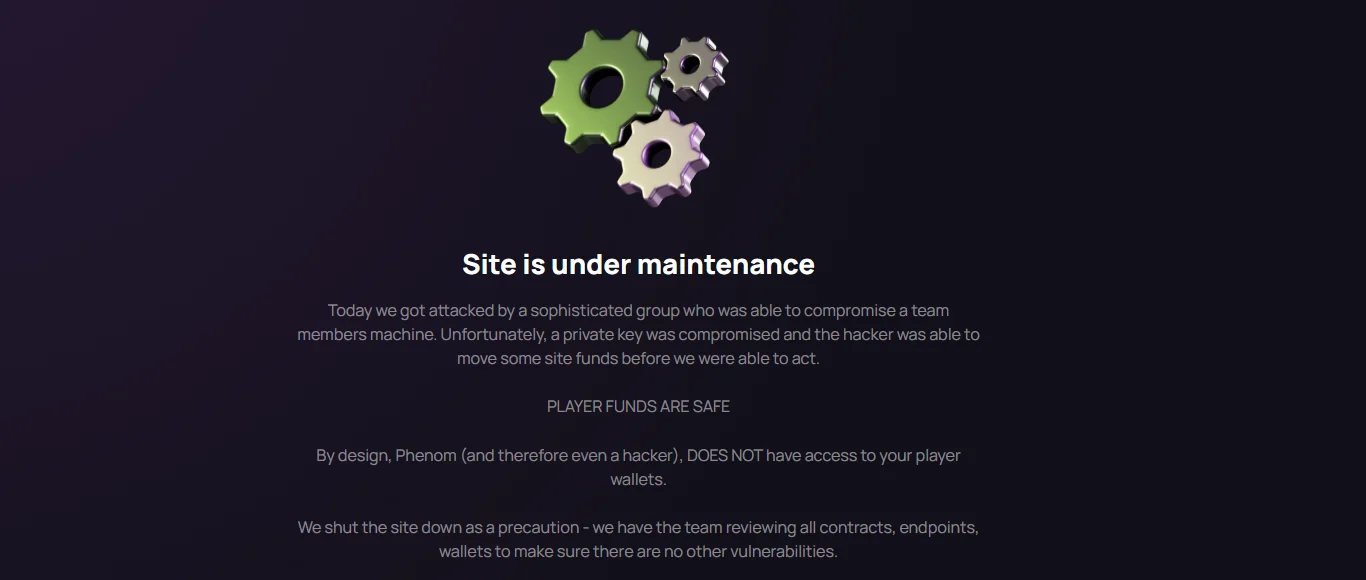

Nothing spikes an online grinder's heart rate quite like logging in for a session and seeing a "Site is under maintenance" screen. When that screen is followed by reports of compromised private keys and sophisticated hackers, panic naturally ensues. That is exactly what the Phenom Poker community woke up to on April 1. Unfortunately for the player-owned crypto site, it was not an elaborate April Fools' joke.
According to a Discord message from Phenom Poker CEO Matt Valeo, which was quickly amplified on X by poker watchdog Todd Witteles, the platform suffered a targeted breach. A team member's machine was compromised, giving hackers access to a private key. Before the security team could fully react, the intruders managed to siphon off exactly $94,267 USDC in operational site funds.
Don't look now, but Phenom Poker has been hacked, and a lot of "site funds" were stolen. Player funds are supposedly safe because Phenom doesn't hold access to personal wallets, but this couldn't be good for its future -- short or long term. pic.twitter.com/Dw1yprqAjv
— Todd Witteles (@ToddWitteles) March 31, 2026
The Non-Custodial Advantage: Why Your Money is Actually Safe
The silver lining here is massive, and it highlights exactly why some players have been migrating to decentralized poker platforms. Valeo confirmed that player funds are entirely safe. This is not just a PR spin; it is a technical reality of Phenom Poker's architecture.
Phenom operates using non-custodial wallets on the Polygon blockchain. In plain English, the platform itself never actually holds the private keys to your personal deposits. The hackers compromised an internal corporate treasury key, allowing them to drain the $94k in site funds. However, because Phenom physically cannot access your connected Web3 wallet, neither can the hackers. The ecosystem was immediately taken offline as a preventative measure to audit all smart contracts and endpoints.
Witteles raised a sharp point on social media regarding the platform's liquidity. A $94,000 hit might be a rounding error for legacy poker networks, but for a newer platform built around a unique player-ownership model, an inability to instantly replace a five-figure loss can spark rumors about financial health.
The PHNM Token Question
The real concern for regular Phenom grinders goes beyond the immediate USDC hack. Phenom's entire hook is the PHNM token, an ERC-20 smart contract that pays out a 50 percent revenue share to token holders every Monday. Because PHNM is not listed on external exchanges and its price is determined by an internal formula based on site performance, prolonged downtime directly impacts the community's bottom line. No games mean no rake, and no rake means lower dividends for the players holding those tokens. Returning the site to a stable, secure state is a literal race against the clock for the platform's valuation.
Paused Tournaments and the ICM Savior
Because the site was taken offline immediately, all running tournaments were paused. Phenom announced they will not be restarting these events. Instead, they are paying out all remaining players based on ICM (Independent Chip Model).
If you are a casual player, you should actually be thrilled by this decision. An ICM payout is mathematically the fairest possible way to handle a sudden server crash. Unlike a straight "chip chop" which heavily favors massive chip leaders, ICM calculates the true dollar equity of your exact stack based on the remaining prize pool and payout structure. If you were nursing a short stack on the bubble, this server shutdown probably secured you a much better cashout than you would have realized playing it out.
Bankroll Security in the Web3 Era
This incident serves as a crucial case study in digital bankroll management. While Phenom's non-custodial architecture successfully protected the player base, the fact that an internal endpoint was compromised reminds us that no platform is immune to sophisticated attacks.
This is exactly why we see traffic consistently flowing toward battle-tested crypto poker rooms that prioritize hardened security alongside their promotions. When you are deep in a weekend major, the only thing you should be stressing about is whether the big blind is squeezing light, not whether a site developer just clicked a bad phishing link.
Phenom Poker is currently auditing its vulnerabilities and will likely return to the felt soon. Until then, use this downtime to audit your own digital security, diversify your bankroll across top-tier secure platforms, and remember that protecting your money off the table is just as important as defending your blinds on it.