In 2007, a broke kid posted on the Two Plus Two forums under the name WCGRider with the subject line "Reaching the end of my rope." He was down to his last thirty dollars, grinding micro-stakes sit-and-gos, getting laughed off the forums, and openly wondering whether he should just quit and go back to school.
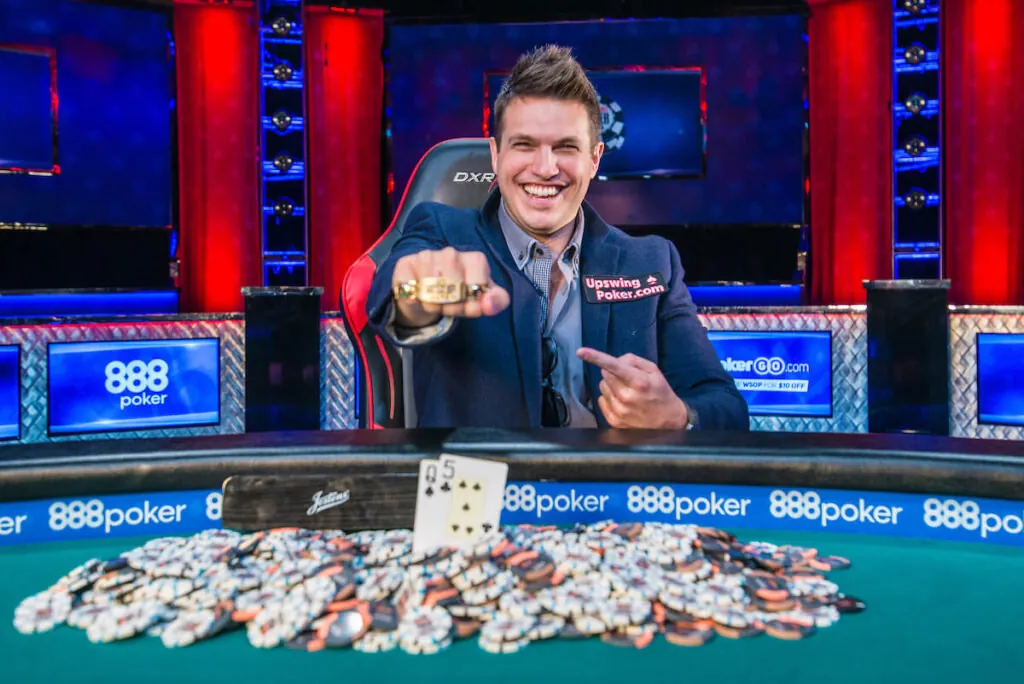
That kid is now worth somewhere north of twenty million dollars, owns three WSOP bracelets, did a standup set on Kill Tony, tried to recall the mayor of Las Vegas, and at one point genuinely couldn't find a single opponent on earth willing to sit across from him heads-up.
This is the strange, combative, occasionally unhinged story of how Doug Polk got from one to the other.
A Warcraft handle and a $20 deposit
Before the bracelets, before the feuds, there was a North Carolina teenager who was very good at video games. Polk's father taught him chess at five, and the strategy bug never left. By fifteen he was competing in World Cyber Games tournaments as a Warcraft III player under the tag T-Rider. That's where the legendary screen name comes from: WCGRider is literally "World Cyber Games Rider." The most feared name in heads-up poker history is a leftover gamertag.
He enrolled at UNC Wilmington, then dropped out to play cards. The opening bankroll was the stuff of forum legend: he deposited twenty dollars at PokerStars and ran it into ten thousand, starting at the one-cent, two-cent tables. For years he wasn't even really beating the game. He was a "rakeback pro," the polite term for a player who only finishes ahead because the site refunds a slice of the rake he generates. In plain terms, the games were beating him and the rebate was bailing him out.
By 2011 he was nearly broke again. That was the fork in the road. Instead of quitting, he doubled down.
The grind nobody wanted to watch
Polk clawed his way up through six-max cash, eventually becoming a regular in the $5/$10 and $10/$20 games. Then he made the decision that defined his career: he abandoned six-max for heads-up, widely considered the purest and most brutal form of poker there is. No hiding behind position, no folding your way to a profit, no soft spots at the table to feast on. Just you, one opponent, and nowhere to run.
Here's a detail you won't find in the polished bios. Back around 2010, when I was dabbling at the heads-up tables myself, WCGRider was already a fixture, camped out at the tables and waiting for action like he had nowhere else in the world to be. I asked another grinder about him once. The answer stuck with me: "Doug Polk has lost his mind, never giving up a pot." It wasn't a compliment at the time. It was a warning. The guy fought for everything, refused to fold in spots where everyone else surrendered, and turned every session into a war of attrition.
Turns out "lost his mind" was just what relentless looked like before the rest of us understood it. He climbed from $2/$4 up to $50/$100 in a hurry, and PokerStars and Full Tilt regulars came to know WCGRider the hard way. By his own account, he feasted hardest on players he considered strong all-around but weak heads-up, exactly the leak he was engineered to punish. The crazy full-ring grinder who never gave up a pot had quietly become an absolute heads-up beast.
And by 2013 he had a new problem: he was so good that nobody wanted to play him.
The Sauce123 challenge
So he made the games come to him. In late 2013, Polk challenged the reigning heads-up king, Ben "Sauce123" Sulsky, to a marathon match north of 15,000 hands. When the dust settled, Polk was up a staggering $740,000, plus a $100,000 side bet for winning. The kid on his last thirty bucks now had a six-figure scalp and the unofficial title of most dangerous one-on-one player alive.
He didn't get there alone. Polk sharpened his game inside a crew that styled itself the "Evil Empire," trading ideas with Ryan Fee and Jason Mo, with Donger Kim and Jason Les as close associates. They reverse-engineered the highest-stakes games online before solver software made that kind of analysis push-button. Polk was, in a real sense, solving poker before the solvers showed up.
In 2015 he even took down a robot. As part of the "Brains vs AI" challenge against the Claudico poker bot, Polk personally beat the machine for 213,000 chips, with the human team splitting $100,000 for the win. A man who got his start in esports closing the loop by beating an AI at cards is a little too on the nose, but it happened.
The feuds: this is where it gets fun
If poker had a designated heel, Polk auditioned for the role and got the part. The man does not let things go. Ever.
Ben Tollerene. In 2016, Polk posted a 32-minute YouTube video branding fellow high-stakes pro Ben Tollerene "a vulture of the high-stakes poker community." The roots went back roughly two and a half years to a coaching swap: Polk would teach Tollerene no-limit, Tollerene would teach Polk pot-limit Omaha, and they'd trade pieces of each other's action. Polk held up his end. Tollerene, per Polk, bailed on the PLO side once his own PLO mentor was leaving the game.
Tollerene's version, posted on the forums, was messier and frankly more human: a coaching deal, some sold action, then a drunken 5 a.m. argument in Polk's hotel room about whether Polk was really the best player in the world. They talked it out, hugged, declared themselves cool. Polk woke up the next morning and fired off an essay over Skype explaining why they could no longer be friends. Two grown men, both crushing for millions, falling out over coaching homework and a sample-size dispute. The part that stung Polk most? He'd looked up to Tollerene as an idol. Lesson there about meeting your heroes, but Polk doesn't do lessons. He does videos.
Daniel Negreanu. The big one. Years of Twitter sniping finally boiled over into a heads-up grudge match in 2020 and 2021: two tables of $200/$400, 25,000 hands, three months. Polk trolled relentlessly in the buildup, repeatedly calling himself a humble "truck driver" who was going to back up the truck and drive off with all of Negreanu's money.
Negreanu actually won the first session, played live at the Aria, then ran into a buzzsaw. At one point Polk introduced a near-unbeatable limping strategy purely to lower variance and lock up his lead. Negreanu, who had not prepared for anyone limping at him, retaliated by tanking on every single hand to grind the sessions to a crawl until they had to drag in Phil Galfond to arbitrate and tell both men to just act like reasonable humans.
The final number: Polk beat Negreanu out of $1,201,807 across 36 sessions, at a 12 BB/100 win rate that would make almost any pro at any stakes weep with envy. The breakdown told the whole story of why he picked this fight: roughly break-even out of position, but a savage 22 BB/100 when he had the button. Negreanu, a Poker Hall of Famer with $42 million in live tournament earnings, was a six-time bracelet winner being asked to fight in a phone booth against a man who'd spent a decade in phone booths. To his credit, Negreanu conceded with grace afterward: he'd needed to run above expectation, and it simply didn't happen.
Matt Berkey. Still simmering, still petty, still extremely online. Polk has spent years insisting Berkey's Solve For Why coaching site isn't worth the money. The feud has flared over Berkey ducking a televised cash game because, by his own admission, he didn't have a half-million in cash lying around after two losing sessions. It flared again when Berkey questioned the security at The Lodge on his podcast and Polk fired back that Berkey didn't have the expertise to run a stream or coach poker. When they finally tangled in cash on a Bally's livestream, they paused mid-session to argue about whose training site was better, Polk loudly demanding Berkey admit that a coach selling a course on the Upswing site was, in fact, an Upswing coach. Naturally, Polk's standing offer to settle it was heads-up no-limit, his killing field, and naturally Berkey declined.
The losses they leave off the highlight reel
For all the dominance, Polk bleeds like everyone else the moment he steps outside his comfort zone. In May 2023, during Hustler Casino Live's million-dollar buy-in game, he ran a stone-cold bluff into Tom Dwan for a $1.1 million pot, got snapped off, and finished the session down $620,000. The poker internet spent days arguing over whether Dwan's agonizing slow call was a real tank or a quiet revenge troll for years of Polk needling "durrrr."
PLO, fittingly, has always been the format that exposes him; he's openly admitted to dropping a million dollars over just a few days of Omaha cash. And the Million Dollar Game left a sour taste for non-poker reasons too: he complained he was "not allowed" to return on later days, grumbled about the lineup being unfavorable, and swore off coming back. The man who never gave up a pot still, occasionally, ships gigantic ones across the table and stews about it on camera.
He stews on the WSOP felt too, with style. Busting a recent Main Event with pocket aces cracked by kings, Polk turned his own beat into an ad read in real time: "Aces versus Kings! Brought to you by Club WPT Gold. My name is Code Doug, and you can sign up today." The case king hit the flop mid-sentence. Even his coolers are monetized.
The side quests: crypto, an empire, and a mayor
Off the felt is where Polk really printed money, and where things got weird.
He co-founded Upswing Poker with Ryan Fee in 2015, grew it into one of the biggest training sites in the game and the YouTube channel past 330,000 subscribers, and eventually sold his stake to ClubWPT Gold in 2025. He's also said flatly that cryptocurrency, not poker, accounts for the bulk of his net worth; he was an early Bitcoin adopter. That instinct cut both ways. He became the paid face of crypto exchange CoinFLEX, which imploded in mid-2022 after claiming a single user owed it nearly $84 million, halted all trading by April 2023, and left Polk publicly defending a company a lot of people thought was sketchy from the jump.
Then there was the time he tried to fire a sitting mayor. In 2020, after Las Vegas Mayor Carolyn Goodman went on CNN and floated the idea of using her own city as a COVID "control group," Polk, who didn't even live in Las Vegas proper, filed paperwork to recall her. His mock campaign pitch was vintage Polk: "My pledge to you today is to do absolutely nothing. Because nothing is better than Carolyn Goodman." He needed roughly 6,700 signatures in 90 days, gathered essentially none, and folded the campaign citing the pandemic, the very thing he'd started it over. Goodman's entire public response was four words: "This is America. That's his choice."
His podcast, meanwhile, became the place poker's biggest scandals went to explode. In 2022, Polk sat down with Martin Zamani, who proceeded to accuse all-time live money leader Bryn Kenney of running a cult-like cheating and collusion operation with his stable of backed "horses." Kenney's lawyers threatened Polk with legal action ten minutes before airtime. Polk announced the threat on Twitter and ran the episode anyway. The saga somehow expanded to include ghosting, multi-accounting, a shaman, and frog poison. Polk handed all of it a microphone and pressed record.
The Lodge, and the rawest year yet
Polk eventually became a co-owner of The Lodge Card Club in Round Rock, Texas, a sprawling room he built up alongside fellow vloggers and investors into one of the most respected poker destinations anywhere. It became his stage, the home of the high-stakes heads-up "King of the Hill" challenges he still hosts. As recently as November 2025 he beat Finnish pro Ossi "Monarch" Ketola there for $1.2 million, calling it the biggest winning cash session of his life. Thirty bucks to that, give or take eighteen years.
Then came March 2026, and the worst headline of his career. The Lodge was raided on March 10 by the Texas Alcoholic Beverage Commission over allegations of money laundering, illegal gambling, and organized crime. Investigators seized over $1.3 million in cash and forced the club to close, laying off hundreds of staff. A leaked warrant pointed to roughly $1.35 million in deposits flagged as suspicious, routed from a cash vault inside the club into the parent company's bank account.
Polk's response was, predictably, combative and extremely public. He branded the whole thing a "witch hunt," sparred with Tom Dwan over it, and released a YouTube video, his first since the raid, vowing that any player with chips stuck in the cage would be paid, personally if necessary. He denied any knowledge of money laundering. By late April the money laundering allegations had been dropped, a grand jury declined to indict Polk or his co-owners, and the path cleared for the club to reopen. The kid who once worried about his last thirty dollars now has to worry about Texas Penal Code 47.04.
The throughline
Strip away the bracelets, the crypto fortune, the lawsuits, the recall petition, the Kill Tony set, and the feuds, and you're left with one line from a railbird in 2010: "never giving up a pot." Everything Polk has built sits on top of that single, slightly deranged trait. He fought for pots nobody else thought worth fighting for, then aimed the exact same stubbornness at Sauce123, at Negreanu, at Tollerene, at Berkey, at a poker AI, at a mayor, and finally at the state of Texas.
He's retired more than once and keeps wandering back to the felt, forever loudly insisting he's fallen out of love with the game while continuing to show up and win at it. The mind everyone was sure he'd lost turned out to be the single most valuable thing he owned.