

In the spring of 2012, Phil Ivey walked into the Borgata Hotel Casino in Atlantic City and sat down at a mini-baccarat table. He had a million dollars in front money, a mysterious Chinese companion beside him, and a plan that would eventually drag him through courtrooms on two continents for the better part of a decade.
By the time the dust settled, Ivey and his partner Cheung Yin "Kelly" Sun had taken two of the world's most prestigious casinos for a combined $22 million. They never marked a card, never palmed a chip, never touched the deck. They didn't need to. They had something better: a manufacturing defect, a pair of extraordinary eyes, and every casino's willingness to accommodate a whale.
This is the full story of what happened, how they pulled it off, and why the courts couldn't quite agree on what to call it.
The Queen of Sorts
To understand the edge-sorting saga, you have to start with Kelly Sun, not Phil Ivey. Because Ivey, for all his poker brilliance, was the supporting actor here. Sun was the architect.
Cheung Yin Sun grew up in Hong Kong, the daughter of a wealthy factory owner. When her father died, he left her roughly $20 million. She lost every cent of it playing baccarat and slot machines in casinos around the world. That kind of degenerate action tends to earn you a reputation, and Sun's was well established on both sides of the Pacific.
In 2006 (some accounts say 2007), things bottomed out. Sun couldn't cover a $93,000 marker at an MGM property in Las Vegas. She was arrested and spent roughly three weeks in a Clark County jail. Women attacked her. The guards wouldn't let her wear her own underwear. She lost 25 pounds before relatives flew in from Hong Kong with $100,000 to settle the debt.
She walked out of that jail with a singular purpose. As she later told the New York Times: "I decided that, one day, I would get back the money by playing at MGM properties."

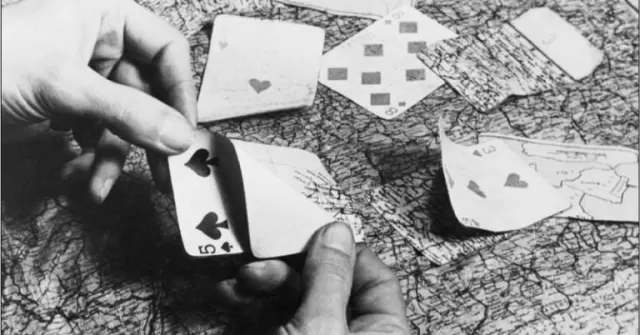
Over the next several years, Sun devoted herself to mastering a technique that most casinos hadn't even heard of: edge sorting. The concept is deceptively simple. Many decks of playing cards, particularly those with "full bleed" designs that run right to the edge, have tiny asymmetries in the patterns on their backs. One long edge of a card might show a complete circle or diamond, while the opposite edge shows a half-circle. The differences are microscopic. To most eyes, every card in the deck looks identical from behind.
Kelly Sun's eyes were not most eyes.
She learned to identify these imperfections at a glance, from several feet away, across a baccarat table. Casinos started calling her "The Queen of Sorts." She preferred "The Baccarat Machine."
But there was a problem. Sun was known. She'd burned through her inheritance at too many tables in too many cities for pit bosses not to recognize her. She needed a front man. Someone famous enough to command VIP treatment, rich enough to demand outrageous accommodations, and charismatic enough to explain away the strange requests that edge sorting required.
She needed Phil Ivey.
The Setup
The two met by chance in 2012 at an Australian casino. Ivey had just won $6 million in a poker tournament and was looking for action. Sun approached him at the baccarat tables. She told him she had a system, and she needed a "beard" to help her execute it. Ivey was skeptical.
Their first joint session in Australia went badly. Ivey lost $500,000 and was not pleased about it. But Sun convinced him to bankroll one more session. She spent the night studying the backs of the casino's cards, memorizing which imperfections corresponded to which values. The next day, they won the $500,000 back plus another $3 million in about an hour. The casino cashed Ivey's chips and asked how he knew this woman. He played dumb.
That was the proof of concept. From there, the pair traveled to casinos in Singapore, Macau, Montreal, and Monte Carlo, refining their method. By the time they turned their attention to the Borgata and Crockfords, the operation was polished.
Here's how it worked in practice. Ivey would contact a casino and request high-stakes baccarat. Given his stature as one of the world's most famous poker players, nicknamed "The Tiger Woods of Poker," casinos fell over themselves to accommodate him. He would make five specific requests:
- A private area for play
- A dealer who spoke Mandarin Chinese
- Permission to bring a guest (Sun)
- One 8-deck shoe of purple Gemaco playing cards for the entire session
- An automatic card-shuffling machine
None of these requests were unusual on their own. High rollers routinely demand private rooms, specific dealers, and preferred card brands. Casinos tolerate superstitions. They encourage them, in fact, because superstitious players tend to gamble more.
But every request had a purpose. The private room reduced scrutiny. The Mandarin-speaking dealer could be charmed by Sun in her native language. The specific Gemaco cards had the asymmetrical patterns Sun had already memorized. And the automatic shuffler was critical: unlike a hand shuffle, it preserved the orientation of the cards. Once Sun sorted the deck, it stayed sorted.
The sorting itself happened during play. As cards were dealt face-up during the first pass through the shoe, Sun would instruct the dealer to rotate certain cards 180 degrees before returning them to the shuffler. She explained this as a superstitious ritual for good luck. The dealers, speaking Mandarin with a charming woman at a table where a famous whale was betting $50,000 per hand, happily obliged.
The cards Sun had them rotate were the 6s, 7s, 8s, and 9s, the most valuable cards in baccarat. Once the shoe had been played through and reshuffled (with orientations preserved), Sun could identify whether the first card in the shoe was a high-value card just by glancing at its exposed edge. In baccarat, where a natural 8 or 9 is an instant winner, that information is devastating.
The estimated mathematical edge this gave the players was between 6% and 10% in their favor. For context, the standard house edge on the banker bet in baccarat is 1.06%. They hadn't just leveled the playing field. They'd flipped it.
Four Nights in Atlantic City
Ivey and Sun hit the Borgata four times between April and October 2012. The results were spectacular.
April 11: +$2,416,000. May 3: +$1,597,400. July 17: +$4,787,700.
The Borgata paid out every dollar, every time. Ivey was a celebrity. The casino was happy to host him. And nothing in the security footage showed anything resembling traditional cheating. No devices, no sleight of hand, no collusion signals. Just a man and a woman playing baccarat, making odd requests about card orientation, and winning at a rate that should have been statistically impossible.
Ivey also won an extra $504,000 at the craps tables using his baccarat profits.
Between the third and fourth Borgata sessions, the pair flew to London.
Twenty-Four Hours at Crockfords
Crockfords Casino, tucked into the Mayfair district of London, claims to be the oldest private gambling club in the world. It's owned by Genting UK and caters to the kind of clientele who consider a £1 million deposit routine.
In August 2012, Ivey and Sun sat down at the punto banco tables (the European name for baccarat) and began playing for the equivalent of roughly $150,000 per hand. They made the same requests they'd made at the Borgata: specific cards, automatic shuffler, Mandarin-speaking dealer. The casino, eager to keep a high roller at the table, agreed to everything.
Less than 24 hours later, Ivey and Sun were up £7.8 million, approximately $12 million at the exchange rate. Then the casino called for a deck change. Immediately, the two players stopped playing, accepted a receipt for their winnings, and left.
What followed was silence. Then suspicion. Crockfords reviewed the security footage. They noticed the card-rotation requests. They noticed the pattern of wins. They connected it to whispers about a technique called edge sorting that had been circulating in the advantage-play community.
Crockfords returned Ivey's £1 million deposit. The £7.8 million in winnings? They kept it.
The Fourth Borgata Session
On October 7 and 8, 2012, Ivey returned to the Borgata for one final session. He played for 18 hours and won $824,900. But court documents later revealed something interesting: at one point during that session, Ivey had been up close to $3 million. The Borgata alleged he intentionally lost most of it back. The timing was suspicious. News of his dispute with Crockfords had just broken publicly, and Borgata speculated Ivey was trying to reduce the size of the target on his back.
The total take from the Borgata across four sessions: $9.6 million, plus $504,000 in craps winnings. Combined with the Crockfords haul, the edge-sorting campaign had generated roughly $22 million.
Now came the hard part: keeping it.
The London Courts (2014 to 2017)
Ivey fired the first legal shot, suing Crockfords and its parent company Genting UK in 2014 for refusing to pay his £7.8 million. His argument was straightforward: he hadn't broken the rules of baccarat, the casino had agreed to every request he made, and edge sorting was a legitimate advantage-play technique no different in principle from card counting.
The UK courts did not agree. Not once, not twice, but three times.
In October 2014, the High Court ruled against Ivey. Justice Mitting declared edge sorting "not a legitimate strategy for beating the game" and found that Ivey had used the croupier as "his innocent agent or tool" to gain an advantage. Ivey was, however, found not to have been dishonest. A fine distinction.
In November 2016, the Court of Appeal rejected Ivey's appeal. Lady Justice Arden ruled that under the Gambling Act 2005, intentional dishonesty was not a necessary element of cheating. Interfering with the natural course of a game could constitute cheating regardless of the player's subjective belief about what they were doing.
Ivey was bewildered. He told the press: "The trial judge said that I was not dishonest and the three appeal judges agreed, but somehow the decision has gone against me. Can someone tell me how you can have honest cheating?"
His lawyer, Matthew Dowd, was equally frustrated: "Four judges have looked at this issue now and none of them have been able to agree on the correct interpretation of section 42 of the Gambling Act."
In February 2017, the UK Supreme Court granted Ivey permission to appeal, briefly reviving hope. But on October 25, 2017, all five Supreme Court justices unanimously rejected the appeal. Lord Hughes wrote that Ivey had "staged a carefully planned and executed sting" and that the pair had taken "positive steps to fix the deck." The integrity of the game, the court concluded, depended on the cards being dealt randomly. By manipulating their orientation, Ivey had undermined that integrity.
The £7.8 million stayed with Genting UK. Ivey's UK legal options were exhausted. The Ivey v Genting Casinos case became a landmark ruling in British gambling law, redefining the legal test for dishonesty in the process.
The Borgata Strikes Back (2014 to 2019)
While Ivey was fighting in London, the Borgata was mounting its own offensive in the United States. In April 2014, the casino's parent company, Marina District Development Co., filed suit against Ivey and Sun, seeking the return of the $9.6 million plus damages. The original claim totaled $15.6 million, which included the comps provided during Ivey's sessions and the estimated amount the casino calculated it would have won from him had he been playing without an edge.
The Borgata also alleged violations of the RICO Act (Racketeer Influenced and Corrupt Organizations Act) and fraud, charges that could have tripled Ivey's liability to roughly $30 million.
In October 2016, U.S. District Court Judge Noel Hillman delivered a complex ruling. He dismissed the fraud and RICO claims, finding that Ivey and Sun had not committed fraud in the legal sense. But he found they had breached their contract with the casino by violating the New Jersey Casino Control Act, which prohibited marking cards. Although Ivey and Sun had never physically marked the cards, exploiting the pre-existing imperfections by manipulating card orientation qualified as gaining an illegal advantage under state law.
The judge's language was notable. He acknowledged Ivey and Sun's skill, comparing their maneuvers to "a play-action pass in American football or the Marshall Swindle in chess." He conceded their "cunning and skill did not break the rules of Baccarat." But he concluded that they had broken "the rules of gambling as defined in this state."
Ivey was ordered to repay $10.1 million: the $9.6 million in baccarat winnings, the $504,000 in craps winnings, and costs.
The Card Maker's Day in Court
In a bizarre subplot, the Borgata also sued Gemaco, the Kansas City card manufacturer whose imperfect purple decks had made the entire scheme possible. The casino claimed Gemaco was partly responsible for its losses and sought $10 million.
In March 2018, a judge ruled that the most Gemaco could be liable for was $27, the cost of replacing a single deck of cards. The case against Gemaco was effectively dead, and the card maker walked away from a potential eight-figure disaster for the price of a cheap dinner.
The Chase
The judgment was one thing. Collecting was another.
Ivey appealed everything. His lawyers argued that forcing him to pay $10.1 million would cause "irreparable harm" and would have a "devastating impact" on his ability to pursue his poker career. The Borgata asked the court to deny Ivey's request for a stay of judgment. The court agreed with the Borgata.
By February 2019, the Borgata's legal team had a problem. They couldn't find any of Ivey's money in New Jersey. A letter from Wells Fargo confirmed his accounts in the state held a zero balance. The Borgata's lawyers alleged the funds had been moved to a Mexican bank account.
The casino petitioned the court for permission to pursue Ivey's assets in Nevada, where he lived and where his businesses (Phil Ivey Enterprises LLC, I.V. Ventures LLC, and Ivey Poker LLC) were based. Court filings estimated Ivey's total holdings at approximately $100 million. In February 2019, the judge granted the Borgata's request.
The WSOP Seizure
The summer of 2019 produced one of the saga's most dramatic moments. Borgata's lawyers turned up at the World Series of Poker armed with a writ of execution, served on Caesars Entertainment and the Rio Casino. Ivey, competing as normal, cashed four times for a total of $133,398, including an eighth-place finish in the $50,000 Poker Players Championship worth $124,410.
The U.S. Marshals Service seized the money and forwarded it to the Borgata.
Then the situation got even stranger. Daniel "Jungleman" Cates and Ilya Trincher filed legal documents claiming that a significant portion of Ivey's PPC winnings actually belonged to them. They said they had paid the full $50,000 buy-in for Ivey's entry in the event and had a 50/50 deal on any profits. By their calculation, $87,205 of the $124,410 was rightfully theirs.
The spectacle of Borgata lawyers seizing tournament winnings at the WSOP while other poker pros filed competing claims over the same money was the kind of absurdist theater that only gambling law can produce.
Settlement
Behind the scenes, things were shifting. In September 2019, the Third Circuit heard oral arguments, and by multiple reports, it did not go well for the Borgata. The casino struggled to convince the court that asking dealers to rotate cards constituted "marking" under New Jersey law. Legal observers noted that if the Borgata lost on appeal, it would set a precedent that could harm MGM Resorts International (which by then owned the Borgata outright) in future advantage-play disputes.
The court referred both parties to its Appellate Mediation Program. Then silence. Nothing appeared on the case docket for nearly a year.
On July 2, 2020, a joint filing appeared in the U.S. Court of Appeals for the Third Circuit. The parties had "reached a settlement." The terms were not disclosed and likely never will be.
Gaming attorney Mac VerStandig, commenting for PokerNews, suggested the settlement was probably more favorable to Ivey than the original $10.1 million judgment: "Borgata's case has always had serious vulnerabilities and Borgata is certainly justified in getting whatever settlement it can get and not risking those vulnerabilities on a remand."
The settlement also covered Sun's liability. A related case in Nevada, where the Borgata had registered the New Jersey judgment to pursue Ivey's assets, was resolved as well.
Eight years of litigation across two countries, multiple courts, and both sides of the Atlantic. Done.
What Edge Sorting Actually Proved
The legal outcomes were clear: every court that heard these cases sided with the house. In the UK, edge sorting was declared cheating under civil law. In the US, it was ruled a breach of contract. Neither country charged Ivey criminally, a distinction worth noting. Whatever the courts called it, prosecutors didn't consider it a crime.
The advantage-play community had broadly assumed edge sorting was legal, that exploiting a manufacturing defect was no different from counting cards or tracking a biased roulette wheel. The Ivey cases proved that assumption wrong. The critical distinction, as the courts saw it, was that Ivey didn't merely observe an existing anomaly. He actively manipulated the conditions of the game by having cards rotated under false pretenses. That crossed the line from observation into interference.
The casinos, for their part, had to reckon with an uncomfortable truth: they had agreed to every single one of Ivey's requests. The Borgata gave him specific cards, a private room, a Mandarin-speaking dealer, and an automatic shuffler. Crockfords did the same. The profit potential of hosting a famous whale overrode whatever red flags those requests should have raised. As one commentator put it, the casinos' own greed was the key that unlocked their vaults.
Kelly Sun's story earned the attention of Hollywood. A film project titled "The Baccarat Queen" was announced, with Ivanhoe Pictures (the producers behind "Crazy Rich Asians") attached and Awkwafina reportedly in talks for the lead role. Whether it will actually get made remains to be seen.
Phil Ivey, freed from the Borgata albatross, returned to playing poker at the highest levels. The settlement meant his US tournament winnings could no longer be garnished, removing the absurd situation where one of the game's greatest players was effectively locked out of American events.
And somewhere, a box of purple Gemaco playing cards sits in an evidence room, the most expensive $27 deck ever manufactured.