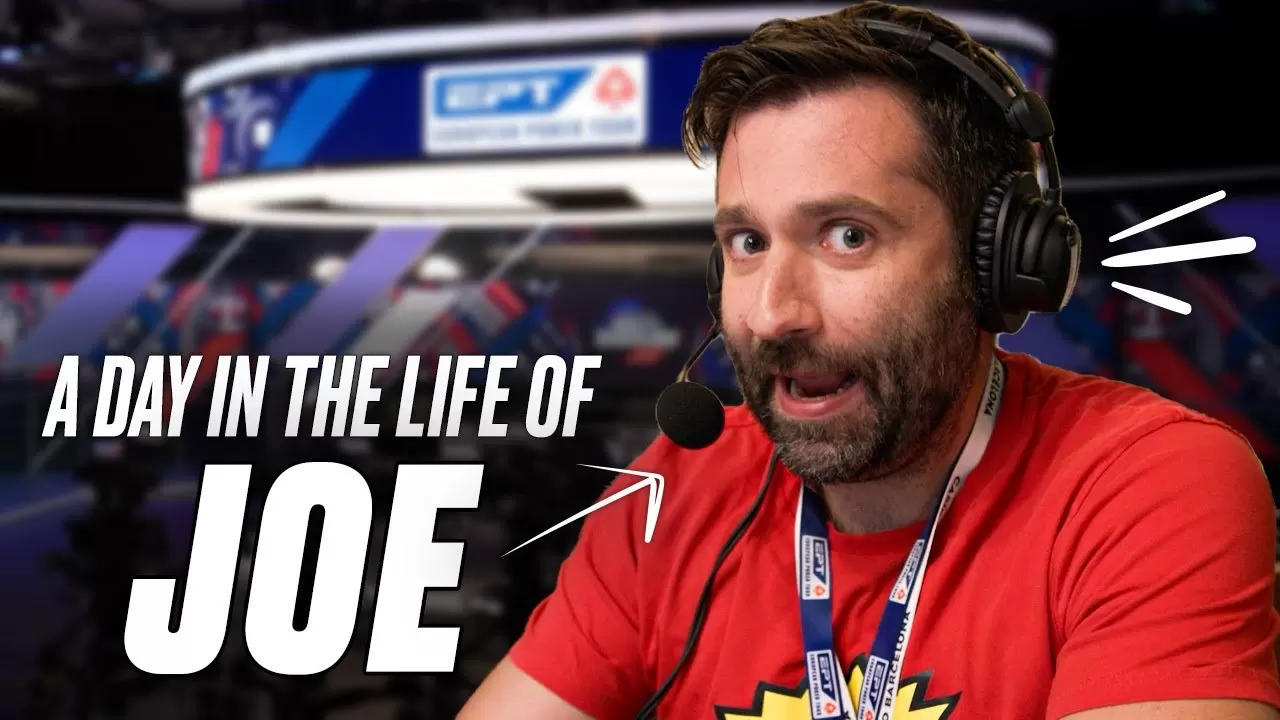

I watched Joe Stapleton's last broadcast on Sunday. Sat there with a cold coffee and a tab open to the Monte Carlo final table stream like some kind of poker degenerate who peaked in 2014. And honestly? It got me a little emotional. Not "crying into my hoodie at 2/5" emotional, but close enough.
Fifteen years. That's how long Stapes sat in the PokerStars booth next to James Hartigan, roasting players, coining catchphrases, and somehow making a three-way all-in between guys named Bernhard, Roman, and Jose feel like must-watch television. And now he's done. Gone. Off to whatever "exciting personal life changes" means when you're a 43-year-old stand-up comic who's spent a decade and a half living out of hotel rooms across Europe.
Good for him. Seriously.
But let's not pretend it doesn't sting a little.
Everyone Loves a Chop Pot (One Last Time)
If you've ever watched an EPT stream, you've heard it. Some pot gets split on a paired board and Stapleton drops the line with that exact mix of sincerity and sarcasm that makes you wonder if he actually means it. He always did. That was the trick. The guy genuinely loved poker, genuinely loved the booth, and somehow made commentary feel like you were sitting next to your funniest friend at the table.
I started watching EPT streams back when the production quality was, let's say, "enthusiastic amateur." Stapleton and Hartigan turned those broadcasts into appointment viewing for me. Not because the poker was always riveting. Sometimes it was a three-hour nit war between two Scandinavians flatting each other into oblivion. But Stapes made it watchable. He made it fun. He made you feel like poker was still allowed to not take itself so seriously.
His sign-off hit different. "I've been here for more than a third of my life," he said. Then thanked and/or banned just about everyone. Classic Stapes. Even the goodbye had a punchline.
Hartigan's response was perfect too. Dry, honest, a little bit brutal in that way only someone who's been your work partner for 15 years can be: "I was here before you and I will be after you. It's not going to be the same."
No. It won't.
So Who Fills the Chair?
PokerStars hasn't announced a replacement yet. And that silence is telling. Because replacing Joe Stapleton isn't like replacing a commentator. It's like replacing a vibe. The EPT booth under Stapes and Hartigan had a specific energy. Quick. Self-aware. Never too reverent. The kind of commentary that could pivot from a genuinely insightful breakdown of a river sizing to a joke about someone's sunglasses in the span of ten seconds.
Whoever they pick, the poker community is going to compare them to Stapes for at least two years. That's a brutal gig. You're basically auditioning for a job where the entire audience already decided they liked the last guy better.
My money? They'll go younger. Someone with a streaming background, maybe. Someone who understands Twitch chat energy but can also explain why a 33% pot bet on a monotone flop is either genius or suicide depending on the stack depth. Good luck finding that person.
Meanwhile, at the Actual Poker Table
While Stapes was saying goodbye, Roman Stoica was busy putting together one of the more impressive final table performances we've seen in a while. The EPT Monte Carlo Main Event had 1,011 entries, a prize pool just under €5 million, and a final table stacked with talent. And Stoica just... handled it.
This wasn't a fluky bink. Stoica has been building toward this for over a year. He won the EPT Barcelona Mystery Bounty back in 2025 for over €300,000. Made deep runs in the Main Events at Malta (16th) and Prague (27th). The results weren't screaming "future EPT champion" from the rooftops, but if you were paying attention, the trajectory was obvious.
He started the final day fifth in chips out of eight players. Not ideal. But here's where it gets interesting for you weekend warriors and 1/2 grinders who think final table strategy is just "shove and pray."
It isn't.
What Stoica Did Right (And What You Can Steal)
Stoica's approach on that final table was a clinic in something most recreational players completely ignore: playing the middle stack correctly.
When you're not the big stack and you're not the short stack, most amateurs freeze. They tighten up. They wait for premium hands. They let the big stack bully everyone while they slowly blind down into irrelevance. I've done it. You've done it. We've all sat there with 25 big blinds thinking "I'll wait for a spot" while someone with 60 big blinds opens every other hand and we fold King-Jack offsuit for the ninth time.
Stoica didn't do that.
He found spots. He limped J9 suited from the small blind at one point and took down a pot with a well-timed turn barrel when a King hit. Not flashy. Not some GTO-approved solver output. Just a guy reading a situation and pulling the trigger.
And then the flip. He got his chips in, held, and suddenly he's got a big stack. From there, it was a demolition job. He paired up with Bernhard Binder (who started the day as the chip leader with 7.25 million) to eliminate three players in rapid succession. Malpelli in fifth. Ju in fourth. Djian in third. Heads-up started with Stoica way ahead, and it was over in a handful of hands.
€825,000.
Four hours.
Done.
The Bernhard Binder Problem (Or: What Happens When You Play Sheriff)
Let's talk about Binder for a second, because his final table is a cautionary tale that every poker player from micro-stakes to mid-stakes should study.
Binder came in as the chip leader. Massive chip leader. 7.25 million to Raul Mestre's 4.5 million in second. He'd been dominating the tournament. Four knockouts on the previous day. Over $13 million in career earnings. The guy started playing tournament poker in late 2022 and has a WSOP bracelet and a Super Main Event title already. He's a legitimate monster.
And he finished second.
Why? Because the chip leader's job at a final table isn't to knock everyone out. It's to let the short and medium stacks kill each other while you pick spots and maintain pressure. Binder got a little too active. The PokerNews coverage literally described him losing the chip lead late on Day 5 because he was "a bit overly aggressive." He got it back, sure. But that pattern continued into the final table.
I see this all the time in my local card room. Guy builds a big stack in a $200 tournament, decides he's Phil Ivey, and starts calling every three-bet because "I can afford it." Three levels later he's shipping his last 12 big blinds in with Queen-Ten and wondering what happened.
The lesson isn't "don't be aggressive." The lesson is "don't be the table sheriff." You don't have to play every pot. You don't have to be the one who busts everyone. Let other people make the mistakes. Your job is to be there at the end with chips.
Raul Mestre: The Comeback Kid Who Ran Out of Script
Quick sidebar on Mestre because his story is kind of wild. The guy took an eleven-year break from live poker. Eleven years. His last Hendon Mob result before this year was from 2015. Then PokerStars offers him an ambassador spot, he comes back, wins the Spin & Go Championship at EPT Paris in February, and two months later he's at another EPT final table with 4.5 million in chips.
He finished seventh.
Sometimes you come back from retirement and everything clicks. Sometimes you've been gone too long and the game has changed in ways you can't quite feel yet. I'm not saying Mestre played badly. He was in the top four in chips at the end of nearly every day. But the final table is a different animal, and the guys sitting across from him have been grinding this format non-stop for years.
There's a lesson here for recreational players too. If you've taken a long break from poker, don't assume you can jump back in at the same level. The game moves. Strategies evolve. The kid who was limping every pot at your home game three years ago has probably watched 200 hours of solver content on YouTube by now and is going to three-bet you out of your shoes.
What This Means for the EPT (And Why You Should Care)
The EPT isn't going anywhere. It's arguably healthier than it's been in years. Over 1,000 entries in a €5,300 Main Event. The high roller scene in Monte Carlo is thriving (Daniel Dvoress just crossed $50 million in live earnings there). The tour is expanding, not contracting.
But losing Stapes is a cultural shift. The EPT's brand was always about accessibility. This wasn't the Super High Roller Bowl. This was a tour where a recreational player could satellite in for a few hundred bucks and end up on the same stream as the best in the world, with Stapleton cracking jokes about their hat choice while they tank-fold the river.
That energy has to survive the transition. Hartigan will carry it forward to Barcelona and beyond. He's excellent at what he does. But "Hartigan and someone new" is a different product than "Hartigan and Stapes." It just is.
For the poker community, the best thing we can do is show up. Watch the streams. Play the satellites. Keep the ecosystem alive. Because the EPT matters. Live poker matters. And the commentary booth, whoever's sitting in it, matters more than most people realize.