
You just rivered the nuts. Your opponent, a classic Friday night limp-caller, is already steaming. He shoves his last $100 into a $400 pot. You know you hold the winner.
The temptation hits. Maybe you will check your cards again. Maybe you will stare at the board in fake confusion. You want him to think he might win for three, four, maybe five agonizing seconds. Then, you slap down your cards and scoop the pot. You think you just needled him. You think you showed him who is boss.
You didn't. You just announced to the entire poker room that you have no idea how to actually make money in this game.
Slow rolling is the lowest form of bad manners at the felt. Everyone hates it. Even the guy who does it hates getting slow rolled himself. But we are not here to give you a lecture on ethics. We are sharp regulars, not your grandmother.
If you are a weekend warrior grinding mid-stakes, you need to hear the real reason slow rolling is hated. It is not because it is rude. It is because it kills your Win Rate.
Let us talk strategy.
1. It Kills the Action Ecosystem
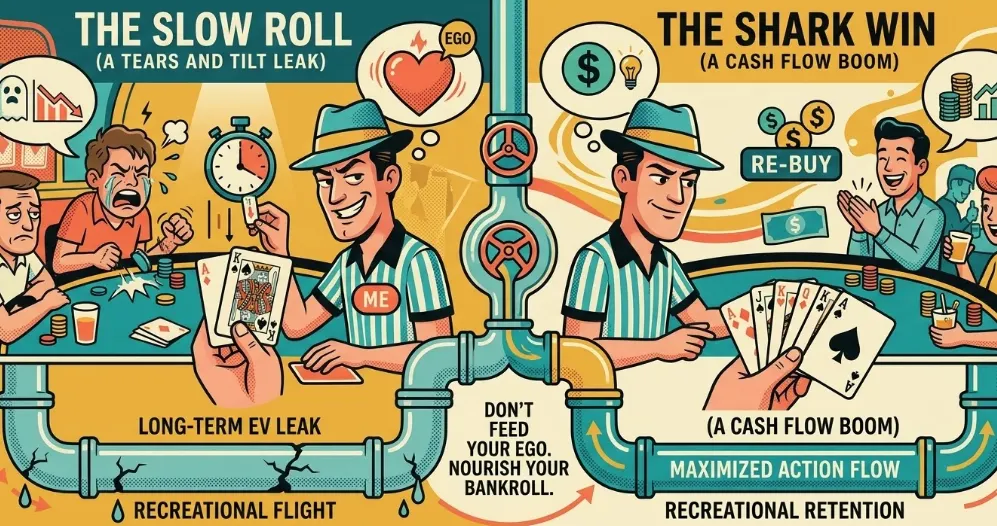
Your long-term Expected Value does not just come from the chips you extract in a single hand. It comes from the general health and action of the entire game. You want recreational players to have a good time. A casual player who loses $200 but had fun is highly likely to reload next weekend. A player who loses $200 and gets needles shoved in his eyes will go play blackjack instead.
Slow rolling makes casual players never want to return. It creates a toxic environment. When the fish leave, the game gets tougher. The recreational player you tilted by slow rolling might tighten up completely. They might get angry and stop playing pots with you entirely.
The goal is to extract maximum value, not to run everyone off. It is simply bad business. Keep the game moving. Keep the jokes flowing. Make sure the recreational player enjoys being there while you stack them.
2. The Professional Exception vs. The Amateur Mistake
There is a time and a place for a slow roll. That place is usually on national television between two bitter rivals.
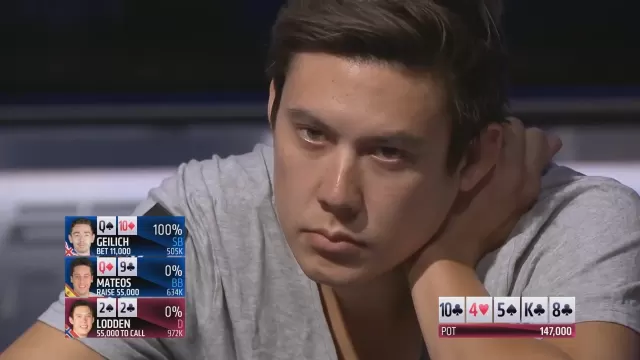
Take Shaun Deeb and Mike Matusow. During season one of Poker Night in America, Matusow shoved the turn with pocket Jacks. Deeb went deep into the tank. He made Matusow sweat. He made Matusow count out the bet. Finally, Deeb called and casually flipped over quad fives.
Matusow erupted. He went absolutely ballistic. It was incredible television. Deeb knew exactly what he was doing. He knew it would get ratings, and he knew it would send "The Mouth" into a legendary tailspin.
There is another famous exception. The late Jack Ury, a 96-year-old poker legend, found himself all-in at the 2009 WSOP Main Event. He looked at his opponent, paused dramatically, and croaked, "You're in trouble." He then slowly turned over a monster hand. The crowd loved it.
Here is the reality check. You are not a poker superstar playing for TV ratings. You are also not a 96-year-old grandfather. You are a regular guy grinding a $2/$5 cash game. When you pull a stunt like Deeb, you do not look like a genius. You look like a jerk who is trying too hard.
3. It Marks You as an Insecure Target
Actual professionals do not slow roll in standard cash games. Why? Because they are focused on efficiency. They want to play as many hands as possible per hour. They make a decision, they show the winning hand, and they get ready for the next deal. Time is literally money.
When you slow roll, you project massive insecurity. It is a desperate plea for attention. It signals that winning a single hand is such a monumental event for you that you need to maximize the theatricality of it.
Real sharks are quiet. They do not need the spotlight. They just need your chips.
When you slow roll, the other competent regulars look at you and take mental notes. They immediately think this person is an amateur playing with emotion. You are giving them a free mental game tell. They know you care more about ego than equity. They will use that against you.
4. It Signals a Leak in Your Own Mental Game
If you derive genuine joy from slow rolling, you have a weak mental game. You are playing the drama rather than the cards. The same player who slow rolls to "teach someone a lesson" is the same player who will tilt-shove his entire stack when he catches a bad beat.
You are showing the table exactly how to exploit you. All someone has to do is give you a little sarcasm, or a standard needle, and you will start making emotional decisions.
A player who cannot handle a standard win with grace is a player who cannot handle a bad beat with control. It is a massive psychological vulnerability.
The Grinder's Conclusion
Let the GTO wizards worry about balancing their ranges. If you want to increase your ROI, balance your table presence first.
Showing the winning hand is part of your job. Do it quickly. Take your chips. Look at the next dealer. The strategic value in poker is not about one hand. It is about maintaining a profitable ecosystem.
Slow rolling is an emotional leak that tells the table you are an amateur with an ego. Be better. Play at rooms where efficiency is valued and the action is always good, like CoinPoker. The real victory is not the show. The real victory is the shape of your graph at the end of the year.