
Grab a drink and protect your cards. We are taking a massive deep dive into the greatest poker movies ever put on film. From the gritty underground clubs of New York to the absurd high stakes of international spy thrillers, this is the definitive breakdown of what Hollywood gets perfectly right and what it gets hilariously wrong. If you are a weekend warrior looking to plug the leaks in your game, you need to know the difference between a written movie script and actual profitable strategy. The cinematic fantasy is costing you money, so let us strip away the glamour and look at the brutal, unvarnished truth about the films that built the poker world.
Rounders (1998)
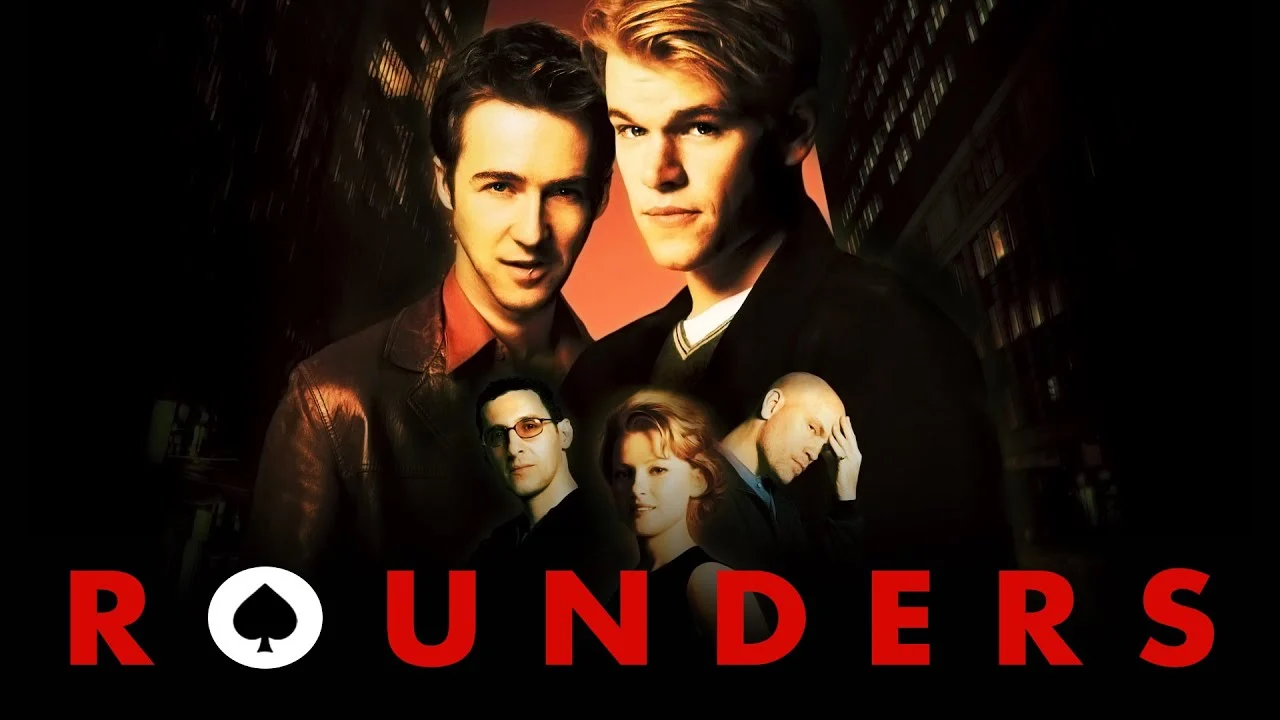
Every mid stakes grinder currently paying rake at a local casino owes a massive debt to John Dahl and his 1998 masterpiece. This film perfectly captured the grim fluorescent lit reality of underground card rooms before the internet sanitized the game into a math equation. Watching Matt Damon navigate the murky waters of New York City poker clubs feels incredibly authentic because the writers actually hung around those specific rooms. They nailed the lexicon, the atmosphere, and the very specific feeling of sitting across from someone who is actively trying to take your rent money. The movie succeeds by romanticizing the grind, making the act of sitting in a smoky basement at four in the morning look like the absolute coolest profession on earth.
But strategically speaking, Mike McDermott is a walking disaster class in bankroll management. Every seasoned dealer has a story about some fresh faced kid who watched this movie, walked into a casino with his entire three thousand dollar net worth, and dumped it all on a single table trying to make a hero play. Mike taking his entire bankroll to Teddy KGB's place in the opening scene is the ultimate amateur move. In the real world, variance does not care about your narrative arc. You can play perfectly, get your money in as an eighty percent favorite, and still lose to a two outer on the river. Real grinders practice strict bankroll management, keeping at least thirty buy ins for their current limit to survive the inevitable downswings.
The climax of the film hinges on a massive physical tell, specifically Teddy KGB aggressively splitting his Oreo cookies when he has the nuts. While this makes for fantastic cinema, it drastically overstates the importance of physical tells in modern poker. In today's game, you are rarely going to spot a player doing something that cartoonish unless they are intentionally trying to level you. A real life equivalent is when amateurs try to stare down their opponents hoping to see a pulsing neck vein. In reality, the most reliable tells at your local casino are betting patterns and sizing. If the tightest player at the table suddenly check raises you on the turn, they do not need an Oreo cookie to tell you they have a set. They are screaming it with their chips.
The Cincinnati Kid (1965)
Long before Texas Hold'em became the Cadillac of poker, Five Card Stud was the game of choice for serious gamblers, and The Cincinnati Kid captured that era with effortless cool. Steve McQueen stars as the young hotshot looking to take down Lancey Howard, a seasoned veteran known simply as The Man. The film perfectly encapsulates the old school gambler mentality, where reputation and stoicism were just as important as your cards. The smoky rooms, the sharp suits, and the slow deliberate pacing of the film mirror the methodical nature of the game itself. It is a time capsule of a bygone era, showing a version of poker that was infinitely more polite but arguably much more ruthless.
The climax of this film features one of the most brutal and heavily debated bad beats in cinematic history. The Kid has a full house, Aces full of Tens, while The Man hits a straight flush on the final card. It is a soul crushing moment that perfectly visualizes the sickening feeling of a one outer hitting you squarely in the jaw. Every poker player has their own version of this story. I once watched a guy in a tournament get his money in with quad eights, only to lose to a runner runner royal flush. He sat completely frozen in his chair for three full minutes before quietly walking out into the parking lot. The Cincinnati Kid accurately portrays the terrifying reality that in poker, you can do everything perfectly right and still get utterly destroyed by the deck.
The core conflict of the movie is really about the destructive nature of ego. The Kid does not just want to win money. He desperately wants to prove he is the absolute best. This is a common and incredibly expensive trap that modern players still fall into. When you sit down at a table and decide you have to outplay the aggressive regular in seat four just to prove a point, you are no longer playing profitable poker. You are playing ego poker. The Man wins the final hand not just because he gets lucky, but because he has completely stripped his ego from the game. He plays his hand coldly and mathematically, letting the Kid's ambition lead him straight into a trap.
Casino Royale (2006)
When James Bond sat down at the felt in Casino Royale, he brought the game of Texas Hold'em to the most glamorous stage imaginable. The concept of a ten million dollar buy in tournament held in a luxurious Montenegrin casino is pure fantasy, but it perfectly taps into the aspirational side of poker. We all want to put on a tailored tuxedo, order a terribly specific martini, and coolly push a mountain of high denomination plaques into the center of the table. The film brilliantly uses poker as a vehicle for psychological warfare, turning every check and bet into a literal matter of life and death. The sheer tension built around the table dynamics makes this one of the most entertaining gambling sequences ever put to film.
Any player who has spent more than a week studying starting hands will tell you that the final showdown in this movie is mathematically hilarious. We get a flush losing to a full house, which loses to a bigger full house, which ultimately loses to Bond's straight flush. The odds of this specific cooler happening in a four handed pot are so astronomically low that you would have a better chance of getting struck by lightning while cashing in a lottery ticket. I once saw a guy at a local home game try to slow roll a straight flush like James Bond, only to realize he had misread his hand and actually just had nine high. The movie encourages this kind of dramatic Hollywood behavior, but at a real table, catching a straight flush usually just results in everyone folding to your small continuation bet on the flop.
Despite the absurd final hand, Casino Royale actually gets one massive concept right, and that is the absolute exploitation of a tilted opponent. Bond deliberately pushes Le Chiffre's buttons, attacking his ego and forcing him into a state of emotional distress. This is a very real and very profitable tactic at the tables. I have seen solid, mathematically sound players completely fall apart because someone needled them about a bad fold. Poker is played by human beings with fragile egos. If you can identify the player who is steaming from a previous bad beat and apply the right kind of pressure, you can induce massive stack donating mistakes. Bond did not just beat Le Chiffre with cards. He beat him by breaking his mental game.
Molly's Game (2017)
Molly's Game strips away the dingy basements and replaces them with penthouse suites, offering a look at the ultra high stakes games of Hollywood elites and Wall Street titans. Based on a true story, this film highlights a side of poker that most players will never see. It focuses heavily on the mechanics of running a game, the logistics of extending credit to billionaires, and the immense power of exclusivity. The poker hands themselves take a backseat to the incredible true story of Molly Bloom building an empire. It perfectly captures the intoxicating nature of proximity to extreme wealth, and how the game of poker is often just a backdrop for networking, ego stroking, and power dynamics among the ultra rich.
The greatest lesson any grinder can take from Molly Bloom is the absolute supreme importance of game selection. Molly did not build her fortune by inviting the best poker professionals in the world to her table. She actively kept the pros out. She understood that her billionaire clients wanted to relax and feel like winners, not get mathematically dissected by game theory optimal wizards. There is a famous story of a mid stakes grinder in Las Vegas who spent months trying to get invited to a private celebrity game, only to get banned after his first session because he played too tight and killed the action. If you want to make money in poker, you do not need to be the best player in the room. You just need to be the fifth best player at a table full of rich tourists who are drinking heavily.
The movie also serves as a stark warning about the legal and financial realities of the underground poker world. Molly crosses the line when she starts taking a rake, which immediately transforms her game from a legal private gathering into an illegal gambling operation. This is a crucial distinction that many home game operators fail to understand until the police knock on their door. In the real world, unregulated games come with massive risks. You have no security, no gaming commission to appeal to, and the constant threat of being robbed or scammed. A buddy of mine once played in a massive raked game in a warehouse, only to have the organizers suddenly disappear with the entire prize pool during a power outage. Molly's Game is a beautiful fast paced thriller, but it is also a reminder of why we pay the casino rake for a safe, regulated environment.
Maverick (1994)
Sometimes you just need to remember that poker is supposed to be fun, and that is exactly where Maverick shines. This movie throws historical accuracy and mathematical probability completely out the window in favor of pure comedic entertainment. Mel Gibson plays a charming con man trying to hustle his way into a massive winner take all tournament on a riverboat. The film is packed with ridiculous wild west tropes, gunfights, and players pulling hidden cards out of their boots. It does not try to teach you anything about game theory optimal strategy. It just wants you to enjoy the ride and laugh at the absurdity of the cowboy poker mythos.
The poker hands in this movie are so spectacularly unrealistic that they actually become brilliant comedy. In the final tournament scene, the dealer manages to deal out a four of a kind, a straight flush, and a royal flush all in the exact same hand. It is the kind of cooler that would cause a real life card room to instantly erupt into accusations of cheating and a possible riot. We all know that one guy at the local pub game who constantly talks about how he folded a straight flush because he just had a feeling the other guy had a royal. Maverick is essentially a movie made entirely out of those ridiculous fabricated bad beat stories that amateurs tell each other at the bar.
Despite the comedic nonsense, Maverick actually captures the social joy of a lively and talkative poker table. Modern card rooms have become incredibly quiet, filled with players wearing headphones and hiding behind sunglasses while staring at their phones. Maverick reminds us of a time when table talk, banter, and outright hustling were a massive part of the experience. Being charismatic and likable at the table is an incredibly underrated skill. I have seen terrible players get invited to incredibly lucrative private games simply because they are funny and fun to be around. Maverick might be a terrible guide for how to play your cards, but it is a pretty good guide on how to actually enjoy your time at the table.
Mississippi Grind (2015)
If the other movies on this list make poker look glamorous or cool, Mississippi Grind is the heavy dose of medicine you take to cure that illusion. This film is a raw unvarnished look at the grueling reality of gambling addiction and the soul sucking nature of a prolonged downswing. It follows two flawed characters as they drift from one depressing regional casino to another, chasing a phantom big score that is always just out of reach. There are no tailored suits or ten million dollar pots here. It is just bad coffee, stale cigarette smoke, and the quiet desperation of men who cannot stop themselves from punting their last few dollars on a bad read.
The road trip aspect of the film perfectly captures the bleak reality of the low stakes tournament circuit. The characters find themselves in generic dimly lit card rooms playing against locals who look like they have not seen the sun in a decade. This is exactly what the life of a traveling grinder actually looks like. It is not staying in luxury suites in Monaco. It is sleeping in your car in the parking lot of a dog track in Iowa because you busted out of the main event two days early and cannot afford a hotel room. I know several highly skilled players who quit the professional circuit simply because the relentless depressing grind of cheap motels and casino buffets completely eroded their mental health.
Ultimately, Mississippi Grind is a masterclass in how tilt and desperation destroy rational decision making. The main character repeatedly ignores basic math and logic, convinced that his luck is simply bound to change. We see this at the tables every single day. A player takes a bad beat, loses their emotional baseline, and suddenly starts calling massive bets with bottom pair because they feel entitled to win a pot. The film shows exactly what happens when you let the game consume you instead of treating it like a mathematical exercise. It is a fantastic movie, but you will likely need to take a long walk outside after watching it just to clear your head.
California Split (1974)
Directed by Robert Altman, California Split captures the chaotic, messy, and intimate world of mid seventies gambling culture better than almost anything else on film. It drops you right into the middle of the degeneracy without moralizing or trying to force a neat Hollywood redemption arc. The overlapping dialogue and loose camera work make you feel like you are actually sitting at a crowded casino bar, listening to two inveterate gamblers rationalize their terrible life choices. It is highly respected by real life players exactly because it captures the visceral feeling of the casino floor, the noise, the ambient anxiety, and the bizarre cast of characters that populate the low limit tables at two in the morning.
The film perfectly illustrates the difference between playing poker for profit and playing simply to satisfy an action addiction. The characters are not calculating odds or looking for positive expected value situations. They just want the rush of putting money into the middle of the table, regardless of the game. I once watched a guy dust off two grand at a one two no limit table, walk directly over to the roulette wheel, and put another thousand on black just to feel something. That is the exact energy California Split portrays. It is the raw unfiltered truth that for many people, the game is not about winning money, it is about escaping reality for a few hours.
The most haunting and accurate moment in the movie comes at the very end, after a massive life changing winning streak. Instead of elation, the main character is hit with a crushing wave of emptiness. He realizes that the money does not actually fix his life, and that the thrill was entirely in the chase, not the result. Any serious grinder knows this feeling intimately. You can grind out a ten thousand dollar winning month, pay your bills, and still feel completely hollow because the actual act of playing has become a monotonous job. It is a brilliant sobering look at the psychological toll of a life spent entirely inside a casino.
High Roller: The Stu Ungar Story (2003)
Stu Ungar is a ghost that still haunts the poker world, and this biographical film attempts to capture the blinding brilliance and tragic downfall of the game's greatest natural talent. Ungar won the World Series of Poker Main Event three times, a feat that is practically impossible to replicate in the modern era of massive field sizes. The movie showcases his uncanny ability to read opponents and memorize entire decks of cards, making him a terrifying force at the gin rummy and poker tables. It paints a picture of a savant who saw the matrix of the game long before solvers and tracking software even existed, relying entirely on raw instinct and an aggressive fearless style of play.
But the real lesson from Stu Ungar's life is not about his genius, it is about the catastrophic danger of self destruction. You can be the absolute best player in the world, capable of calling down river bets with ten high, but if you cannot manage your life away from the tables, you will eventually go broke. Ungar's struggles with addiction and sports betting are legendary in Las Vegas. There are countless stories of him winning hundreds of thousands of dollars in a single tournament, only to lose every penny at the craps table or the sportsbook before the sun came up. He is the ultimate cautionary tale for any young player who thinks that natural talent is enough to guarantee a lucrative career.
The tragedy of Ungar is a stark reminder that poker is a game of endurance, not just a game of skill. The modern poker landscape requires discipline, emotional control, and physical stamina. You have to treat your body and your bankroll with equal respect if you want to survive the swings. I know incredibly talented players who washed out of the game entirely because they partied too hard after a big win and could not focus the next day. High Roller is a tough watch, but it should be mandatory viewing for anyone who thinks they are too smart to succumb to the pitfalls of the gambling lifestyle.
A Big Hand for the Little Lady (1966)
This classic western flips the traditional macho poker narrative completely upside down, delivering one of the most entertaining and clever gambling stories ever told. It centers on a recovering gambling addict who suffers a heart attack in the middle of a massive high stakes hand, forcing his seemingly innocent wife to step in and play out the hand with their entire life savings on the line. The movie is less about the technical aspects of poker and much more about the psychological manipulation of a table full of hardened sharks. It is a brilliant study in how table image and perceived weakness can be weaponized to extract maximum value from arrogant opponents.
The true genius of the film lies in the ultimate angle shoot. The wife, Mary, claims to know absolutely nothing about the rules of poker, asking naive questions and acting completely overwhelmed by the situation. The veteran players at the table immediately dismiss her as a threat, their egos refusing to believe that a clueless pioneer woman could possibly outplay them. This is a tactic you see utilized constantly in modern card rooms. The old guy drinking coffee who pretends he does not understand string betting rules is almost always the guy who is about to take your entire stack. Playing dumb is one of the most profitable, albeit slightly unethical, strategies a player can deploy against an overconfident table.
Without spoiling the brilliant twist ending, the film ultimately proves that poker is not played with cards, it is played with people. The best bluff is not the one where you push all your chips into the middle, it is the one where you convince the entire table of a narrative that simply is not true. I once played with a guy who faked a phone call to his wife, crying about losing his paycheck, just to induce a pity call on the river when he actually had the absolute nuts. A Big Hand for the Little Lady is a masterclass in the art of the hustle, proving that the greatest players are always playing the opponent, never the hand.