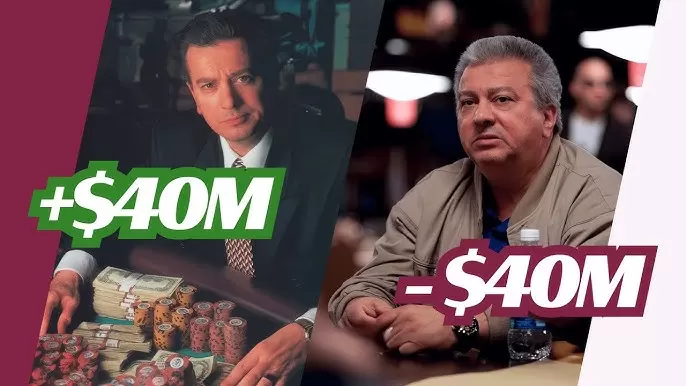

The first thing you need to know about Archie Karas is that the $40 million is the boring part of the story.
The boring part. Read that again. The guy won $40 million in cash playing poker, pool, and craps at Binion's Horseshoe between 1992 and 1995, and somehow the money is not even the most interesting thing about him.
I've been reading and re-reading the Archie Karas legend for twenty years and every time a new detail surfaces it gets weirder. The shoeboxes full of cash. The pool game against a mystery opponent known only as "Mr. X." The time Jack Binion personally asked him to please sell some chips back to the house because Archie had all of them. A man who estimated he had been a millionaire "more than fifty times" and broke a thousand. A man who drove a little white pickup with a camper shell and sometimes slept in it while $17 million sat in a casino vault across town.
He told a poker journalist once, "I needed to save money for gambling."
He was not kidding.
Antypata to Portland
Archie Karas wasn't even Archie Karas. He was born Anargyros Karabourniotis on November 1, 1950, in a village called Antypata on the Greek island of Kefalonia. His father was a builder. The family was so poor that young Anargyros used to shoot marbles to win a couple of drachmas for bread. Actual marbles. Actual bread. This is not a metaphor a ghostwriter inserted later.
When he was fifteen he got into a fight with his father on a construction site. Accounts differ on what exactly happened. One version has his father throwing a trowel at his head that narrowly missed. Another has a shovel connecting. Either way, Anargyros went home, packed his stuff, and got on a cargo ship as a waiter making sixty dollars a month. He spent two years at sea, hitting ports in India and Japan, before the ship docked in Portland, Oregon in 1967. He jumped ship. No papers. No English.
He hitchhiked south until he got to Los Angeles, where an aunt gave him a job bussing tables in a Greek restaurant. Next to the restaurant was a pool hall. You can see where this is going.
Archie learned English from customers. He learned pool from strangers. Somewhere in his early twenties he figured out he was better at pool than most people and within a few years he was hustling pool for more money than he ever made as a waiter. When the pool games dried up because nobody wanted to play him anymore, he wandered into the poker room in the back.
By 1970 he was playing $5,000-a-hand stakes against men twice his age. By his own count, by the late eighties he'd been a millionaire and broke so many times he'd lost track. His old friend Yosh Nakano once said of him, "He could make a million dollars one day and be broke the next and start all over again."
Michael Konik, the Cigar Aficionado columnist who first told Archie's story in 1994, wrote one of my favorite lines ever written about a gambler: "One day I might be driving a Mercedes, and the next day I might be sleeping in it."
Konik added, dryly, that this wasn't a punchline. That had literally happened.
December 1992
By the end of 1992 Archie had blown roughly two million dollars at the LA card tables. He had fifty dollars left and his car. He pointed the car east and drove to Vegas.
Here is where everything everyone thinks they know about The Run starts.
He walked into The Mirage, saw a poker player he recognized from LA, and talked him into a ten-thousand-dollar loan. He walked the loan over to Binion's Horseshoe, sat down in a $200/$400 Razz game, and in three hours ran it up to $30,000. He paid his friend back. He had twenty grand of his own for the first time in months.
Then he went to a bar with a pool table near the Liberace Plaza on East Tropicana. There was a guy there everyone in the scene knew but nobody in the press has ever named. Archie refused to name him either. Said it would hurt the man's reputation. He's been "Mr. X" in every retelling of the story for thirty years.
They played nine-ball. Started at $5,000 a rack. Worked up to $40,000. Over several months of sessions the stakes kept climbing until they were playing for more per game than most pool pros make in a year.
One night Archie lost $320,000 in about forty seconds. Mr. X broke and sank the 9-ball on eight of ten consecutive racks. Archie never got a shot off. He just sat there watching.
He still walked away from Mr. X up $1.2 million by the time they stopped.
The Horseshoe
With a four-million-dollar bankroll after a few more sessions, Archie set up shop at Binion's Horseshoe and waited for someone to play him.
Stu Ungar came first. Three-time WSOP champion. Widely considered the greatest no-limit hold'em and gin rummy player who ever lived. Ungar was backed by Lyle Berman, who co-founded Grand Casinos. Archie beat them. Took half a million off Stu at Razz in one session.
Then Chip Reese, who Doyle Brunson himself called the best cash player alive. Archie took $700,000 off Reese in one Seven-Card Stud sitting.
Then Johnny Chan. Then Doyle. Then Puggy Pearson. They lined up and one by one Archie stacked them. Ironically, according to Brunson, Archie had been considered a weaker player in the decade before The Run. The LA pros used to give him handicaps. Now the same pros were backing away from the table.
Archie was playing heads-up for stakes so outrageous that Binion's had to manufacture special $5,000 chips because their normal inventory wasn't dense enough. At one point he owned every single $5,000 chip in the casino. Roughly $18 million worth. Jack Binion personally came over and asked Archie to sell some back because the house was running low on the denomination for other players.
He kept them.
The Night Lyle Berman Tried to Save Him
There is one anecdote from this period that lives rent-free in my head.
Lyle Berman was standing near the craps pit at the Horseshoe one night watching Archie have one of those runs. Berman later told reporters that Archie had about $35 million in the box in front of him. Thirty-five million dollars in cash and chips, sitting on a craps table, with armed guards around it, and a crowd of spectators watching each roll.
Berman walked over. He was not a stranger. He'd been in the game for decades. He leaned in and said, quietly, "Archie, do you know what an annuity is?"
Archie, according to Berman, looked at him. Thought about it. Asked if he'd have to pay taxes on it. Berman said yes. Archie lost interest.
He went back to rolling the dice.
The Fall
In 1995, it stopped.
Craps was first. Archie lost $11 million at the Horseshoe dice table in a span of weeks. Got a chunk back. Lost it again. Then he wandered over to baccarat, a game where literally nobody has an edge, and proceeded to lose seventeen million dollars.
Some reports say he lost $30 million in 48 hours at craps and baccarat combined. Other reports stretch the collapse over a few weeks. The numbers get fuzzy because Archie never kept books. He carried shoeboxes. The casino knew what Archie was down. Archie, by most accounts, did not.
He went back to Greece for a break. Visited his mother. Came back to Vegas and lost the rest.
By 1997 he was broke. Not poker-broke. Actually broke. Zero. He'd gambled, by his own estimate, over a billion dollars across his lifetime.
Doyle Brunson later called The Run "the most amazing run I'd ever seen, maybe the greatest one ever." And it ended the way all of them end. The dice stopped cooperating and nobody in Vegas was willing to stake him anymore.
The Later Years
This is the part that rarely makes it into the highlight reels.
He kept playing when he could get a stake. Mike Sexton, the late Poker Hall of Famer and host of World Poker Tour, backed him into WSOP events repeatedly. Sexton and his brother Tom even bought Archie a used car at one point. Just gave it to him.
Archie cashed in a handful of WSOP events in 2008 and 2009. Made a Razz final table. Made a Deuce-to-Seven Draw final. Best tournament cash of his career was $53,783 in 2009. Respectable money for most players. Not even a rounding error against what he used to win in a night.
During that 2008 WSOP, Archie started approaching journalists and whispering that something was funny with the cards at his table. He wouldn't name names. Other players at the table were telling the floor that something was funny with Archie.
Five years later the floor was right.
In 2013 he got busted at Barona Resort and Casino in San Diego for marking cards at a blackjack table. Putting "daub" on the cards, which in cheating parlance is invisible paint you can only see through a contact lens or tinted glasses. He was trying to cheat out of around $8,000. Eight thousand. The same man who won $17 million off Johnny Chan in one sitting.
He pled guilty. Got three years probation instead of the one year he expected. He blamed his lawyer. "My attorney lied to me," he said later. "They didn't have no proof that I did it."
In 2014 he pled guilty to burglary in a related incident. In 2015 the Nevada Gaming Commission added him to the Black Book. Lifetime ban from every casino in the state. The same state where, twenty years earlier, Jack Binion had personally walked over to ask him for his chips back.
Soft White Underbelly
In 2021 Archie showed up on Mark Laita's YouTube channel Soft White Underbelly. If you don't know the channel, it does long-form sit-down interviews with people at the margins. Homeless people, sex workers, addicts, ex-cons. Laita shoots them in stark black-and-white portraiture. It's beautiful. It's also devastating.
And there was Archie Karas. Seventy years old. Greek accent still thick. Talking about his father throwing the trowel. Talking about the shoeboxes. Talking about how he'd been diagnosed with a brain aneurysm in 2020 and blamed it on the stress of gambling.
He said this, almost in passing: "Money means nothing to me. I don't value it. I had all the material things I could ever want. Everything. The things that I want, money can't buy. Freedom, love, happiness, and health, especially health."
When Laita asked him what made him sad, Archie said being broke and sick.
When Laita asked him if he was proud of anything he'd done, Archie said, "Not much, to tell you the truth. Because in the end, the pressure got to me, my health went down, so I paid the price. Whatever you do, you pay the price. Nothing is for free. You win, you pay the price. You lose, you pay the price. Nothing is for free in this world."
The interview has several million views now. It's the most Archie Karas footage that exists anywhere.
One Last Proposal
Archie Karas died on September 7, 2024, in Los Angeles. He was 73.
His son had died not long before. Voula Balason, his on-again off-again girlfriend of many years, said that loss broke something in him he never got back. Two months before he died, still old and sick and broke, Archie proposed to her in the Greek Orthodox Church.
She said yes.
Think about that for a second. The man who owned every five-thousand-dollar chip in Las Vegas, the man who won $17 million off Stu Ungar and lost it at a baccarat table in an afternoon, spent his last real act of agency asking a woman to marry him in a small church. No cameras. No cash. No shoeboxes.
I'm not sure what to do with that image but I think about it a lot.
The Unverifiable Part
Here's the thing about Archie Karas stories. Half of them aren't verifiable. The guy lied about some things. Forgot others. Embellished here, undersold there. The $40 million number itself is disputed. Some sources say the peak was $17 million. Some say $26 million. One old pool hustler who knew him well insists the real number was $26 and change.
The Mr. X story has never been corroborated by any second witness.
The "sleeping in his Mercedes" anecdote comes from Archie himself, filtered through Konik, and there's no photograph of any Mercedes.
But that's kind of the point of Archie Karas. He was a folk hero. Folk heroes come with apocrypha attached. Paul Bunyan's ox wasn't blue either, probably.
What's verifiable is this. He showed up in Vegas in December 1992 with nothing. He played for stakes that no one before or since has matched from a cold start. He beat, one after another, the best poker players who have ever lived. Brunson confirmed it on the record. Berman confirmed it. Chan confirmed it. Then he lost it all and couldn't stop and ended up cheating at a San Diego blackjack table for eight grand.
The Run ended thirty years ago. Archie died in 2024. The old-timers at Binion's who saw the shoeboxes are mostly gone now. The Horseshoe itself is gone, or rather it's been renovated into something unrecognizable.
What's left is the story. And the story, even the parts that probably aren't true, is the best one the game has ever produced.
You want to argue Stu Ungar was a better player? Fine. Ivey more skilled? Sure.
Nobody ran it like Archie ran it. Nobody ever will.