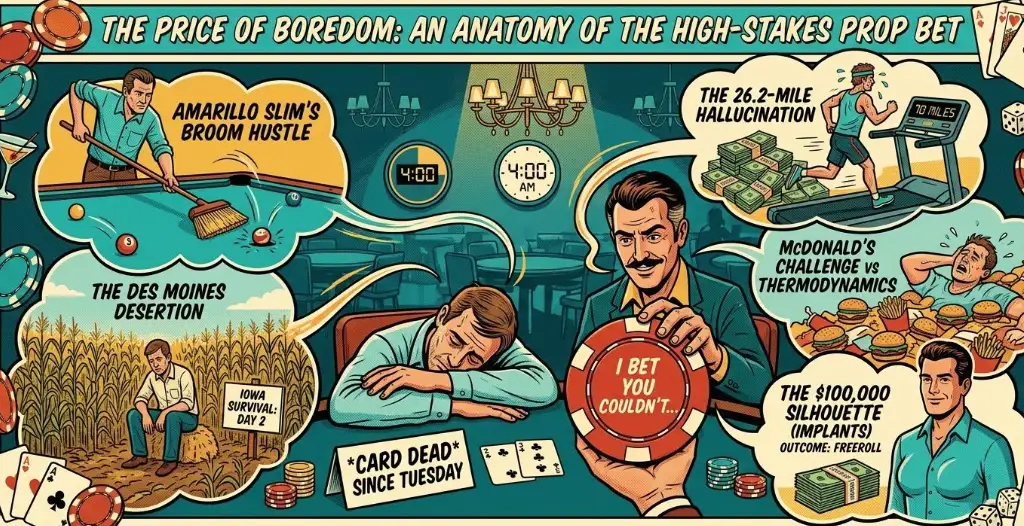
The most expensive phrase in the English language isn't "I do," and it certainly isn't "all in." Those are calculated risks with known variables. The most ruinous words ever spoken usually echo at 4:00 AM in the Bellagio's Legends Room by a pro who has been card-dead since Tuesday:
"I bet you couldn't..."
Professional poker requires the discipline of a Franciscan monk and the cold, analytical heart of a solver. Unfortunately, the human brain is not built for the sensory deprivation of folding preflop for six hours. It craves dopamine. When the auto-shuffler’s hum becomes a drone and the VIPs have long since retired to their suites, the high-stakes regular looks for a way to stimulate the central nervous system.
Enter the Proposition Bet. It is the unofficial sport of action junkies and individuals who have tragically confused their bankrolls with their physical durability. A true prop bet isn't about luck. It is a stress test. It asks the ultimate macroeconomic question: What is your exact hourly rate for absolute misery?
The Hustler’s Broom: The Amarillo Slim Doctrine
To understand the architecture of the modern prop bet, you must study the Amarillo Slim doctrine. Slim did not gamble. He engineered outcomes based on severe information asymmetry. His philosophy was the analog precursor to modern table selection. Never sit at a game unless you know exactly who the mark is.
His masterpiece involved a pool table and a world-class snooker champion. Slim challenged the pro to a match for serious cash with one specific caveat. They could not use pool cues. They had to use ordinary household brooms. The champion assumed his superior understanding of angles and physics would carry the day and quickly accepted.
What the champion did not know was that Slim had spent the previous six months in his basement obsessively practicing with a specific type of broom. He could run racks with the grace of a janitorial Mozart. Slim did not beat the man at snooker. He beat him at a custom game where he was the only experienced regular. It was not a gamble. It was an ambush.
The Des Moines Desertion: Pricing in Peace of Mind
While Slim relied on mechanical edge, modern pros often fall victim to their inability to endure low variance. Consider the legend of John "Johnny World" Hennigan. A world-class talent and multi-bracelet winner, Hennigan treats a quiet room like a medical emergency.
Years ago, his peers wagered six figures that he could not survive six weeks in Des Moines, Iowa. The terms were generous. He could play golf, eat at the best steakhouses, and live in luxury. He simply had to exist in a pleasant Midwestern city where the headline news rarely spikes the adrenal glands.
He lasted two days.
Hennigan negotiated a buyout and paid a massive penalty to flee back to the neon chaos of Las Vegas. For Johnny World, the return on investment for boredom was catastrophically negative. To a man conditioned to the electric crackle of the Strip, the sound of Iowa crickets is psychological waterboarding. He essentially paid $50,000 for a 48-hour vacation to a place he hated. It proved that in the world of high-stakes gambling, "peace of mind" is an overhead cost few can afford, and action itself carries a quantifiable premium.
The 26.2-Mile Hallucination: Pushing the Mortal EV
Then there are the endurance bets, usually booked by people who view sleep as a leak. Take the infamous Ashton Griffin treadmill bet.
Griffin booked a wager of roughly $300,000 that he could run 70 miles on a treadmill in 24 hours. The catch was severe. He had been up all night, had just finished a massive losing session, and had not trained for an ultramarathon. Backers were laying him 3-to-1 odds. His parents reportedly begged him to stop, terrified his heart would literally quit.
In a display of pure willpower, Griffin finished the run with 45 minutes to spare. He won the money, but he likely aged a decade in the process. It is the physical equivalent of five-bet shoving 100 big blinds with seven-high. It is terrifying, it defies basic logic, and when it works, you look like a genius until the lactic acid sets in. It highlights a dangerous reality of the poker mindset. Pros are so accustomed to ignoring short-term pain for long-term EV that they occasionally forget they possess a mortal body.
Thermodynamics vs. The Golden Arches: Reading the T&Cs
Sometimes the house is not a casino. Sometimes it is a fast-food franchise. Consider the Mike Noori McDonald’s Challenge. The bet required Noori to consume $1,000 worth of McDonald's food in 36 hours. To the arrogant mind, the math looked solvable. Noori figured he would just order the expensive salads to hit the financial cap without bursting his stomach.
But the betting syndicate enforced strict rules. They capped the salad expenditure at $200. There were no easy outs, just heavy hitters like apple pies and McDoubles.
By hour twelve, Noori did not look like a professional gambler. He looked like a man who had attempted to swallow a mid-sized sedan. You cannot bluff the laws of thermodynamics. One thousand dollars of McDonald's is not just a meal. It is the biomass of a small toddler in processed carbohydrates. He failed miserably, eating less than $100 worth. This was a classic case of failing to read the fine print. You can sometimes outplay a tight-aggressive reg, but you cannot beat the sheer volume of a value menu when it has a numerical advantage of 400-to-1.
The $100,000 Silhouette: Freerolling the Overhead
The absolute gold standard for exploiting a prop bet belongs to Brian Zembic. In the late 1990s, a friend laid Zembic $100,000 that he would not get breast implants and keep them for a year. Zembic viewed his body as a depreciating asset class rather than a temple and accepted immediately.
In a move of peak degenerate efficiency, Zembic found a cosmetic surgeon who also played high-stakes backgammon. Zembic played the surgeon for the cost of the procedure, won, and got the surgery for free. He essentially freerolled the overhead. He collected his $100,000, but the real kicker is that he kept them for two decades. He claimed they were excellent conversation starters and actually improved his dating life. This is the ultimate pot odds calculation. The long-term social utility and financial windfall of a 38C chest heavily outweighed the medical absurdity of the situation.
The Damage Report
We watch these stories unfold with a mix of horror and quiet admiration. They remind us that the professional poker player is fundamentally wired differently. They look at the impossible, analyze the dead money, and ask for 3-to-1.
So, the next time you find yourself card-dead for four hours, staring at the felt and feeling that familiar itch in your skull, resist the urge. Do not look at the regular next to you and wonder if you could beat him in a footrace while carrying a cocktail waitress.
Because he might just call. Six hours later, you will be explaining to casino security why you are doing burpees in the Bellagio buffet line while reciting the Ghent Altarpiece from memory.