The 2026 World Series of Poker hasn't dealt a single hand yet and it's already generating headlines. A wave of rejection letters from WSOP's sponsorship team has confirmed what many feared: the days of slapping any logo on your hoodie and sitting down at a feature table are over.
The flashpoint is Section 52 of the updated WSOP rulebook, titled "Participant Likeness and Image." Under the revised language, any player who wants to display a logo, patch, or promotional language at a feature table or while producing event content for digital or linear distribution must submit written approval to Host Properties at least 24 hours in advance. Show up unapproved? You can be asked to remove it. Refuse? Disqualification is on the table, at tournament director discretion.


Patch disputes at the WSOP are nothing new. The series has toggled between corporate lockdown and casual indifference for decades, depending on who was running production and who was writing the checks. But the post-ESPN era had settled into a relatively relaxed groove. Players wore what they wanted, sponsors got their screen time, and nobody made a fuss.
That era is now officially dead.
The ClubWPT Gold Fallout
To understand why Section 52 got teeth in 2026, you need to rewind to last summer's Millionaire Maker. Jesse Yaginuma and James Carroll played heads-up for the bracelet and over $1.25 million in prize money, but the real story was the ClubWPT Gold promotion lurking behind the action. ClubWPT Gold had offered a "Gold Rush" ticket to certain players: win a designated WSOP bracelet event while wearing their patch, and the site would pay you an extra $1 million.
Yaginuma held a Gold Rush ticket. Carroll did not. Carroll started heads-up with a 9-to-1 chip lead that eventually ballooned to 16-to-1. Over 59 hands broadcast live on PokerGO, Yaginuma came back to win in fashion that had poker Twitter reaching for the pitchforks.
The fallout was severe. The WSOP withheld the bracelet and the prize money, launched an investigation, and ultimately declared no winner for the event, the first time a live bracelet had ever been withheld over integrity concerns. Both players were banned from Caesars properties for life. ClubWPT Gold, which is owned by the World Poker Tour and operates as a direct competitor to the WSOP's parent company GGPoker, honored the $1 million payout to Yaginuma anyway.
Rule 40(e) is the WSOP's direct legislative response, banning players from accepting any third-party payment or prize based on the outcome of a WSOP event. But Section 52 is the broader enforcement mechanism: control what brands get screen time in the first place, and you reduce the incentive for promotional schemes that could compromise competitive integrity.
ESPN returning to produce the 2026 series, via Omaha Productions (the Manning brothers' outfit), only raises the stakes. More eyeballs on the broadcast means more value in patch real estate, and more reason for Caesars to police who gets that exposure.
CoinPoker Gets the Letter
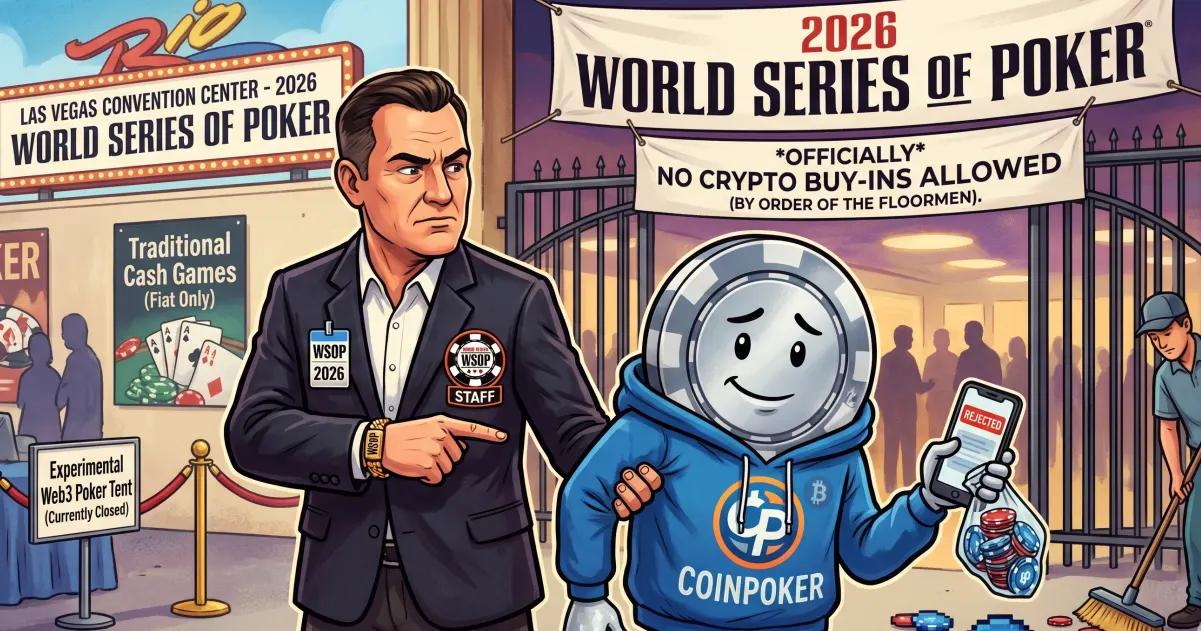
Patrick "Pads" Leonard was one of the first to go public. On Friday, the British pro and CoinPoker ambassador shared the rejection from WSOP's Sponsorship & Media Team, which stated plainly that his logo approval request was "not approved" pursuant to WSOP policies. Leonard posted the full email exchange on X, where his message has since been viewed over five million times.
Re: @25kfantasy not sure what/if I’ll play. Currently been denied to wear a patch, which I believe can lead to disqualification at the tournament directors discretion.
— Patrick Leonard ? (@padspoker) May 15, 2026
I imagine, as with a lot of other players, this will complicate things. I understand and respect WSOP is more… pic.twitter.com/GrkEXEF83I
"Not sure what/if I'll play," Leonard wrote, framing the situation as a warning to anyone considering him for the $25K Fantasy draft. "Currently been denied to wear a patch, which I believe can lead to disqualification at the tournament director's discretion. I imagine, as with a lot of other players, this will complicate things."
Leonard said he would respect the rules even if he disagrees with them. But his broader point carried weight: "I do think that sites are extremely demotivated to invest in players in our space when the flagship series restricts outside investment."
It's a fair observation. Sponsorship deals are one of the few revenue streams available to tournament pros beyond prize money, and the WSOP is the single highest-visibility event in the sport. If a site can't get its logo on camera during the biggest series of the year, the value proposition of signing ambassadors drops considerably.
CoinPoker's rejection shouldn't come as a shock, though. The site operates on blockchain infrastructure and is not regulated in the United States. The US appears on CoinPoker's own list of restricted territories. Given that Section 52 explicitly prohibits material relating to "any enterprise, service or product that abets, assists or promotes illegal gambling," an unregulated crypto poker room was always going to be a tough sell.
The Approved vs. Denied List
Joey Ingram weighed in on X with what might be the most significant detail: ACR Poker and BetMGM are reportedly approved partners. BetMGM makes sense immediately. It's a fully regulated US operator, live in multiple states, and has had ambassadors at WSOP feature tables for years without incident. PokerStars and BetRivers, as regulated operators in the expanding US online poker market, would likely receive the same treatment.
ACR is the interesting one. Americas Cardroom is not a regulated site in the US. It operates offshore, accepts US players, and has built a massive presence in the poker community through sponsorships, content creators, and major tournament series. If ACR has indeed been approved while CoinPoker and others were denied, it raises questions about where exactly the WSOP is drawing the line.
Shaun Deeb compiled a running list on X as of May 16. The known approved brands include ACR and GGPoker. The denied list includes CoinPoker (via Leonard's rejection), Phenom Poker, and ClubWPT Gold. Deeb also noted that Coin Poker's parent entity was denied, adding that he's "very pro all patches and promotion."
The two-per-table cap adds another wrinkle. Under the new rules, no more than two players at any feature streaming table can represent the same sponsor. If four GGPoker qualifiers end up at the same feature table, only two get to wear the patch, with a high-card draw deciding who covers up. It's a logistical headache for operators who send thousands of satellite qualifiers through the WSOP every summer.
Bigger Than Patches
Ingram made the sharpest observation about the scope of what's actually happening. In a follow-up post, he argued this isn't really about patches at all.
"From how I'm reading the WSOP rules, this is now about controlling what branded/promotional content can be created inside the WSOP and then distributed on YouTube, IG, X, livestreams, etc.," Ingram wrote. "If your content includes sponsor reads, affiliate links, logo overlays, promotional language, or a brand WSOP does not approve, that may no longer be treated as just 'creator content.' It may be treated as unauthorized promotion."
That's a much bigger conversation. A massive ecosystem of poker content creators monetize their WSOP coverage through exactly those channels: sponsor reads, affiliate links, logo overlays, branded gear. If the WSOP can now dictate which brands appear in content produced at its events, regardless of whether the creator is at a feature table, it fundamentally changes the economics of poker content creation during the summer.
The real question, as Ingram framed it, isn't "Can I wear this patch?" It's "Can I use the WSOP as the backdrop for monetized poker content promoting a competing or restricted gaming brand?"
What It Means for This Summer
The 2026 WSOP runs May 26 through July 15 across 100 bracelet events and 749 tables, the largest footprint in series history. ESPN is back. The Horseshoe and Paris will be packed. And somewhere in the middle of all that action, tournament directors will be making judgment calls about which logos stay and which get covered with tape.
For players with approved sponsors, nothing changes. For players whose brands got rejected, the calculus gets uncomfortable fast. Leonard floated the idea of playing $200 daily with Brad Owen at the Horseshoe rather than grinding the series full-time, a sentiment that likely resonates with any ambassador who just watched their patch value evaporate.
The WSOP's position is defensible. They're running a billion-dollar brand, ESPN is broadcasting to mainstream audiences, and last year's ClubWPT Gold debacle proved that uncontrolled third-party promotions can create genuine integrity problems. But the execution is generating friction. The 24-hour approval window is tight when feature table assignments often aren't finalized until the morning of play. The selective enforcement, approve ACR but deny CoinPoker when both operate offshore, invites accusations of favoritism. And telling content creators they need permission to promote their sponsors in their own videos opens a can of worms that extends well beyond the felt.
Poker has always been a sport where the players are the product. Their personalities, their brands, their stories. When the house starts telling the product what it's allowed to wear, you're going to hear about it.
The series starts in nine days. Expect this conversation to get louder.