
There is a specific, dangerous scent that permeates the poker economy around this time of year. It is not cigarette smoke or stale beer. It is the smell of unearned confidence.
It usually starts in November. A decent recreational player—let's call him "Tyler"—binks a mid-stakes Sunday tournament for $18,000. It is the most liquid cash Tyler has ever seen. His dopamine receptors light up like a Vegas slot machine. He looks at his bank account. Then he looks at his boss, "Kevin," who is asking him for the Q3 reports.
Tyler does some quick, horrific math on a napkin. "I made $18k in eight hours. That's over $2,000 an hour. If I play 40 hours a week, I am basically a hedge fund manager."
Tyler does not understand variance. Tyler does not understand sample sizes. Tyler is about to make a financial mistake that will haunt his credit score until the 2030s. He is going "Pro."
Here is the tragicomedy in five acts that plays out in Discord servers and card rooms every single day.
Phase 1: The Gear Acquisition Syndrome
The moment Tyler quits his job, he does not open a GTO solver. He opens Amazon.
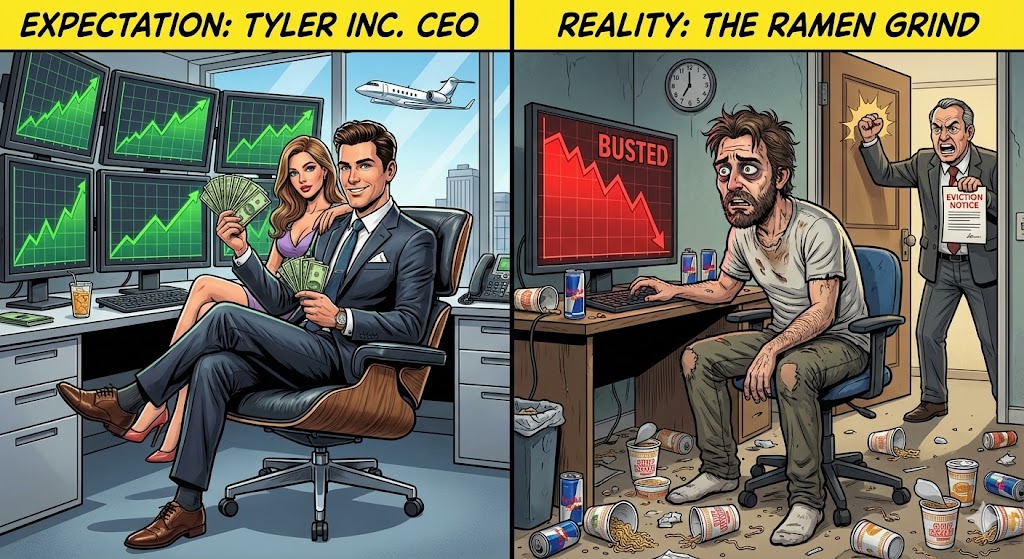
In the mind of the new pro, success is aesthetic. He needs the uniform. He buys a $1,400 Herman Miller ergonomic chair because a forum poster said it adds +2BB/100 to your win rate. He buys three curved monitors, even though his brain can only process two tables at once. He buys a subscription to a high-end training site that he will use exactly twice.
He stocks his fridge with a comical amount of Red Bull and "brain fuel" nootropics he bought from a podcast ad. He updates his Twitter bio to "Professional Poker Player / Risk Analyst." He feels like a titan of industry. He is the CEO of Tyler Inc.
Phase 2: The Tuesday Morning Hangover
The first week is glorious. Tyler wakes up at noon. He plays Call of Duty until 3 p.m. He registers for a few tournaments, busts out by 8 p.m., and goes to the bar because "it's a networking expense." He tells women on Hinge that he is a "Financial Consultant" who "works his own hours."
But then the reality of the grind sets in. Professional poker is not the final table of the WSOP. It is folding. It is folding J-4 offsuit for six hours straight while listening to a three-hour podcast about ancient Rome.
Tyler realizes that being your own boss means your boss is a psychopath. When you worked for Kevin, you got paid even if you had a bad day. In poker, you can work perfectly for 12 hours, make flawless decisions, and your "boss" (the deck) will reach into your pocket, take $800, and kick you in the ribs.
Phase 3: The Social Decay
Tyler is now living on a different temporal plane than the rest of humanity. He goes to bed at 6 a.m. and wakes up at 3 p.m. His skin takes on the pallor of a cave-dwelling creature.
His friends stop inviting him to things because he always cancels. "Sorry guys, can't make dinner, there's a juicy $200 rebuy on Ignition with crazy overlay."
His social circle shrinks to the three other degenerates he talks to on Discord, all of whom are also lying about their win rates. His girlfriend leaves him because she's tired of dating a vampire who speaks exclusively in EV calculations. He is alone with his monitors, his Red Bull, and his dwindling bankroll.
Phase 4: The Ramen Equity
Three months in. The $18,000 is now $5,500.
This is where the math gets dark. Tyler forgot that humans need to eat, pay rent, and keep the internet on. He is treating his bankroll like a checking account. Every burger he eats is technically a buy-in for a micro-stakes tournament.
The glamour is dead. The Herman Miller chair is covered in laundry. Tyler is no longer playing to "crush souls." He is playing to make rent.
You have never seen true fear until you see a man playing a $60 pot with the desperation of someone diffusing a bomb because he needs that pot to pay his phone bill. He becomes the biggest "nit" on Earth. He folds Ace-King pre-flop because he's terrified of a coin flip. The sharks smell this fear. They eat him alive.
Phase 5: The LinkedIn Walk of Shame
It is over. The account balance is two digits. The credit cards are maxed out. The "Risk Analyst" is now Googling "entry-level data entry jobs near me."
This is the hardest part. Tyler has to crawl back to the real world with a six-month gap on his resume.
"So, Tyler," the interviewer asks, squinting at his CV. "What were you doing between November and May?"
Tyler straightens his tie, sweating through his only good shirt. He cannot say "I was punting off my life savings chasing river cards in my underwear at 4 a.m."
"I was pursuing a private entrepreneurial venture in the high-frequency trading sector," Tyler lies. "But I decided I missed the structure and camaraderie of a corporate environment."
He gets the job. He sits back in a grey cubicle. Kevin walks by and asks for the Q3 reports. And Tyler smiles. Because for the first time in six months, he knows exactly how much money he is going to make next week.
The Takeaway
If you are thinking about going pro because you had one good month, do yourself a massive favor. Go to the bathroom, look in the mirror, and splash cold water on your face.
Poker is a wonderful, profitable hobby and a terrible, soul-crushing career. Unless you have a bankroll that can survive a nuclear winter and the mental fortitude of a stoic philosopher, keep the day job. Kevin might be annoying, but at least he doesn't check-raise you on the river.