
Ask the average regular wearing sunglasses at a Tuesday morning $1/$2 table how they are doing. They will almost universally tell you they are "about break-even."
They are lying.
They are not lying to you maliciously. They are lying to themselves because the truth is incredibly uncomfortable. The human brain is a master of self-deception. It vividly remembers that glorious night you stacked the local loudmouth for three buy-ins with quad sevens. It conveniently wipes the hard drive of the fourteen subsequent sessions where you bled away $50 an hour calling down nits with second pair.
If you want to stop donating to the ecosystem and start withdrawing from it, you need a cold dose of reality. Let us strip away the casino glamor and look at the brutal math, the tragic stories, and the elite mindset required to actually survive this game.
The Cold, Hard Science of Losing
Poker is not purely zero-sum. It is a negative-sum game. The rake is a constant, invisible tax that drains the table. If you and seven buddies played poker for 48 hours straight and passed the same $1,000 back and forth, you would all eventually end up broke. The casino would own every single chip.
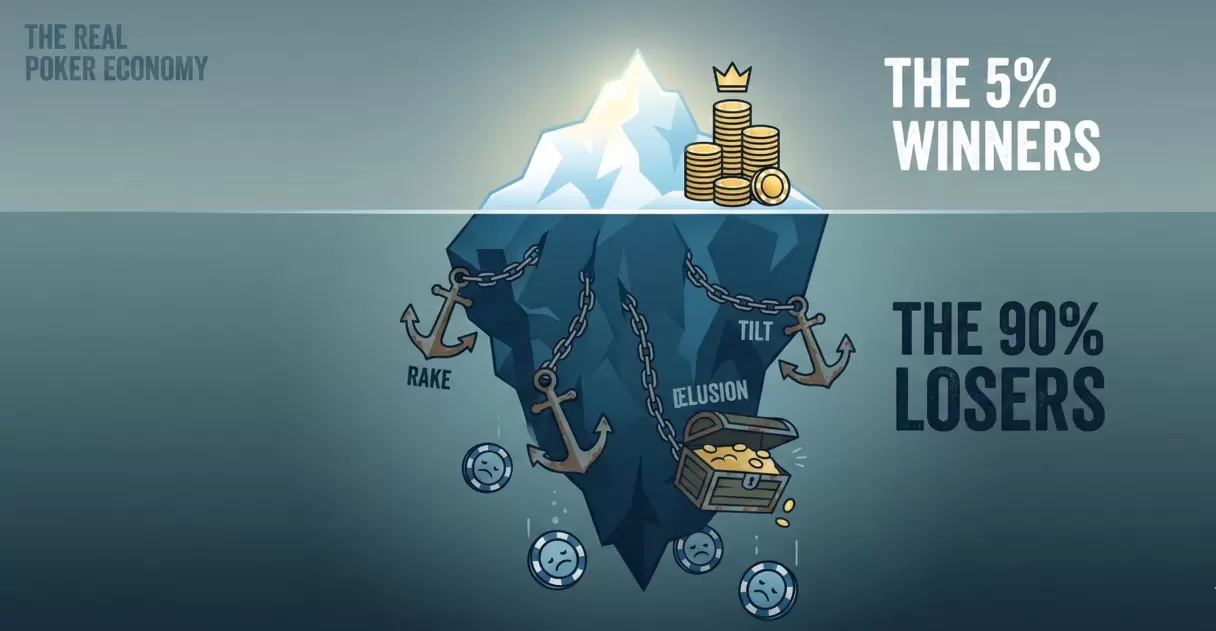
When researchers actually crunch the numbers, the data is staggering. In a massive behavioral study analyzing 27 million online poker hands, scientists found that only about 10% of players were profitable after paying the rake. Furthermore, only a microscopic 1% of players made more than minimum wage.
It is the Pareto Principle on steroids. A tiny fraction of apex predators is eating the vast majority of the player pool.
Hollywood Predators and Tragic Whales
You can see this dynamic play out at the highest levels of society. Take the infamous high-stakes Hollywood games run by Molly Bloom. Actor Tobey Maguire reportedly walked away with over $30 million. He did not do this by being incredibly lucky. He did it by being utterly ruthless, game-selecting perfectly, and preying on wealthy amateurs who thought their business acumen translated to the felt.
On the flip side of that same coin are the lives absolutely ruined by the delusion of skill.
For every Tobey Maguire, there are thousands of tragic stories. The legendary comedian Norm Macdonald, a notorious degenerate gambler, once famously admitted to throwing a stack of winning casino chips directly into the ocean just to feel something. There are countless undocumented stories of players remortgaging homes, destroying marriages, and chasing losses at the $2/$5 tables until there is nothing left. The dark side of variance is not a joke. When ego meets bad bankroll management, financial ruin is a mathematical certainty.
The Day Trading Parallel
Why do so many smart people lose at poker? Because they treat it exactly like amateur day trading.
During a massive bull market, every guy with a smartphone thinks he is the next Warren Buffett. In poker, a short-term lucky streak creates the exact same delusion. Weekend warriors refuse to treat the game with the respect it demands. They play like they are in a movie, chasing inside straight draws because they "feel it coming." They tilt off two buy-ins because their aces got cracked, completely ignoring the fact they played the hand horribly post-flop.
Then there is the modern low-stakes trap: The GTO Wizard wannabe.
These players watch high-stakes crushers analyzing complex solver outputs and try to apply those exact strategies at $25NL. They attempt intricate, multi-street bluffs against calling stations who literally cannot locate the fold button. Trying to play perfect Game Theory Optimal poker against a table of erratic, tipsy recreational players is like bringing a chess board to a knife fight. You are overthinking the meta-game while they just stab you with top pair.
The Rise of Bots and the Professional Delusion
The modern game features a new, silent predator that does not sleep or tilt. Artificial Intelligence and automated bots have permanently altered the online landscape. A decade ago, you were just trying to outsmart a hungover college kid playing from his dorm room. Today, you might be heads-up against a piece of sophisticated software executing flawlessly balanced mathematical strategies. While poker sites wage constant war to ban these accounts, AI remains the new grim reaper of the low-stakes ecosystem. If you are playing sloppy and predictable poker, these programs will quietly siphon your bankroll penny by penny without ever typing a single word in the chat box.
This shifting, shark-infested landscape makes the classic poker dream an increasingly dangerous career choice. Every year, thousands of decent players hit a massive upswing and dramatically quit their steady corporate jobs to "turn pro." It is almost always a catastrophic miscalculation. Treating poker as a primary income source transforms a fun intellectual challenge into a brutal, soul-crushing daily grind. You are no longer playing for the thrill of a well-timed bluff. You are desperately trying to extract enough big blinds from the local fish to cover your monthly health insurance premium. That immense pressure destroys the mental game of all but the most calloused grinders.
Nowhere is this stress more tragic than with the family men who use the card room as an escape hatch from reality. Every regular knows this guy. He tells his wife he is working late, but he is actually punting away his family's disposable income at the $2/$5 tables. Playing with "scared money" is the absolute fastest way to guarantee a loss. When a player is subconsciously terrified of explaining a missing mortgage payment to their spouse, they play passively. They fold the winning hand to aggression out of pure fear. They become the ultimate, predictable prey for the aggressive regulars who are playing with properly segregated bankrolls.
These modern hurdles prove why the game is exponentially harder than it was during the poker boom. You are battling not just the house rake, but soulless machines, desperate professionals, and your own heavy emotional baggage. The era of easy money is dead and buried. You cannot just log in with a basic understanding of hand rankings and expect to print cash. You need bulletproof discipline and psychological armor that most recreational players simply refuse to build.
The Moneymaker Dream vs. The Grinder Reality
But let us not ignore the happy endings. Poker can be beaten.
Everyone knows the Chris Moneymaker story. The accountant who turned an $86 online satellite into $2.5 million and a World Series of Poker bracelet. That story is beautiful, but it is an anomaly.
The real success stories are far less glamorous. Look at legendary online grinders like "BlackRain79" (Nathan Williams). He did not get rich overnight. He played millions of hands at the absolute lowest stakes, methodically exploiting the specific weaknesses of bad players. He embraced boredom. He printed money by playing a highly disciplined, robotic style of poker that capitalized on the impatience of others. He bought a house and traveled the world not through massive tournament scores, but through the relentless accumulation of small edges.
Crossing the Chasm into the 10 Percent
If 90% of players fail, how do you cross the chasm and join the elite few who actually build a bankroll? It requires a complete rewiring of your brain. You have to stop playing for the adrenaline spike and start playing for Return on Investment.
-
Embrace Boring Poker: Winning low-to-mid stakes poker is not about making sick soul-reads on the river. It is about disciplined pre-flop folding. It is about value-betting relentlessly when you have it and folding quickly when you face aggression. It is repetitive, it is unsexy, and it works.
-
Game Select Like a Coward: Your ego wants you to sit with the best regular in the room to prove your worth. Your bankroll wants you to sit with the drunk tourist splashing chips. The absolute fastest way to increase your win rate is to swallow your pride and find softer tables.
-
Master the Bankroll: The quickest way to join the graveyard of ruined players is playing outside your means. Variance does not care how good you think you are. If you do not have at least 30 to 50 buy-ins for your current stake, you are merely renting your chips until the inevitable downswing wipes you out entirely.
The statistics are brutal, but they are not a death sentence. Most people sitting at a poker table are destined to lose because they lack discipline. If you stop lying to yourself, respect the rake, and tighten up your game, you can finally stop being the prey and start being the predator.