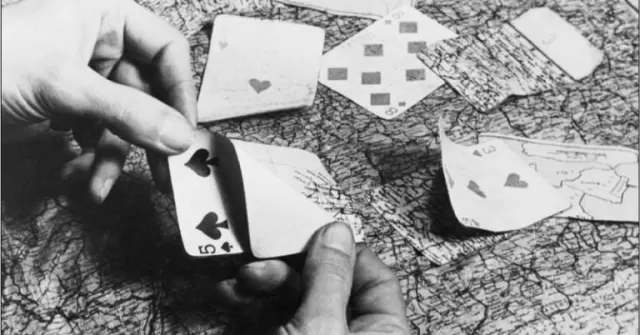

Next time someone at your home game drops "poker was invented in Texas," feel free to call. They're bluffing. And badly.
The truth is nobody "invented" poker. Not one person. Not one country. Not even one century. Poker crawled out of a swamp of older card games, got sharpened on riverboats by professional cheats, survived multiple wars, dodged the law for decades, and eventually became the most popular card game on the planet.
Here's how it actually happened. No fluff. No filler. Just the hand history.
The Ancestors: Poker Before "Poker"
Every origin story needs a villain, and poker's begins with gambling itself. Humans have been betting on cards since the Chinese invented playing cards around the 9th century. But poker's DNA comes from a few specific games that were floating around Europe and Persia long before anyone shuffled a deck on American soil.
As-Nas (Persia, 1600s-1800s): This is the one poker historians love to argue about. As-Nas was a Persian card game using a 25-card deck with five suits. Players were dealt five cards and bet on who had the best hand. Sound familiar? There was no draw, no community cards. Just cards, bets, and bluffing. Some scholars say As-Nas is poker's direct ancestor. Others say the connection is overblown. Either way, the Persians were bluffing each other out of money centuries before Chris Moneymaker sat down at a PokerStars satellite.
Poque (France, 1700s): This is probably the strongest link. Poque was a French card game involving betting, bluffing, and hand rankings. It arrived in New Orleans with French colonists. The name "poker" almost certainly comes from "poque." Say it out loud. Yeah. It's right there.
Primero (Spain/Italy, 1500s): Often called "poker's mother," Primero involved three cards, betting rounds, and bluffing. It was wildly popular across Renaissance Europe. If poker has a great-grandmother, this is her.
Brag (England, 1700s): A bluffing game that British colonists brought to America. Three cards, betting, and a healthy dose of lying to your friends' faces.
Here's the key insight most casual players miss: none of these games ARE poker. Poker is what happened when all of them collided in one sweaty, lawless port city.
New Orleans: Ground Zero (Early 1800s)
If poker has a birthplace, it's New Orleans. Specifically, the French Quarter. Specifically, the kind of places your mother told you to avoid.
In the early 1800s, New Orleans was a melting pot of French, Spanish, English, and Caribbean cultures. Card games from all of those traditions were being played in gambling dens, saloons, and back rooms. Somewhere in that chaos, poker emerged.
The earliest confirmed references to poker come from the 1830s. Jonathan H. Green described "the cheating game" in his 1843 book about Mississippi riverboat gambling. He noted a game played with 20 cards (Aces, Kings, Queens, Jacks, and Tens) dealt to four players, five cards each. No draw. No discard. Just bet or fold.
This is the pro-vs-amateur moment in poker history. Amateurs think poker was always played with 52 cards. It wasn't. The original game used 20 cards. That means no flushes, no straights. Just pairs, trips, and full houses. The game was raw. Simple. And absolutely infested with cheaters.
Riverboats and Professional Sharps (1830s-1860s)
Here's where poker gets interesting. And by interesting, I mean crooked.
Mississippi riverboats were the online poker rooms of the 19th century. They were where the action was. Wealthy plantation owners, merchants, and travelers would board steamboats for multi-day trips up and down the Mississippi River. And waiting for them? Professional gamblers. "Sharps." Card mechanics. Grifters with fast hands and zero conscience.
These guys were the original poker pros. They didn't study GTO solvers. They studied marked cards, bottom dealing, and cold decking. The game wasn't about strategy. It was about cheating better than the other cheaters.
But something important happened during this era: the 52-card deck became standard. More cards meant more players per table, which meant bigger pots, which meant more money for the house and the sharps. The draw was introduced. Now players could discard and replace cards. Suddenly the game had another layer of deception.
Flushes and straights were added to the hand rankings. Poker was becoming recognizably modern.
The Civil War and Stud Poker (1860s-1900s)
War is hell. It's also apparently a great incubator for card games.
During the American Civil War, soldiers on both sides played poker constantly. It was cheap entertainment in camps and trenches. The war spread poker across the entire country in a way that riverboats never could.
Stud poker emerged during this period. Instead of all cards being hidden, some were dealt face-up. This was revolutionary. For the first time, you had real information about your opponents' hands. Bluffing became more nuanced. Reading your opponent became more important. The game got deeper.
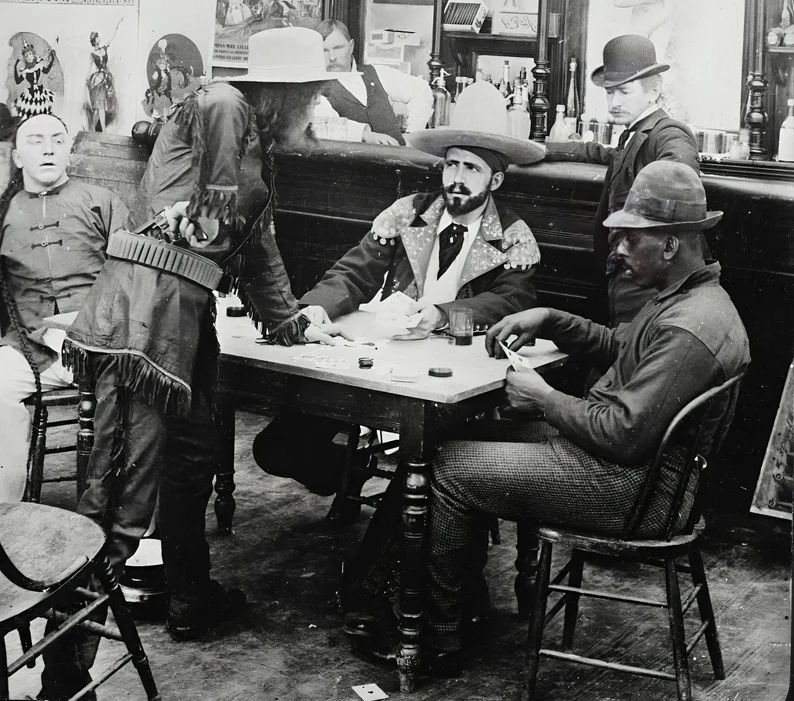
Five-Card Stud became the dominant form of poker in the late 1800s. It was the game cowboys played in saloons. It was the game depicted in Western movies. It was poker, and everyone knew it.
Meanwhile, the wild card was introduced. The joker appeared in American decks around 1875. Lowball games emerged. Split-pot games followed. Poker was mutating, branching, evolving.
The 20th Century: Poker Gets Organized
The early 1900s brought two things that changed poker forever: legitimacy and structure.
Las Vegas legalized gambling in 1931. Suddenly poker had a permanent home. No more back rooms and river barges. You could sit down at a real table, in a real casino, and play real poker. Legally.
Seven-Card Stud became the dominant game, replacing Five-Card Stud and Draw. More cards meant more decisions. More decisions meant more skill edge. Better players won more consistently. The game was rewarding competence over luck, which is exactly what serious players wanted.
But the real revolution was still coming.
Texas Hold'em: The Game That Ate Poker (1960s-Present)
Hold'em's exact origin is debated, but the Texas Legislature officially recognized Robstown, Texas, as the game's birthplace, dating it to the early 1900s. It arrived in Las Vegas in 1963, brought by a group of Texan gamblers. At first, it was just another poker variant. Then Benny Binion got involved.
In 1970, Binion hosted the first World Series of Poker at his Horseshoe Casino. The main event was a small, invitation-only affair. Johnny Moss won the inaugural event by vote of his peers. By 1972, the tournament switched to a freeze-out format with a buy-in. Texas Hold'em was the chosen game.
Why Hold'em? Because it's almost perfectly designed for both television and strategy.
Two hole cards. Five community cards. Four betting rounds. Simple to learn. Brutally difficult to master. Every player sees the same board, creating shared drama. The hidden hole cards create suspense.
The pro would tell you: Hold'em dominated because it maximizes the skill-to-luck ratio over any meaningful sample size while remaining accessible enough that a complete beginner can sit down and understand the basics in ten minutes. That's a rare combination. That's game design genius. And it happened almost by accident.
The Poker Boom: Moneymaker and the Internet (2003-2006)
You cannot tell the history of poker without talking about two things: the internet and Chris Moneymaker.
Online poker started in the late 1990s. Planet Poker dealt the first real-money online hand in 1998. PokerStars launched in 2001. PartyPoker followed. Suddenly you could play poker in your underwear at 3 AM against strangers from 50 countries. The game was never the same.
Then came 2003. Chris Moneymaker, an accountant from Tennessee, won a $39 PokerStars satellite. That satellite fed into another satellite. That satellite put him in the World Series of Poker Main Event. He won the whole thing. $2.5 million.
An accountant. $39. World Champion.
The "Moneymaker Effect" exploded poker into mainstream culture. The 2004 WSOP Main Event had 2,576 entrants, up from 839 the previous year. By 2006, it was 8,773. Online poker rooms were printing money. ESPN was broadcasting poker like it was the NFL. Everyone and their grandmother was playing Texas Hold'em.
This was also the era when poker strategy went supernova. Poker forums became universities. Books multiplied. Training sites launched. Concepts like position, pot odds, implied odds, and continuation betting went from insider knowledge to common vocabulary. The average $1/$2 player in 2006 was playing better poker than most "pros" from the 1980s.
Black Friday and the Modern Era (2011-Present)
April 15, 2011. "Black Friday" for online poker. The U.S. Department of Justice seized the domains of PokerStars, Full Tilt Poker, and Absolute Poker, charging their founders with bank fraud, money laundering, and illegal gambling. The American online poker boom was over.
But poker didn't die. It migrated. European and Asian markets grew. Live poker remained strong. And slowly, U.S. states began legalizing regulated online poker. Nevada, New Jersey, and Delaware led the way. Pennsylvania, Michigan, and others followed.
Meanwhile, poker strategy entered the GTO era. Game Theory Optimal play. Solvers. AI research. In 2017, Libratus, an AI developed at Carnegie Mellon, defeated top human professionals at heads-up No-Limit Hold'em. Poker strategy went from "read the player" to "balance your ranges."
The modern game is a weird hybrid. At the highest levels, players use solver-approved strategies and database analysis. At the mid-stakes, it's a mix of solid fundamentals and old-school reads. And at the low stakes? At your Friday night home game? It's still the same beautiful chaos it's always been. People bluffing with nothing. People calling with everything. People doing things that no solver would ever recommend and occasionally getting rewarded for it.
That's poker. It always has been.
So, Who Invented Poker?
Nobody. And everybody.
Persian merchants playing As-Nas. French colonists playing Poque. English soldiers playing Brag. Mississippi riverboat cheaters. Civil War soldiers. Las Vegas casino owners. Texas road gamblers. An accountant from Tennessee.
Poker wasn't invented. It evolved. It adapted. It survived prohibition, wars, government crackdowns, and the rise of the internet. It went from a 20-card cheating game in a New Orleans back room to a global phenomenon played by over 100 million people.
No single person gets the credit. But every single person who ever sat down, put their money in, and tried to outplay the person across from them? They're all part of the story.
Now stop reading history and go play some cards.