This is the only game that truly mirrors the American soul: a potent cocktail of raw luck, blistering mathematics, and the kind of bare-knuckled psychological warfare that would make a CIA interrogator blush. It's a game of risk, of reinvention, and of the unshakeable belief that even with a garbage hand, you can bluff your way to a fortune.
It's played in millions of home games, in casino backrooms, and for stacks of chips taller than a small child at the World Series of Poker (WSOP) in Las Vegas. With an estimated 60 million Americans playing at least once a year, poker isn't just a game. It's a cultural throughline, a story that begins on a muddy, lethal river and ends in the cold, binary heart of an AI supercomputer.
But to understand where it's going, you have to appreciate the scoundrels, cheats, and visionaries who got it here.
Chapter 1: The Big Muddy Miracle
Like many American stories, this one starts with immigrants and a healthy dose of vice. While poker has hazy roots in German, Persian, and English games, its most direct and rowdy ancestor is undeniably French.
In the 17th century, the French played Poque, a game of betting and bluffing that was, essentially, poker's fancy European cousin. When French colonists brought this game to North America, they didn't land in New England. They landed in New Orleans.
In the early 1800s, New Orleans was the perfect petri dish. It was America's first great gambling city, a chaotic, humid port boiling over with sailors, merchants, farmers, and hustlers. Around 1822, a man named John Davis opened the first proto-casino, a 24-hour establishment offering food, liquor, and every game of chance. In this cultural gumbo, Poque shed its French manners, got a gritty American makeover, and its name was anglicized into "Poker."
It was still a crude beast, played with a 20-card "short" deck (Aces down to Tens). But it was built on a revolutionary idea: you didn't bet on your hand; you bet on your opponent's nerve.
Chapter 2: Malice in Water-Palaces
This new game didn't stay in New Orleans for long. It found its true finishing school on the Mississippi riverboat.
As cities began to crack down on gambling dens, the "sharps" (a polite term for professional cheats) moved to the unregulated, floating parlors of the river steamers. These weren't the glamorous saloons of the movies; they were smoke-filled, whiskey-soaked death traps for the unwary.
This was the era of the professional gambler, an apex predator of the felt. And the competition was fierce. In 1835, in Vicksburg, Mississippi, five professional gamblers were cornered by a vigilante mob, accused of cheating, and publicly hanged. This event had a chilling effect, pushing even more of the "sporting fraternity" onto the relative safety of the riverboats, where the only law was the captain's.
It was in this high-stakes, lawless environment that poker evolved at lightning speed. Two crucial innovations were born:
-
The 52-Card Deck: The 20-card deck was too limiting. The full 52-card English deck was adopted, allowing for more players and, crucially, the invention of the flush.
-
The Draw: The concept of "Draw Poker" was introduced, giving players one last, desperate chance to discard and draw new cards—or, more importantly, pretend they were.
The bluff was now an art form. The game was part math, 90% larceny.
Chapter 3: The War, The West, and The Dead Man's Hand
Poker's "greatest viral marketing campaign" was, strangely, the Civil War (1861–1865). Soldiers on both sides, crushed by the boredom of camp life, played poker incessantly. When the war ended, these veterans carried the game to every corner of the nation.
It became the game of the American frontier, a staple of every saloon and cattle drive. It was here the game's folklore was written in blood.
Look no further than James Butler "Wild Bill" Hickok. On August 2, 1876, the legendary lawman and gunfighter was playing poker in Nuttal & Mann's Saloon in Deadwood, South Dakota. Hickok, a notoriously careful man, broke his own cardinal rule: he sat with his back to the door. A small-time gambler named Jack McCall, nursing a grudge, walked in, drew his revolver, and shot Wild Bill in the back of the head, killing him instantly.
The hand Hickok was holding? Two pair: black aces and black eights. To this day, it's known as the "Dead Man's Hand."
He wasn't the only legend. There was Doc Holliday, a dentist from Georgia slowly dying of tuberculosis, who became one of the most feared gamblers and gunfighters in the West. He was a man who, as one contemporary noted, was "genial and companionable" but also a "desperado." He was arguably more afraid of a bad beat than a bullet.
Chapter 4: The Cadillac from Texas
For nearly a century, "poker" meant Five-Card Draw. But around 1900, in the dusty backrooms of Robstown, Texas, a new variant was quietly being perfected.
This game used "community cards" that all players shared. It was more complex, more strategic, and demanded a new level of psychological warfare. It was Texas Hold'em.
For decades, it remained a niche game for serious gamblers. As the legendary Doyle Brunson, one of the game's godfathers, famously said, Hold'em was "the Cadillac of Poker."
It remained a Texas secret until 1967, when a group of grizzled Texan "road gamblers," including Brunson and "Amarillo Slim" Preston, brought the game to a struggling Las Vegas casino called the Golden Nugget. It was a hit with the pros.
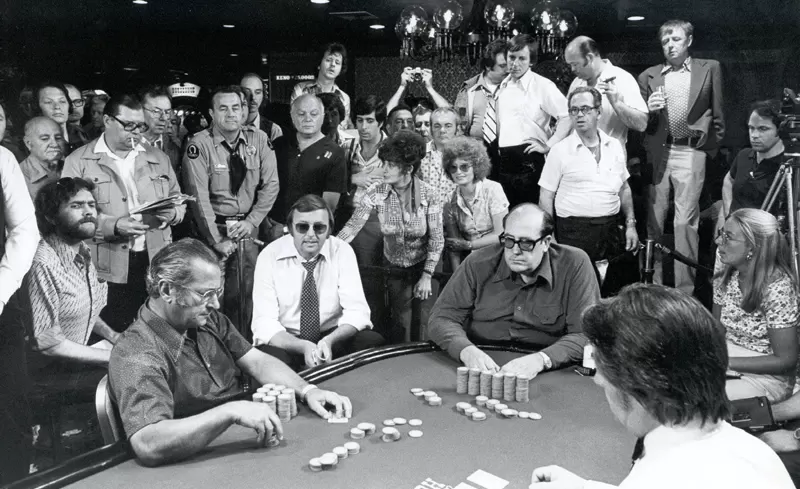
In 1970, casino owner Benny Binion had a brilliant idea. He invited the best (and richest) players he knew to his Horseshoe casino for what he dubbed the "World Series of Poker." That first event was less a tournament and more a glorified, bourbon-fueled hangout. At the end, the seven or eight players... just took a vote for who won (the legendary Johnny Moss).
By 1971, they'd made the main event a "freeze-out" tournament. The game they chose? Texas Hold'em.
This was not an overnight success. The 1971 main event had a grand total of... six players. The 1972 event had just eight. But Binion, a master showman, stuck with it. By 1979, it grew to 54 entrants. By 1991, 215. It was a slow, steady burn.
Then came the explosion.
Chapter 5: The Boom: A Cam, a Cult Classic, and a Man Named Moneymaker
The "Poker Boom" of the 2000s was a perfect storm of three key events that launched the game into the stratosphere.
1. The Technology: The Hole Card Cam Before the 1990s, watching poker on TV was as exciting as watching paint dry. You saw men staring at each other. You didn't know why. Then, in 1997, a poker player and Holocaust survivor named Henry Orenstein patented the "hole card cam," a small camera that let the television audience see the players' hidden "hole cards." Suddenly, the game was a gripping psychological drama. You could see the bluff. You could feel the tension. You were in on the secret.
2. The Gospel: Rounders (1998) This Matt Damon and Edward Norton film wasn't a box office smash, but it became a sacred text. It romanticized the "grinder" lifestyle, gave the game a gritty, intelligent soul, and gave a new generation a lexicon: "He's got the nuts," "I'm splashing the pot," and the immortal, "If you can't spot the sucker in your first half-hour at the table, then you are the sucker."
3. The Spark: Chris Moneymaker (2003) This is the event that truly lit the fuse. An accountant from Tennessee, with the almost-too-perfect name Chris Moneymaker, won an $86 online satellite tournament. That single ticket got him into the $10,000 WSOP Main Event. It was his first-ever live tournament.
He was a pure amateur, surrounded by sharks. And he won the whole thing, claiming $2.5 million.
It was the ultimate "anyone can win" dream realized. The "Moneymaker Effect" was instantaneous. The 2003 Main Event had 839 entrants (a record at the time). The next year, in 2004, that number tripled to 2,576. The boom was on. When Casino Royale (2006) had James Bond swap Baccarat for a high-stakes Hold'em game, it was official: poker was the coolest game on the planet.
Chapter 6: The New Frontier: Bots, Brains, and Broadcasters
For the last decade, poker has been in a new, quieter arms race. The game is being "solved."
The AI Problem: The enemy is no longer just the man across the table. It's the bot in the cloud. AI programs known as "solvers," like DeepStack (2016) and Pluribus (2019), have been proven to be superhuman in No-Limit Hold'em. They've taught the world GTO (Game Theory Optimal) play—a mathematically perfect, unexploitable strategy.
The modern pro isn't a "feel" player from Texas; they are an "AI-trained" assassin who has spent thousands of hours studying solver outputs. This has squeezed the fun—and the profit—out of the game for many.
The Entertainment Solution: So, if the game is all math, how is it still popular? It's become an entertainment product. The new "riverboat" is Twitch.
Streamers like Lex Veldhuis ("LexVeldhuis") and Benjamin "bencb" Rolle ("RaiseYourEdge") aren't just players; they are personalities. They broadcast their high-stakes play to thousands, sharing their thought processes, celebrating their wins, and (more humorously) lamenting their bad beats in real-time. They've built massive communities, turning a solo game into a shared experience.
This, combined with the slow, messy, state-by-state grind of legal online poker in the U.S., is the game's new frontier.
The Enduring Bluff
Poker has always adapted. It moved from French parlors to lawless riverboats. It was refined by war and baptized in the blood of the Wild West. It was standardized in Vegas, exploded by television, and is now being perfected by artificial intelligence.
The game is now faster, harder, and more mathematical than Benny Binion could have ever imagined. But at its core, it's still the same.
It's one human, looking at another human, and asking one simple, terrifying question: "Are you bluffing?"