Picture a Tuesday night in late 2008. On Full Tilt Poker, the $500/$1,000 tables sit dead, as they have for days. The best players alive, Tom Dwan, Phil Galfond, the Dang brothers, Patrik Antonius, are scattered across the lobby playing stakes they consider beneath them, or not playing at all. Then an account called lady marmelade logs in.
Within ninety seconds, every seat is full. The waiting list is longer than the table. On the TwoPlusTwo railbird threads, someone posts one word: "He's on." Thousands of people stop what they're doing to watch. This happens every time, and everyone knows why. The biggest games in the history of online poker do not exist because the world's best players want to fight each other. They exist because one man, a French-Canadian billionaire who used to eat fire on street corners, is willing to pay all of them at once for the privilege of the game.
When he logs off, the games break instantly, like a set being struck after the show. Which is fitting, because for him it was always a show.
Act One: The Accordion Years
Guy Laliberté was born in Quebec City in 1959, and the origin story is almost too on-the-nose. His parents took him to see the Ringling Brothers circus as a boy. He read a biography of P.T. Barnum and never fully recovered. At 18 he hitchhiked across Europe with no money and no plan, feeding himself by busking with an accordion, and along the way apprenticed himself to two of the least employable skills on earth: fire-breathing and stilt-walking.
He came back to Quebec and worked the streets as a performer. In 1984, he and a band of fellow street artists talked the provincial government into funding a touring show for Quebec's 450th anniversary celebrations. The troupe had no animals, no ringmaster, no sawdust, just acrobats, absurd costumes, and original music. They called it Cirque du Soleil.
Twenty years later, that scrappy government grant had become a global empire with thousands of employees on five continents and revenues north of $800 million a year. The fire-eater was a billionaire. And billionaires, sooner or later, find their way to a poker table.
Act Two: The Most Wanted Man on the Internet
Laliberté discovered high-stakes poker in the mid-2000s and attacked it the way he attacked everything, with total commitment and complete disregard for the price tag. He was not delusional about his skill. That's the detail that separates him from every other whale story in gambling history. He knew exactly what he was. He once described himself, in the middle of the bleeding, as a willing student paying tuition to the best in the world.
The tuition was historic. He started on Full Tilt in October 2006 under the name noataima, and over about eighteen months that account lost $7.06 million, a burn rate of roughly $105 per hand. Not per session. Per hand. When noataima became too famous, he opened patatino, Italian for "little potato," which lost another $5.92 million. When patatino's cover blew, lady marmelade appeared and gave up $6.63 million in under a year. In the fall of 2008 alone, an account called elmariachimacho materialized in September and had donated $4.16 million by Christmas.
The new identities were meant to buy him a honeymoon period of anonymity. They never lasted a week. High-stakes regulars can identify a recreational player's fingerprints faster than any forensics lab, and the railbirds turned unmasking him into a community sport. A fresh unknown sits at $500/$1,000, limps a pot, overcalls three streets, and the forums light up: it's him. The waiting lists would assemble like seagulls behind a fishing boat.
Full Tilt, it should be said, banned multi-accounting for every other human being on the platform. For Laliberté, the rulebook developed a curious flexibility. When you are personally responsible for the existence of the site's flagship attraction, the site discovers it can be accommodating.
The scoreboard by the end: at least five Full Tilt accounts plus a PokerStars account called Zypherin, with tracked losses that tally past $31 million, including a single calendar year, 2008, in which the accounts dropped a combined $17.1 million. The largest beneficiaries were Dwan, Galfond, and the Dang brothers, which means some of the most celebrated winning graphs of poker's golden era were, to a meaningful degree, charts of one man's entertainment spending viewed from the other side.
He wasn't hopeless everywhere, either, and that's part of the charm. In April 2007 he finished fourth in a World Poker Tour championship event at Bellagio for $696,220, outlasting hundreds of professionals. He sat in on High Stakes Poker and Poker After Dark and gave off the unmistakable air of a man having considerably more fun than the people trying to win his money. Live, reading humans across a table, he could genuinely play. Online, against the sharpest pools ever assembled, he was the ocean's most generous current, and he seemed entirely at peace with both facts.
Act Three: The Year He Left the Planet
Here is where the story stops being a gambling anecdote and becomes cinema. In 2009, at the absolute peak of the bleeding, while the forums tracked his losses like a national debt clock, Laliberté decided the table stakes on Earth were insufficiently interesting. He announced, from Russia's Star City cosmonaut training complex, on his 50th birthday, that he was going to space.
That September he strapped into a Soyuz rocket as the first Canadian space tourist and spent twelve days aboard the International Space Station. He brought his trademark red clown nose and wore it in zero gravity, becoming, in his own words, the first clown in space. From orbit, he hosted a two-hour global broadcast about water conservation featuring U2, Al Gore, Shakira, and Peter Gabriel across fourteen cities, stitched together by a poetic tale about the moon, the sun, and a drop of water, written for the occasion by Life of Pi novelist Yann Martel. The whole mission promoted One Drop, the clean-water foundation he had launched two years earlier with $100 million of his own money.
The trip cost more than $41 million once all the bills landed, a number that later produced its own subplot when Canadian tax authorities spent years arguing in federal court about whether a billionaire's rocket ride was a business expense. The court's view was, roughly, that it was not.
Do the math on that stretch of his life and it produces one of the great sentences available in gambling history: between 2008 and 2009, Guy Laliberté lost approximately as much money playing internet poker as he spent going to actual outer space, and only one of those purchases included a clown nose. The same era also featured a former partner suing him for more than $50 million, a filing that reportedly itemized, among its needs, a helicopter. Some men have expensive years. He had an expensive decade, and appeared to enjoy every minute of it.
And then, the detail that tells you everything about the man: after the space trip, after $26 million or more had already gone, a new Full Tilt account named Esvedra appeared in the summer of 2010 and played for a full year. Es Vedrà is a rock off the coast of Ibiza, where his parties were the stuff of Mediterranean legend. The whale had returned from orbit, surveyed the damage, and quietly pulled up a chair for one more encore.
Act Four: The Grievance
For years, Laliberté played the perfect sport. He never berated a winner, never blew up a table, never blamed the cards. The pros adored him, which, given the circumstances, was the least they could do.
Then came Black Friday. In 2011, the U.S. Department of Justice cracked Full Tilt open and what spilled out was not a poker site but something the government described as a global Ponzi scheme, a company that had been paying its inner circle from player deposits it no longer possessed. Suddenly the whole architecture of the era looked different, and Laliberté started doing arithmetic of his own.
In 2014, he unloaded to Le Journal de Montréal. He said he had been robbed by people he knew personally. His opponents, he pointed out, were sponsored pros drawing hourly wages, collecting 100% rakeback, and in some cases playing on enormous lines of site credit that were never repaid, meaning they were shoving millions across the table without risking their own money against a man risking nothing but his own. He compared his situation to the hero of The Shawshank Redemption, though considerably less politely. His summary of his own role required only four words: "I was an idiot."
Was he actually colluded against? Nobody has ever proven it, and much of his money went to players who beat everyone on earth, not just him. But his central complaint, that Full Tilt's insiders were playing a fundamentally different financial game than its customers, is no longer a conspiracy theory. It's a court record.
Act Five: The Revenge, Staged His Way
A normal whale, wounded and wiser, disappears. A circus impresario builds a bigger tent.
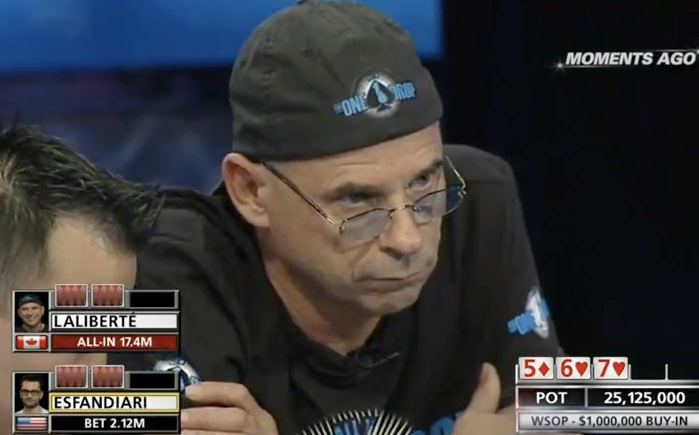
In 2011, Laliberté announced the most audacious tournament in poker history: The Big One for One Drop, a $1 million buy-in event at the 2012 World Series of Poker, with $111,111 from every single entry siphoned directly to his water charity. The poker world gasped, then paid. Forty-eight players put up a million dollars each. Antonio Esfandiari won $18,346,673, at the time the largest prize in tournament history, and the event raised over $5.3 million for One Drop.
And in the field, playing his own creation, was Laliberté himself. The most documented losing player in online poker history navigated a lineup of the greatest tournament players alive and finished fifth, for $1,834,666.
Consider the shape of that revenge. He didn't hire lawyers to chase the pros. He built a game so glamorous they couldn't refuse it, charged every one of them a six-figure entry fee for charity, then beat 43 of them at their own craft on his way to a seven-figure cash. The sharks who had feasted on lady marmelade spent a week of their lives being raked, in the most literal sense, by the fish. It remains the most elegant act of table revenge ever staged, and he staged it, naturally, as a spectacle.
Curtain Call
The later chapters never break character. In 2019, he was briefly detained by French Polynesian police for growing cannabis on Nukutepipi, his private atoll, which is the most on-brand legal difficulty money can buy. In 2020, the pandemic bankrupted Cirque du Soleil and he sold his final stake, walking away still worth around a billion dollars, the street performer's grant money having survived four decades, several fortunes, a space program, and the hungriest poker games ever spread.
Poker players still argue about what the nosebleed era meant, who was really the best, whose graph tells the truth. Almost all of those arguments skip the quiet fact underneath: the golden age they're arguing about was, to a startling degree, one man's ticket price. The railbirds got their theater, the pros got their fortunes, a water charity got its millions, and the man who paid for all of it got exactly what he came for, which was the show.
He ate fire for spare change and lost $31 million for fun. Somewhere in there is the whole biography: the acts changed, the stakes grew, but the man on the stilts never once looked down.