
The scandal that killed the 2014 Borgata Winter Poker Open was not cracked by a floor manager, a surveillance analyst, or a state investigator. It was almost certainly cracked by a maintenance worker at Harrah's Resort Atlantic City, holding a flashlight, wondering why the water dripping through a guest room ceiling had anything to do with a sewer line full of poker chips.
It was mid January 2014. Guests in two adjoining rooms had reported a leak. Guests on the floor below had water coming through the ceiling. Somebody went looking for the blockage, and what came out of the pipe was 503 counterfeit tournament chips, most of them denominated 5,000, a few of them 25,000, none of them worth a single actual dollar and all of them stamped with the logo of a rival casino down the boardwalk.
Nine miles of pipework and one very unlucky flush had just ended a $2.4 million poker tournament.
Four thousand eight hundred hopefuls
The Borgata Winter Poker Open opened on January 14, 2014, and Event 1 was the kind of tournament that makes a poker room's year. Five hundred dollars plus sixty in juice. Big stack structure. Two million guaranteed. It was the first significant American festival of the calendar, held in the best poker room on the East Coast, and the field responded accordingly: 4,812 entries, a prize pool of $2,407,000, and a first place prize of $372,123 waiting at the end of it.
For most of that field, this was the tournament of the year. Atlantic City in January is grim and cheap, which is exactly why the regs love it. Guys drove down from Queens and Hartford and Philly, split rooms three ways, and played their annual shot at a life-changing score for the price of a decent night out.
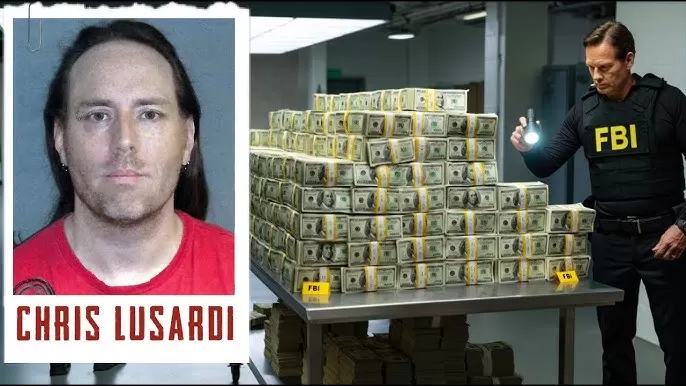
One of the entrants was a 42 year old man from Fayetteville, North Carolina named Christian Patrick Lusardi. He had no tournament results worth mentioning, no television appearances, no reputation. He was a nobody in the field of nearly five thousand nobodies, which was the entire point.
He also had roughly $3.6 million in fake chips.
The bootlegger's second business
To understand how a recreational player ended up with a suitcase full of counterfeit casino currency, you have to understand what Lusardi did for a living, which was not poker.
Between June 2010 and July 2012, according to federal prosecutors, Lusardi ran a counterfeit DVD operation spanning the United States and Canada. Discs arrived from China. He received, manufactured and sold. Over that window he took more than $1.3 million through a PayPal account. When agents eventually searched his Fayetteville home, they found more than 35,500 pirated DVDs alongside the equipment to make more.
So here is a man whose actual profession was importing counterfeit goods from Chinese manufacturers and applying fake branding to them. Look at that sentence again and the poker scheme stops looking like a flash of criminal inspiration. It looks like a guy applying his existing supply chain to a new product line.
Investigators say he ordered the chips online from a manufacturer in China, then affixed counterfeit Borgata logo stickers to them himself. Same playbook. Different sticker.
Day 2 chip leader
The tournament ran multiple starting flights, and when they merged, Lusardi emerged as the overall chip leader going into Day 2.
Nobody blinked. Poker media reported it because that is what poker media does. An unknown player crushing a 4,800 runner field is not suspicious, it is Tuesday. Big fields produce big stacks belonging to people nobody has heard of. That is the entire romance of the format.
What nobody could see from the outside was that roughly $800,000 in fake chips had been fed into the tournament across the first two days. The audit later put it at 160 counterfeit 5,000 denomination chips, introduced at various points rather than all at once. The method was less "chip dump" and more "top up as required," a man quietly refilling his own stack whenever the deck stopped cooperating.
Two things eventually gave it away, and both of them were mundane.
The first was arithmetic. There were more chips on the tables than the Borgata had put into play. Once the count comes back wrong, the game is over, it just takes a while for everyone to find out.
The second was human. Borgata poker room management later confirmed that two players had flagged suspicious chips during the event. Something about them looked wrong at the table, discolored or off in a way that a person handling towers of them for twelve hours can notice and a camera cannot. Those players said something to staff. That matters, and we will come back to it.
The flush heard around Atlantic City
Lusardi cashed the event for $6,814, then sensed the walls closing in.
What he did next has kept the poker world entertained for over a decade. He went back to his room at Harrah's, which is to say a completely different casino from the one whose tournament he had just compromised, and started flushing the evidence.
Ceramic and clay chips do not biodegrade. They do not dissolve. They are, in engineering terms, small dense discs specifically designed to survive being thrown, stacked, splashed and shuffled several million times. What they do in a hotel drain stack is exactly what you would expect: they go around one bend, meet each other, and stop.
The pipe backed up. Water found the ceiling below. Maintenance came. Chips came out. Harrah's called the Borgata, and the Borgata, one presumes, had the strangest phone call of its corporate life.
He also had a go at a public toilet in the Borgata's own men's room, where 22 more fake 5,000 chips were later recovered. Between the two sites, investigators eventually accounted for $3,605,000 in face value.
Colonel Rick Fuentes of the New Jersey State Police could not resist when the case closed, noting that when you gamble on a flush at high stakes, "you either win big or lose big." Acting Attorney General John Hoffman described the scheme as something that "played out like a Hollywood movie plot." Both men were right, though the movie in question is closer to Fargo than Ocean's Eleven.
Twenty-seven players in limbo
The Borgata suspended Event 1 on January 17. The New Jersey Division of Gaming Enforcement ordered it cancelled outright on January 18.
By then, 423 players had already busted in the money and been paid, with a minimum cash of $1,082. Twenty-seven players were still alive. They had survived three days and 4,785 opponents. Allard Broedelet sat on 10.315 million chips, more than ten percent of everything in play, with $372,123 in front of him and eight or nine hours of poker standing between him and the rest of his life.
He never got to play them.
Think about that from inside the tournament room. You have gone deep in the biggest field you will ever play. You have not slept properly in three days. You are two tables from a career score. Then someone tells you the event is suspended, then cancelled, then that your prize money is frozen indefinitely while the state of New Jersey works out what it owes you. No bad beat. No cooler. No hand at all.
State police arrested Lusardi on January 24 at yet another Atlantic City hotel. The initial charges included rigging a publicly exhibited contest, criminal attempt, and theft by deception.
The impossible math problem
Then came the genuinely hard part, and it is the part most retellings skip because plumbing is funnier than administrative law.
How do you unwind a tournament that was corrupted from Day 1?
Some players busted to Lusardi directly. Some busted to players Lusardi had donated chips to. Some busted on tables he had never sat at, but in a tournament where one stack is artificially enormous, every payout jump and every ICM decision downstream is contaminated. There is no clean line. There is no way to rewind the game state.
DGE Director David Rebuck issued the final order in April 2014, distributing $1,721,805. The 2,143 entrants who had not cashed got their entry fees back. Players who had already won prizes kept them, with a further $50,893 paid out to those whose prizes were unpaid at the moment play stopped. The final 27 split the remainder equally: $19,323 each.
Broedelet, sitting on a stack ten times the average with a shot at $372,123, received the same as the short stack praying to ladder one more spot. The Borgata, which was under no obligation to do so, also handed back $288,720 in entry fee revenue it had legitimately earned.
Six of the final 27 sued. Their argument was straightforward: an equal split ignored chip standing, and if the remaining money had simply been divided among them, each would have received more than $53,000. They wanted the difference, roughly $33,000 a head, and they accused the casino of failing to properly monitor the tournament and of being slow to act when players raised concerns about discolored chips.
They lost. A state investigation found the Borgata had run the tournament properly and was not at fault. The suit was dismissed, and on appeal the court held that the Director had acted reasonably in making sure every affected entrant got their money back, every prize winner kept their prize, and the last 27 shared what was left without any one of them being unfairly penalised. Legally sound. Emotionally, cold comfort to a man who was holding ten percent of the chips.
Eight months
Lusardi's punishment arrived in two parts, and the poker crime turned out to be the lesser one.
The federal DVD case went first. He pleaded guilty in September 2014, and on March 30, 2015 was sentenced to 60 months in prison, three years of supervised release, and restitution of $1,137,864.01. Sentencing had actually been delayed twice, in part because the Motion Picture Association needed more time to finish its victim impact statement. Hollywood, it turns out, moves slower than a clogged sewer line.
The New Jersey state case followed. Indicted in July 2015, guilty plea in August, and on October 22, 2015 a five year sentence for second-degree trademark counterfeiting with a concurrent three years for criminal mischief. He was ordered to pay the Borgata $463,540 for the lost tournament revenue and Harrah's $9,455 for the plumbing.
That second figure is the detail that never stops being funny. Somewhere in a New Jersey court file, there is a line item establishing the precise retail cost of flushing $2.7 million in fake poker chips: nine thousand four hundred and fifty-five dollars.
He was paroled on July 25, 2016, after roughly eight months in New Jersey state custody.
What actually changed
The Borgata did not wait for regulators to tell it what to do. Before the DGE had finished its review, the room had already moved to new tournament chips carrying security features detectable under ultraviolet light. The DGE opened a broader review of tournament standards across the state.
The deeper change was cultural. Tournament chips had always been treated as the cheap cousin of cash game chips, because they represent no real money and nobody imagined a player would spend thousands of dollars manufacturing them abroad on the hope of turning a $560 buy-in into $372,123. Lusardi proved the maths worked. Every major room in America had to sit with that.
And then there is the part worth repeating, because it is the only genuinely useful thing to come out of the whole mess. Borgata's poker room manager, Vincent Alonge, made a point afterwards of thanking the two players who noticed the chips looked wrong and told somebody. Not the cameras. Not the count. Two guys at a table who thought something felt off and were willing to sound stupid about it.
Loose chips
- He was on the watch list. One account holds that Borgata had been keeping an eye on Lusardi since 2010, after receiving a letter about possible cheating activity. Treat that one as poker folklore until better sourced, but it circulates for a reason.
- Nobody caught him playing. Lusardi was eventually spotted on security footage, but only after the fact. The surveillance never flagged it live. A leaking pipe in a competitor's hotel did the police work.
- The chips outlasted the DVDs. His pirating operation ran for two years and turned over $1.3 million. His poker scheme lasted three days and netted $6,814. Guess which one made him famous.
- Restitution outweighed the score by 69 to 1. He cashed for $6,814 and was ordered to pay the Borgata $463,540. That is before the seven-figure federal restitution.
The tournament was never replayed. The 27 never got their shot. Twelve years on, the Winter Poker Open runs every January, the chips glow under UV light, and somewhere in New Jersey there is a plumbing invoice that changed how American poker rooms think about the little clay discs they hand out for free.