
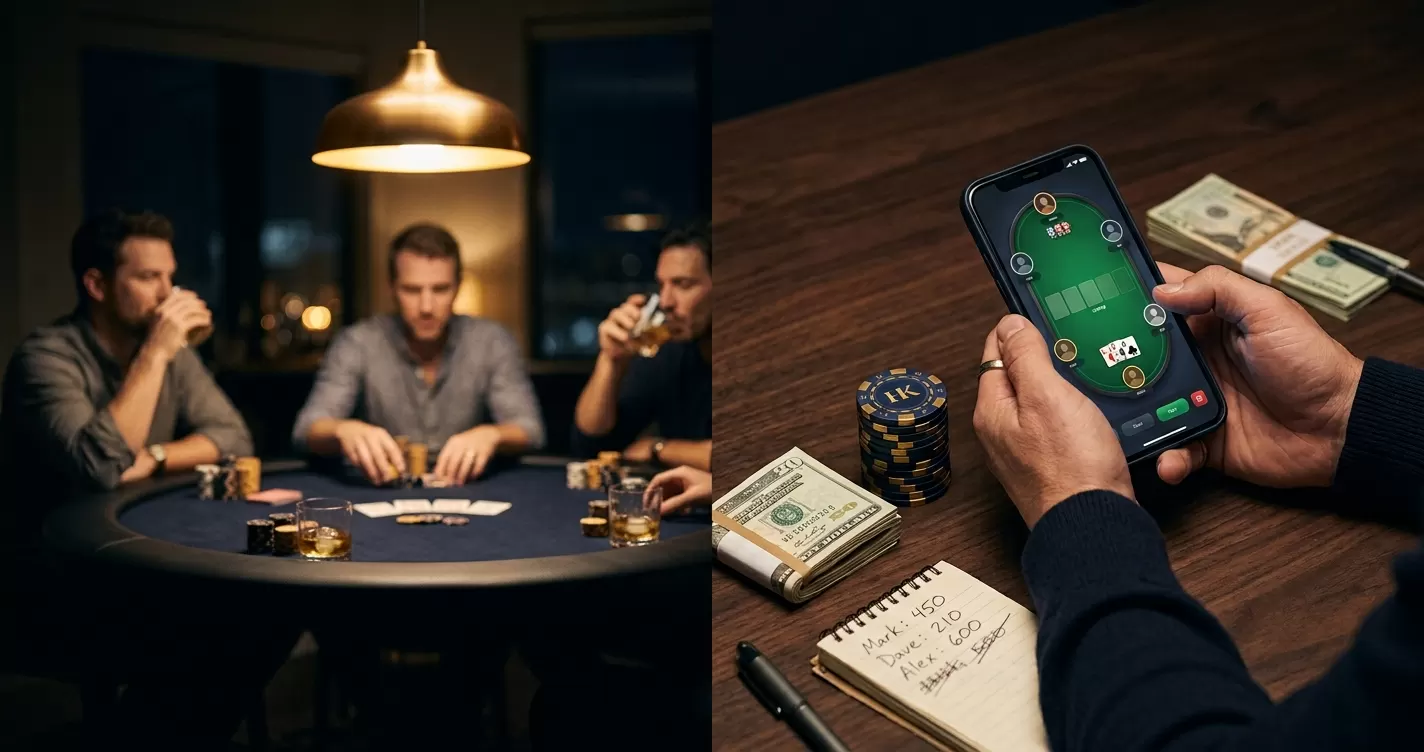
Somebody in your Telegram group has a seat for you. Private club, 1/2 with a straddle, "softest game you'll ever see," and all you have to do is send $200 to a person called Mike and download an app. Mike will put chips in your account. When you want to cash out, you ask Mike. If you have never done this before, that is the moment your brain says: wait, who is Mike, and why does the app say the chips are worth nothing?
Both are fair questions, and both have simple answers. Club poker is not a new hustle. It is the American home game, the one that has run in kitchens and basements for as long as anyone can remember, moved onto a phone so it can run every night and seat players from three time zones. Mike is the host. The app is the table and the deck. Once you understand how the money moves between the two, the whole thing stops looking mysterious and starts looking like what it is: a game that runs on trust, which is exactly why you should pick your host carefully. The clubs on our club directory are the ones we play in ourselves, and every one of them is covered by our Funds Guarantee. This guide explains what that guarantee is protecting you from.
The home game that moved onto your phone
A bit of history helps, because it explains why agents exist at all. On 15 April 2011, a day American players still call Black Friday, the US Department of Justice seized the domains of PokerStars, Full Tilt Poker and Absolute Poker, and American players lost their regular online game overnight. Full Tilt alone owed around $150 million to US players at the time (PokerNews, 15 April 2026). State-regulated poker came back slowly and only in a handful of states: Nevada and Delaware in 2013, then New Jersey, Pennsylvania, West Virginia and Michigan over the following decade, according to the same PokerNews piece. If you live in the other forty-four, the legal online game never came back.





Americans did what Americans have always done when the casino is too far away: they ran their own game. The club apps simply gave that game better software. PPPoker launched on 11 April 2016 and was one of the first apps built around private clubs (Cardplayer Lifestyle). PokerBROS followed and now carries a 4.5-star rating from about 6,900 reviews on the US App Store (Apple App Store, fetched 16 September 2026). ClubGG is built by NSUS Limited, the same company behind GGPoker. These are mainstream products with real support teams, and the clubs running on them are where a large part of American recreational poker now happens.
Why the app says the chips are worth nothing
Here is the sentence that confuses every first-timer. The PokerBROS App Store listing says: "Chips have no monetary value and are non-redeemable." ClubGG's site says its references to pots and betting "do not involve gambling for real money" (clubgg.com). Read those as statements about the app, not about your club. The app companies sell software. They do not hold your money, they do not sell you chips for cash, and they do not pay out. That is what lets them sit in the App Store next to Candy Crush.
The money side lives one level down, with the people who run each club. They decide that in their club a chip is worth one dollar, they take your deposit, they credit your chips, and they pay your cashout. Think of the app as the table and cards, and the club as the guy who owns the table and keeps the cash box. The app is not being shifty when it says chips are worthless. It is telling you, accurately, that your real relationship is with the club.
Five words you will hear in your first hour
Where your money actually goes
Chips and cash travel on two separate roads. Chips are created inside the app by the club and pushed to your account by your agent. Cash never enters the app at all. It goes from you to the agent, and later from the agent back to you. The two roads meet in exactly one place, and that place is a person.
Upswing Poker's guide to PokerBROS puts the money side plainly: the app has no cashier, so "the 'owner' behind each club at PokerBROS can facilitate deposits and cashouts," and "agents get a cut of the rake produced by each player they recruit into a club" (Upswing Poker, updated 22 August 2025). That second point matters more than it sounds. A good agent earns a little every time you play a hand, for as long as you keep playing. Their business only works if you come back next week. Most agents understand this perfectly, which is why most cashouts in this world arrive without drama.
A deposit, step by step
You message your agent, tell them how much, and they tell you where to send it. In the US that is usually a peer-to-peer payment app such as Venmo, Zelle, Cash App or PayPal, the same apps people use to split a bar tab. Outside the US it is usually crypto, most often USDT or Bitcoin. You send $200. Within a few minutes the agent credits 200 chips to your player ID (at a one-to-one rate) from a pool the club has allocated to them. You open the app, the chips are there, you sit down.
Two things to confirm before the first deposit. The rate, meaning what one chip is worth, because it can differ between clubs. And any fee or minimum. Neither is a red flag by itself; a club that runs on crypto may pass on network fees, and many clubs have a $50 or $100 minimum to keep the games funded. What you want is to hear the numbers before you send money, not after. A good agent volunteers them.
A withdrawal, step by step, and what "Monday" means
You message the agent with an amount and where to send it. They confirm, remove the chips from your account, and send the money. In a well-run club that is the whole story, and it usually takes a few hours. The one wrinkle is settlement. Clubs in a union pool their tables, which means Club A's players win and lose against Club B's players all week. At the end of the cycle the clubs square up, and agents square up with their clubs. A cashout requested on a Wednesday might wait for that cycle if the agent's float is low. When your agent says "settlement is Monday," they are usually telling the truth, and it is one reason our clubs list their payout windows up front.
The version to watch for is the second Monday. One honest delay is normal. A pattern of new reasons each week, especially combined with a suggestion that you keep playing while you wait, means the agent is paying old cashouts with new deposits. That has a name, a Ponzi scheme: a business that only works while more money comes in than goes out. It is rare in established clubs, and every case that has made the news shares the same shape.
When it has gone wrong, and why a directory exists
We are not going to pretend the scene has no history. In late 2018, a New York tournament player known as "NYPokerKing" promoted a PPPoker club whose withdrawals slowed and then stopped; by early January 2019, forum posters had documented around $84,000 owed to players (Flushdraw, 6 January 2019). Later that year four PPPoker clubs refused to pay a combined $60,000 to a group of players after the app flagged them as possible bots, while other clubs that received the same warning paid out normally (Professional Rakeback). And in May 2024, four men in Indiana were charged over a club on Pokerrrr2 that had moved about $1.9 million through Venmo, PayPal, Cash App and Zelle between 2020 and 2023 (Poker.org, 9 June 2024). That last one is worth a second look, because it is also proof of demand: a club in one Midwestern state ran nearly two million dollars through it in three years.
Notice what the bad cases have in common. Each was a club that players found through a promoter, a streamer or a friend of a friend, with nobody independent watching the payouts. Poker podcaster Joey Ingram told Upswing exactly that about his own loss: "I put my faith in an agent who was recommended by someone else." A referral from someone being paid to refer you is an advertisement. That gap is what a vetted directory fills. Before a club goes on our list we join it, play in it, test the cashouts and check the union, and if a listed club ever withholds a settled balance our Funds Guarantee kicks in. None of the clubs in the stories above would have made it onto the list.
A quick word about credit
Some clubs let regulars play on credit, meaning the agent fronts chips and collects later. It feels friendly, and in a tight group it often is. The risk is not your credit, it is everyone else's. As Upswing's guide notes, "if you win money from opponents playing on credit, those players could choose not to settle up with the agent." A club that fronts a lot of chips has more chips in play than cash behind them. Ask whether your club does it. The answer will tell you a lot about how the book is run.
How to read an agent in one conversation
You do not need to investigate anyone. Good agents look alike, because they are all solving the same logistics problem, and they tend to give themselves away in the first ten messages.
They give you the rate, the minimum, any fee and the payout window before you ask.
A small test cashout on day one gets a "sure," not a speech.
Their club ID and union are public and match what other members say.
They tell you whether the club runs credit without being asked twice.
Same payment details every week.
Deposit bonuses that grow every time you mention leaving.
Cashouts marked "processed" (chips gone) with the money still "coming."
A new payment address each week, or a request to pay a third person.
Pressure to keep playing while a withdrawal is pending.
Winners suddenly "under review." Losers never are.
Your first week in a new club
This is the routine we use ourselves before a club goes on the directory, and it works just as well for a player. It costs nothing in a good club and saves everything in a bad one.
Rake, rakeback and the small print
Because your agent is paid out of your rake, it helps to know roughly what that rake is. PokerListings' review puts standard PokerBROS pot rake at 3 to 5 percent depending on the game, notes that club owners can add their own charges, and warns that advertised rakeback can be "whittled down by clubs charging tax percentages, withdrawal fees, and similar impositions" (PokerListings, updated 25 July 2026). Numbers vary by club, so run this sum with your own club's settings.
Take a 1/2 game with 5 percent rake capped at 3 big blinds, which is 6 chips. A 60-chip pot pays 5 percent of 60, which is 3 chips. A 200-chip pot would owe 10 but stops at the 6-chip cap. Say you play 4,000 hands a month, see a flop in a quarter of them (1,000 hands), and the average raked pot costs you 4 chips. That is 1,000 multiplied by 4, or 4,000 chips of rake a month. With 30 percent rakeback you get 0.30 multiplied by 4,000, which is 1,200 chips back, or $1,200 at a dollar a chip. Now imagine a "withdrawal fee" of 3 percent on a $2,000 cashout: 0.03 multiplied by 2,000 is $60. Not a disaster, but it is the kind of number you want to know before you deposit, not discover on the way out. Our club pages list rake, cap and rakeback for exactly this reason.
So, who is Mike?
Mike is the host of a home game that happens to live on your phone. The app gives him a table, a deck and a way to seat players from anywhere; he provides the cash box and the trust. That arrangement has quietly become one of the biggest poker scenes in America, and most of the people running it are exactly what they appear to be: poker people who found a way to keep the game going. The only real question is whether your Mike is one of them, and you do not have to guess. Start with a club someone has already tested, deposit small, cash out early, and keep your receipts. After that, enjoy the softest 1/2 you have played in years.
Every club on Global Poker Sites has been joined, played and cashed out by us before it was listed, on ClubGG, PokerBROS and PPPoker. Rate, rake, union and payout window are on each page, and your settled balance is covered by our Funds Guarantee.
Browse verified poker clubsSources: PokerNews on Black Friday; Cardplayer Lifestyle; PokerBROS on the Apple App Store; ClubGG; Upswing Poker; PokerListings; Flushdraw; Professional Rakeback; Poker.org; GPS Funds Guarantee. 18+. Check the law where you live and never deposit money you cannot afford to lose.