Berlin, 25 August 1942
"Casinos are marvelous institutions, and we must say to everyone with too much money: Come on, you people, come and gamble!"
Adolf Hitler, dinner-table remarks, as the Sixth Army closed on Stalingrad
The man had a point, from his side of the table. The Reich needed money and the Reich had reopened the casinos to get it. What he did not mention was that the most interesting card games in Europe that year were being played by people he had locked up.
1933
Baden-Baden reopens after 61 years dark
1942
A Cambridge student starts taking notes in Stalag VII-A
1945
A tarock deck is drawn in pastel at Dachau
This is a story about cards under the swastika. It runs from the roulette wheels of Baden-Baden to the barracks of Bavaria, from a Cambridge economics student who turned a prison camp into a textbook, to a Slovene architect drawing tarot cards in the last weeks of Dachau. Poker is in here, and so is bridge, and Skat, and a great deal of cigarettes. It is not a story with a moral. It is a story about what people do with a deck of cards when everything else has been taken away.
The House Reopens
Germany had banned its casinos in 1872, the year after unification, on the grounds that an empire should not run on roulette. For sixty-one years the great spa towns sat with their gaming rooms shuttered while the money went to Monte Carlo instead. Then the Nazis came in, looked at the balance sheet, and changed their minds.
Baden-Baden reopened in 1933. Photographs from that year, reproduced in Robert Jarvis's Gambling Under the Swastika, show workmen unpacking a brand new roulette wheel four days before the grand opening, and the "counting room" the morning after, with a fresh delivery of cash from the Deutsche Bank sitting on the table. The regime that had spent a decade railing against decadence and Jewish finance now had a house edge of its own, and it liked it. More casinos followed through the thirties, and the Reich Lottery, promoted on Berlin street corners by so-called "lucky women" with fistfuls of tickets, funnelled money into the Winter Relief charity that was in practice a Nazi Party welfare arm.
This was the official gambling of the Third Reich: state-run, taxed, respectable. The unofficial kind was Skat, the three-handed trick-taking game that had been the German national card game since the 1820s and was played in every barracks, every U-boat mess and every dugout on the Eastern Front. Wehrmacht-issue decks survive by the thousand in collectors' drawers. Poker, an American vice, barely appears in the German record at all. It arrived in Germany the same way the Americans did: in bomber crews, through the sky, and into the camps.
The Cigarette Standard
Richard Radford was a Cambridge economics undergraduate when he was captured in Libya in 1942. He spent the rest of the war as a prisoner, ending up in Stalag VII-A at Moosburg in Bavaria, one of the largest POW camps in Germany. He did what any economics student would do in the circumstances. He took notes.
The paper he published in the journal Economica in November 1945, "The Economic Organisation of a P.O.W. Camp," is still on university reading lists eighty years later, and it is the best account we have of how a camp actually ran. The answer is: on cigarettes.
Stalag VII-A price board · quoted in cigarettes
50
cigarettes per man per week from the Red Cross in a good week. 25 in a bad one.
1 tin
of jam bought a pound of margarine "plus something else."
30 v 25
hand-rolled cigarettes per ounce of pipe tobacco versus the official rate. Gresham's law followed.
~40
cigarettes for a loaf of bread by February 1945. Chocolate had risen from 15.
Source: R. A. Radford, Economica, November 1945
Within "a week or two" of prisoners arriving, Radford wrote, "rough scales of exchange values came into existence." Red Cross parcels arrived with a standard mix of tinned meat, jam, margarine, chocolate, biscuits and tobacco, and men who wanted more jam and less bully beef started trading. The cigarette, being "homogeneous, reasonably durable, and of convenient size," became the currency. Prices were quoted in cigarettes. Debts were settled in cigarettes. And when the weekly Red Cross ration arrived, the whole camp went through a burst of inflation as the money supply jumped overnight.
"One man capitalised his knowledge of Urdu by buying meat from the Sikhs and selling butter and jam in return." Another, a padre, "started off round the camp with a tin of cheese and five cigarettes and returned to his bed with a complete parcel."
R. A. Radford, 1945
The camp's Sikh prisoners, who would not eat beef, were initially willing to swap tinned meat for almost anything, until they worked out their position and "began to insist on jam and margarine." A market in futures developed: bread was issued on set days, so a loaf on Tuesday cost more than a loaf on Monday, and men sold bread they did not yet have. A camp shop and later a restaurant appeared, run on a paper currency called the Bully Mark that was "backed 100 per cent. by food." For a while the Bully Mark "showed signs of replacing the cigarette as currency." Then the parcels stopped coming, food got scarce, and it collapsed to four-fifths of a cigarette. Holders were paid out, Radford records, "in cups of coffee or in prunes."
The cigarette currency had its own problems, and they were the problems of every currency. Men began hand-rolling cigarettes from pipe tobacco, getting thirty thin ones out of an ounce where the official rate was twenty-five. Bad money drove out good, exactly as the economists said it would. "The real cigarette virtually disappeared from the market," Radford wrote, and "each cigarette was examined before it was accepted and thin ones were rejected." He had watched Gresham's law happen in a hut in Bavaria.
Where was the poker in all this? Radford, being an economist, was more interested in prices than in players, and he does not describe the games. But he did not need to. A camp with a unit of account, a stable store of value, a rationed money supply and thousands of bored men is a poker economy by definition. Every tin traded was a bankroll. Every futures trade on Tuesday's bread was a side bet. The men who did well in Radford's camp were the ones who understood that a cigarette was worth what the next man would pay for it, and nothing else, which is the only thing a poker player really needs to understand.
Foodacco and the Two Per Cent Rake
Stalag Luft III at Sagan, the camp of the Great Escape, was run for airmen, and airmen were officers, and officers organised. The American Ex-Prisoners of War Association's records of the camp note, in the same flat tone one might use for the weather, that "cigarettes serve as the medium of exchange." Then they describe something unusual.
The camp had an institution called Foodacco, "whose chief function was to provide POWs with a means of exchange and a stable barter market where, for example, cocoa could be swapped for cigars." Foodacco charged a commission on every transaction, and the profits went to a communal camp fund. The commission was two per cent. Sagan had, in other words, built itself a raked exchange, and it was raking at a lower rate than most poker rooms today.
Foodacco, Stalag Luft III
2%
commission on every barter, paid into the camp fund
Typical online club, 2026
5%
of the pot, capped, before the agent's cut
The official recreation list for the camp reads like a country club with barbed wire: "bridge tournaments, building of model planes, visits to occasional movies, listening to phonograph recordings," a camp radio station called KRGY broadcasting music and news over a loudspeaker. Bridge was the respectable game and it got the tournaments. Poker was played in the huts, for cigarettes, and left no records, because nobody at the time thought there was anything to record.
Further south, in Stalag XVII-B at Krems in Austria, a camp of about 4,200 American non-commissioned officers, two prisoners named Donald Bevan and Edmund Trzcinski were paying rather closer attention. After the war they turned what they saw into a play, and the play became Billy Wilder's Stalag 17 in 1953. Its central character, Sefton, runs a distillery, organises mouse races, rents out a telescope pointed at the women's compound, and will take a bet on anything up to and including whether the next escape attempt will succeed. The film is a comedy and Sefton is a type. But Trzcinski said the character was loosely based on an actual airman in his barracks, and the trade Sefton runs, cigarettes and chocolate bribed to German guards in exchange for eggs and whiskey, is exactly the trade Radford was documenting three hundred miles away.
Side story
The money that wasn't
Germany paid its prisoners for forced labour in Lagergeld, camp scrip issued in seven denominations from one Reichspfennig to ten Reichsmarks. The notes were valid only inside the wire, and only at the camp canteen. The canteens, in the words of the US Holocaust Memorial Museum's catalogue note on the surviving notes, "were poorly stocked, which rendered the notes essentially worthless."
So the prisoners found a use for them. The same catalogue records that the men "used the notes for gambling among themselves to combat boredom." Worthless paper, freely printed by the house, staked on cards by people who had nothing else. It was play money in the most literal sense, and it circulated for five years until Germany discontinued it in 1944.
The Deck That Was a Map
The decks the prisoners were playing with had, in some cases, been sent by their own governments with rather more than fifty-two cards in mind.
Soak. Peel. Fifty-two pieces of Germany.
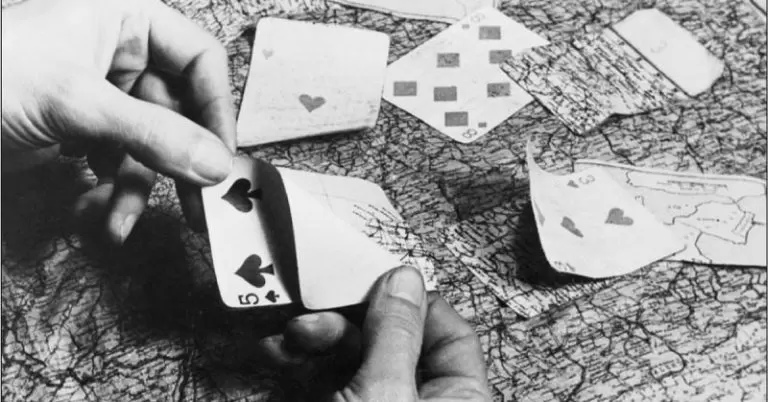
Under the Geneva Conventions, prisoners were entitled to receive parcels, and parcels could contain games. The American Office of Strategic Services and the British Special Operations Executive noticed this at roughly the same time. In the United States, the OSS went to the United States Playing Card Company in Cincinnati, the makers of Bicycle cards, and asked for a special run. The result looked like an ordinary Bicycle deck. Soaked in water, each card could be peeled apart into layers, and between the layers was a section of a map. Fifty-two sections, laid out in order, gave an escape route out of Germany, with other cards carrying notes on what to avoid and which landmarks to look for.
The decks went out in parcels through front organisations, and the National Park Service's account of the programme notes that "a crooked cellophane seal on the box indicated that there was more than met the eye." How many were made, how many reached camps, and how many men walked out of Germany on the strength of a wet ace of spades is unknown. The programme stayed classified for decades. Two complete decks are known to survive, both at the International Spy Museum in Washington. Everything else was, presumably, used.
The British had got there first, and had done it with Monopoly. In 1939 MI9 hired an eccentric former journalist named Christopher Clayton Hutton to invent escape aids, and Hutton went to John Waddington Ltd of Leeds, who printed both Monopoly and, conveniently, silk maps. Silk was the material of choice because it "wouldn't tear or dissolve in water as easily as paper and was light enough to crumple up into a small space." Waddingtons hid the maps inside the board, added a playing token containing a compass, tucked a two-part metal file into the box, and buried real German, Italian and French banknotes in the piles of Monopoly money.
How the escape committee read a Waddingtons board
Marylebone Station
Italy
Mayfair
Norway, Sweden, Germany
Free Parking
Northern France, Germany
A full stop after the square name, made to look like a printing flaw, told the camp which silk map was inside the board.
The sets went out through fake charities, and the escape committees in the camps knew to look for the dots. The often-repeated claim that a third of all Allied escapers used a Waddingtons set is a guess that has hardened into a statistic through repetition; nobody counted. But the boards existed, the dots existed, and the story stayed officially secret until 2007.
Cards for the Enemy
Playing cards ran the other way too, as weapons.
In besieged Leningrad in the winter of 1941 to 1942, with the city starving and the printing works barely functioning, an artist named Vasily Vlasov drew a deck of caricatures of the Nazi leadership. Hitler, Göring, Goebbels and Himmler as kings and jacks, with the suits reworked as allegories of what fascism brought: famine, violence, death. The lithography stones had to be heated with blowtorches to get the ink to take, and the presses were cranked by hand. Seven hundred copies were printed. Soviet partisans distributed them behind German lines.
The intended audience was the Wehrmacht, and the Wehrmacht played with them. Card games with anti-Hitler decks were, naturally, banned, and Landsers played anyway, in secret, because a deck is a deck and the front was boring and cold. Soviet troops advancing westward kept finding Vlasov's decks in abandoned German dugouts.
The joker, Kharkevich deck, 1943
"Though I may not be noticed at the beginning of the deck, at the end of the game I am the one who decides the fate of the game."
That second deck, designed by Ivan Kharkevich with input from German prisoners of war, was never printed at all. Its joker was an ordinary soldier, and the line above is written in trench slang, aimed at the men who would have understood it. It sat in an archive until 2004.
The Decks Nobody Was Supposed to Make
The POW camps were, for all their misery, governed by conventions and inspected by the Red Cross. The concentration camps were not. And yet even there, people made cards.
At Camp Vught in the occupied Netherlands, the only SS concentration camp outside Germany and Austria, Jewish prisoners produced a hand-drawn deck in which the face cards were the camp's SS authority figures, drawn, with a private joke that must have taken some nerve, in British army uniforms. The aces showed camp buildings. The jokers showed the prisoners themselves, the number 13 pinned to their chests, standing in dust and barbed wire. Vught held around nine thousand Jewish inmates at its peak in May 1943 and operated for about twenty months. The deck survived the camp, and the camp is now a national memorial.
Then there is Boris Kobe. Kobe was a Slovene architect, designer and artist, born in 1905, who was deported to Allach, a sub-camp of Dachau. In 1945, in the last weeks before liberation, he drew a full Austrian-style tarock deck of fifty-four cards, each about nine centimetres by six, in ink and coloured pastel, "the only art materials that were found at the camp."
Kobe's twenty-two trumps, Allach, 1945
I to XI
Camp life: hygiene, feeding, roll call. Bleak humour.
XII to XIX
What the guards did to the prisoners.
XX to XXII
Death.
The cards "were not meant to be played with, but to depict the power games between life and death." Kobe deliberately drew the ten of spades and ten of clubs as aces, a mistake no card maker would make by accident, so that nobody could ever mistake the deck for a game. The central idea, in the words of the curators who first exhibited it in 2000, was "a man being reduced to a number."
And in Theresienstadt, the "model ghetto" the Nazis showed to the Red Cross, a Viennese Jewish engineer named Oswald Pöck drew a Monopoly board in 1943. The squares were the ghetto's own streets and buildings; the currency was the ghetto's own worthless scrip. It was a board game about being trapped, made by a man who was. Pöck was deported to Auschwitz in 1944 and did not survive. The board did, and is at Yad Vashem.
The Last Hand
By February 1945 the Red Cross parcels had stopped reaching Radford's camp, and the economy he had spent three years documenting fell apart in a matter of weeks. "Food, itself scarce, was almost given away in order to meet the non-monetary demand for cigarettes," he wrote. A loaf of bread went to a German guard for a bar of chocolate, which tells you what the guards were eating. Price controls were tried and failed; "public opinion turned against the recommended scale and authority gave up the struggle." By April, "chaos had replaced order in the economic sphere; sales were difficult, prices lacked stability."
Then the American army arrived, and with it, in Radford's phrase, "an age of plenty." The cigarette economy ended the way all bubbles end: the outside world showed up with real money, and the whole elaborate structure of bread futures and Bully Marks and thin cigarettes rejected at the counter simply stopped mattering, overnight, to everyone.
Radford
Finished his degree at Cambridge. Thirty-three years at the IMF.
Kobe
Went home to Ljubljana and designed buildings until 1981.
The Bicycle decks
Two survive, in a museum in Washington. Nobody has ever soaked them.
Somewhere in a Leningrad archive is a joker who decides the fate of the game. And in a card room in Baden-Baden, the wheel the workmen unpacked in 1933 kept spinning right through the war, the way Hitler wanted it to, taking money from people who had too much.
The people who had none played for cigarettes. Some of them, by every account, played very well.