

Open the US App Store listing for PokerBROS and you get a 217 MB download, an 18+ rating for "Simulated Gambling", and one sentence doing more legal lifting than most paralegals manage in a career: "Chips have no monetary value and are non-redeemable. Using this app for real money is a strict violation of our terms and conditions." Then you join a club, message an agent, send $200 over Zelle at 1:40am, and 200 chips appear in your account before the confirmation email does. Both of those things are true at the same time. The gap between them is the whole legal story, and it is a more interesting story than either the "it's all illegal" crowd or the "it's just a game, bro" crowd would have you believe.
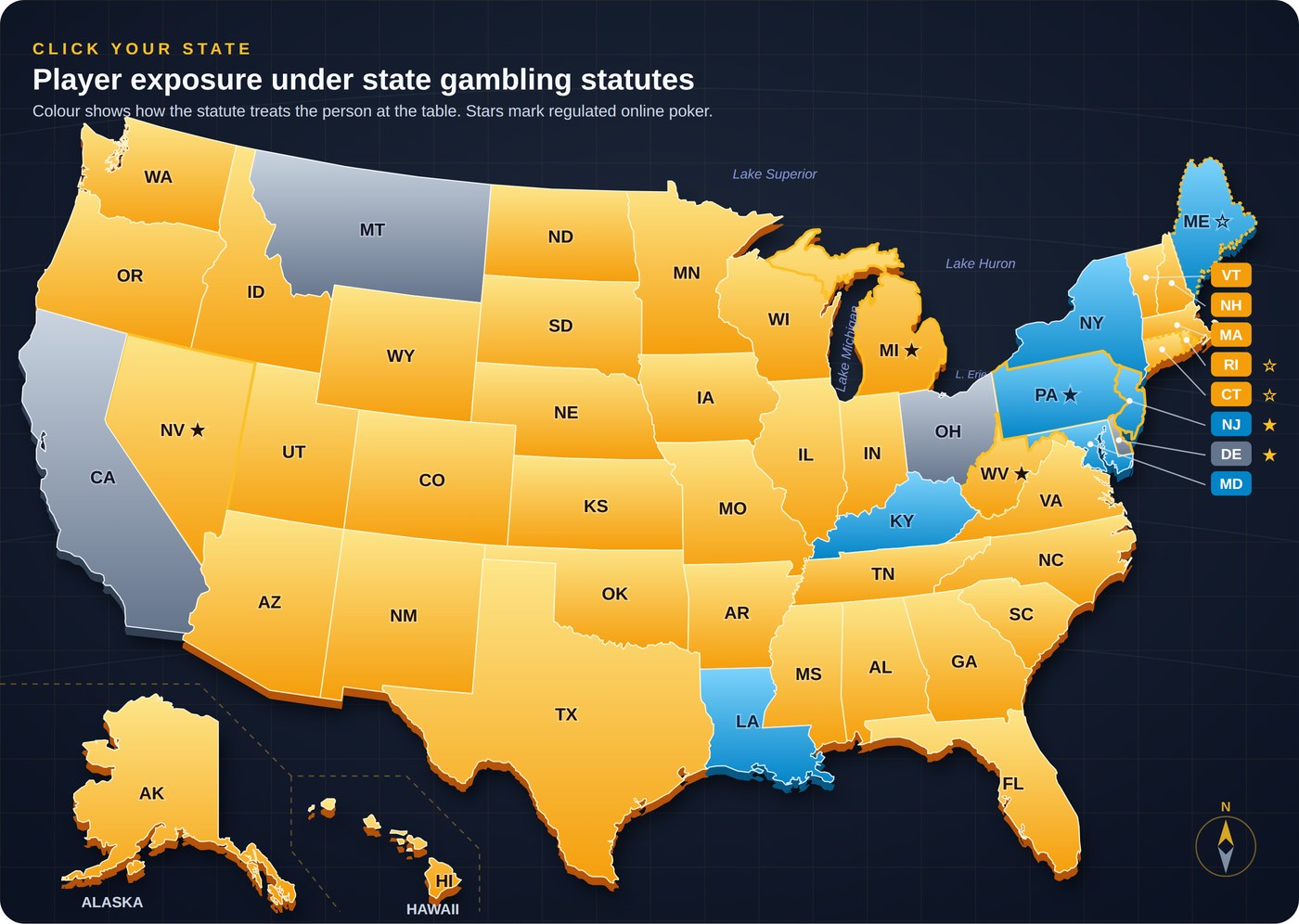
Most answers to "is PokerBros legal" are either a shrug or a scare. This piece walks through what the app actually is, how the money moves, which federal and state laws touch the play-chip model, who those laws were written to catch, and where a US player stands in practice. It is written by people who play in these clubs, not lawyers, so treat it as a detailed map rather than legal advice. If you want the practical mechanics of clubs and agents first, our guide to poker app agents, deposits and cashouts covers that end; this one is about the law. If you only want your own state, click it on the map or in the list below: every state has its own entry with the statute linked, the penalty named and a direct answer in the first line.
One question that is really three
"Is PokerBros legal" bundles three questions with three different answers, which is why every forum thread on the subject ends with two people shouting past each other and a third asking about rakeback. Is the software legal? Is the agent who converts your dollars into chips legal? Are you, the person sitting down at a $1/$2 table with a beer, doing anything illegal? Answer one and people assume you have answered all three. You have not.
The software question is the easy one. PokerBros is distributed by Apple and Google in the United States as a social poker game with in-app purchases, sitting on the shelf next to the free-chip Hold'em apps your uncle plays on the toilet. The Google Play listing shows more than 500,000 downloads and a developer reply to reviewers that the app "is strictly a play-money app". You can install it in all fifty states without anyone caring. The other two questions depend entirely on what happens outside the app, so that is where we need to go.
Where the money actually moves
Inside PokerBros, the only thing you can buy from the developer, Thinklean Limited, is diamonds. The App Store lists packs from 60 diamonds at $0.99 up to 6,468 diamonds at $99.99, which works out to roughly 1.5 cents per diamond at the top end (99.99 divided by 6,468 is 0.0155, for those checking). Diamonds pay for club features and cosmetics. Chips, the thing you actually play with, are issued by the club owner from the club's own balance. The developer's position, spelled out in the same listing, is that "there is no money deposits and withdrawals". Its terms and conditions, effective April 2025, go further still: any in-app reference to "cashier", "earnings" or "fees" is "solely for instructional or illustrative purposes", and a club icon or avatar that "implicates the use of real money" can be deleted without refund. The developer would very much like you to know it has never seen a dollar.
The bit that turns a social game into the most active cash-game ecosystem available to American players is the agent. An agent is a person, usually reachable on Telegram or WhatsApp at hours that suggest they do not sleep, who takes your dollars or crypto, credits chips to your club account, and pays you out when you leave. Clubs join unions so their players can share tables and their owners can share liquidity, and unions settle up between clubs on a weekly cycle, the same way a home-game host squares up with the guy who staked half the table. None of that touches the app's payment rails. The app never sees your Zelle. It sees chips moving between accounts, which is exactly what a play-money game is supposed to see.
Developer sells diamonds ($0.99 to $99.99). Club owners issue chips. Chips are labelled non-redeemable. This is the layer Apple and Google approve, and the only layer the developer will discuss.
You pay the agent in dollars or crypto. The agent credits chips. Unions settle weekly. This is the layer every gambling statute is actually written about, and the layer that decides whether you get paid.
The disclaimer describes the first layer accurately. The law looks at the agreement between you and your agent, and that agreement lives entirely in the second.
Hold that two-layer picture. Every statute, case and state rule below is really a question about which layer someone is looking at.
Why American poker ended up here
None of this is a new arrangement. The private game predates the casino card room by a long way, and the club app is the home game with a hand history, a rake button and a host who answers messages faster than your last landlord. When the big sites left in 2011, the games did not stop. They moved back to kitchens and basements, then to Facebook groups and group chats, then to apps built specifically for that audience. GlobalPokerSites' own PokerBros review dates the app to 2019, and the Google Play counter has since passed half a million installs, because Americans in more than forty states had no licensed online poker room to play in and a strong, well-documented preference for playing anyway.
The play-chip structure is the compromise that made that possible at scale. The developer keeps a clean, app-store-compliant product and stays out of the money entirely. Clubs and agents take on the part of the business that gambling law regulates, and they do it the way American home games have always done it: a known host, a chip rate, a settlement day, and a reputation that either holds up or does not. Understand that split and the legality question stops being about software and starts being about people, which is where it should have been all along.
The federal statutes and who they were built to catch
American poker players have a folk memory of federal law dated 15 April 2011, when the Department of Justice unsealed indictments against the founders of PokerStars, Full Tilt Poker and Absolute Poker. The press release from that day lists the charges: violating the Unlawful Internet Gambling Enforcement Act, operating an illegal gambling business, bank and wire fraud conspiracy, and money laundering. Notice who was named. Founders and payment processors. Not one of the players who had money on those sites was charged, and plenty of them had a lot of money on those sites. That pattern is not prosecutorial kindness; it is written into the statutes themselves.
Start with UIGEA, the 2006 law everyone cites and almost nobody has read, which is fair, because it arrived as Title VIII of a port-security bill signed on 13 October 2006, which is not where most people go looking for poker law. Its operative section, 31 U.S.C. § 5363, opens with the words "No person engaged in the business of betting or wagering may knowingly accept" and then lists credit cards, electronic fund transfers, cheques and other bank-routed payments. It is a payments law aimed at operators. It also does not decide what gambling is unlawful; it borrows that answer. The definitions in § 5362 say "unlawful Internet gambling" means a bet or wager placed over the internet "where such bet or wager is unlawful under any applicable Federal or State law". So the big federal law points you straight back to your state legislature, which is where the actual answer lives.
The same section defines a bet or wager as "the staking or risking by any person of something of value upon the outcome of a contest of others, a sporting event, or a game subject to chance", and it carves out games "in which participants do not stake or risk anything of value other than personal efforts". That carve-out is the legal foundation of every free-chip poker app on earth. Whether a PokerBros club hand falls inside it depends entirely on whether your chips are "something of value", and the answer to that changes the moment an agent has promised, in a Telegram message you both still have, to buy them back at a dollar each.
The second statute is the Illegal Gambling Business Act, 18 U.S.C. § 1955, the workhorse used against Black Friday and, more recently, against the Los Angeles home-game operation that produced federal charges against former NBA player Gilbert Arenas in July 2025 (Arenas, for the non-basketball readers, is a former NBA guard who, according to the indictment summary, hosted high-stakes Pot Limit Omaha with dealers, chefs and valets in an Encino mansion). The statute bites anyone who "conducts, finances, manages, supervises, directs, or owns all or part of an illegal gambling business", with up to five years in prison, provided the business breaks state law, involves five or more people running it, and either runs for more than thirty days or grosses $2,000 in a single day. A union with owners, agents and sub-agents clears the five-person and thirty-day tests before breakfast. Read the verb list again, though: conducts, finances, manages, supervises, directs, owns. "Plays" is not in it.
The third is the Wire Act of 1961, a law written for bookmakers with rotary phones, which the Justice Department tried to stretch over all online gambling in a 2018 opinion. The First Circuit rejected that in New Hampshire Lottery Commission v. Rosen on 20 January 2021, holding that "the Wire Act's prohibitions are limited to bets or wagers on sporting events or contests". For a poker player, that statute is now a sports-betting matter, and you can stop worrying about it unless your club also runs a parlay card.
Federal exposure, in short, sits with the people taking the money and running the game, and it only exists at all if a state law has been broken first. Which brings us to the question the disclaimer is supposed to settle and does not.
What "no monetary value" is worth in court
The most important case for anyone in club poker was not about poker and did not involve anyone who could tell you what a c-bet is. In 2015 a Washington resident named Cheryl Kater, who had bought and then lost "over $1,000 worth of chips" since 2013, sued Churchill Downs over Big Fish Casino, a social slots app whose chips "cannot be exchanged for cash or any other tangible value", according to its own terms. The district court dismissed the case with prejudice, agreeing that the chips were not a thing of value. On 28 March 2018 the Ninth Circuit reversed it in Kater v. Churchill Downs, holding that the virtual chips were a "thing of value" under Washington's gambling statute because, once a player runs out, she "must buy more chips to have the privilege of playing the game". The chips did not need to be cashable. Extending the privilege of playing was enough.
One detail in that opinion should make every club regular sit up. The panel noted that although Big Fish's terms banned cashing out, the app "does contain a mechanism for transferring chips between users, which can be utilized to 'cash out' winnings". A player-to-player chip transfer, in other words, was treated by a federal appeals court as a cash-out route, disclaimer or no disclaimer. Club apps are built around chip transfers between accounts. That is not a gotcha aimed at PokerBros; it is simply how a court read a very similar feature.
In August 2020 a federal judge in Seattle approved a $155 million settlement, split $124 million from Churchill Downs and $31 million from Aristocrat, plus changes to the games themselves. The Washington State Gambling Commission now says publicly that games "that ask the player to wager virtual currency for the potential of winning more virtual currency are likely to constitute illegal gambling" under state law. Washington, to be clear, is the outlier here, but it is an outlier with a published appellate opinion, which is more than most states can say about anything to do with online poker.
Read all of that alongside the PokerBros disclaimer and its real function comes into focus. "Chips have no monetary value" describes the developer's relationship with you. Thinklean does not sell chips for cash, does not buy them back, and forbids anyone else from doing so in its terms. That is a sensible position for a software company that wants to stay on two app stores and out of federal court. It says nothing about the relationship between you and an agent who has agreed to pay you $1 per chip. Under UIGEA's definition and Washington's, the "agreement or understanding that the person will receive something of value" is what makes a bet a bet, and that agreement exists off-app whether the app likes it or not. The disclaimer is a shield. It is just not your shield.
Legislators are now writing that logic into statute. A June 2025 Snell & Wilmer summary of the sweepstakes-casino crackdown records Montana's ban, effective 1 October 2025, and Connecticut's definition of the target as any game "that utilizes a dual-currency system of payment" that "simulates any form of gambling". Sweepstakes sites are a different business from a poker club, and a much bigger one, but the instinct is the same: look at what the second currency does, not what the terms of service call it.
Four kinds of state, not fifty
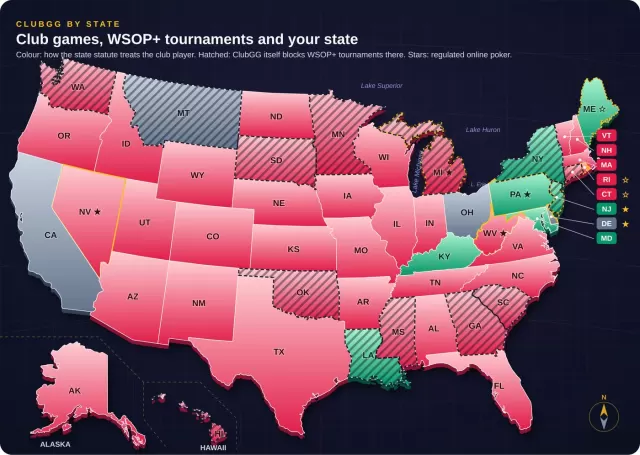
A fifty-entry list would mostly repeat itself, because most states have never written a word about online poker and prosecute nobody for playing it. What matters is how a state's law treats the person at the table, as opposed to the person running the table, and on that question four groups cover almost everyone.
Nevada, New Jersey, Delaware, Pennsylvania, Michigan, West Virginia. Licensed real-money poker exists, and the six share liquidity through MSIGA. Club apps compete with a legal product here.
Washington (class C felony to transmit or receive gambling information online) and Nevada (misdemeanor to place a wager with an unlicensed operator). The paper risk reaches the seat, not just the agent.
New York's Penal Law defines a "player" as someone gambling "solely as a contestant or bettor" and aims its offences at those who advance or profit from gambling. The agent is the target; the reg is not.
Texas makes betting at cards a Class C misdemeanor but gives a defence for private games where "no person received any economic benefit other than personal winnings". Rake is the word that matters.
Group one is the regulated map, and it has grown. According to PokerNews' tracker, updated 19 June 2026, licensed online poker is live in Nevada, New Jersey, Delaware, Pennsylvania, Michigan and West Virginia, with Connecticut, Maine and Rhode Island having legalised it without a single site launching, which is its own kind of achievement. Pennsylvania's Governor Josh Shapiro signed the Multi-State Internet Gaming Agreement on 23 April 2025, and the Pennsylvania Gaming Control Board said the move expanded the shared player pool "by over 50%". In these states a club app is not filling a vacuum; it competes on softer games, faster payouts and higher stakes with a product the state has already blessed, and, judging by the club lobbies, plenty of players in those states still choose the club. That tells you something about the games, and something about the regulated lobbies at 3am on a Tuesday.
Group two is where the disclaimer helps you least. Washington's RCW 9.46.240 makes it a class C felony for "whoever knowingly transmits or receives gambling information" by the internet, and the Ninth Circuit has already ruled that Washington treats non-cashable chips as things of value. The Gambling Commission's page talks about companies offering games to Washington residents rather than about players, and we found no reported prosecution of a poker player under the section, but the statute reaches the seat and no other state's does so bluntly. Washington is the state that treats your Zynga chips like a Vegas marker. Nevada's NRS 465.093 makes it a misdemeanor to "place, send, transmit or relay through a medium of communication a wager" to an unlicensed person, while NRS 465.092 hits whoever accepts it with a gross misdemeanor and disgorgement of profits. Nevada has never met a bet it did not want a licence fee from, and Thinklean has noticed: its terms now name Nevada, alongside Minnesota and Missouri, as states where you "may not use the Service", with the Nevada restriction dated 13 February 2025. That is the developer drawing its own map of where the play-chip argument is not worth testing.
Group three is the largest in practice and the most reassuring for the person holding the cards. New York's Penal Law § 225.00 defines a player as "a person who engages in any form of gambling solely as a contestant or bettor, without receiving or becoming entitled to receive any profit", then builds its offences around people who "advance" gambling or "profit" from it "other than as a player". It also defines "something of value" to include "any form of credit or promise directly or indirectly contemplating transfer of money or property", which is a lawyer's description of an agent's chip rate. The legal weight in a state like this lands on the agent and the club owner, full stop. Many states follow the same promoter-versus-player logic without spelling it out so cleanly, which is why the enforcement record looks the way it does.
Group four is the interesting technicality, and Texas, home of more underground poker than any state that is not Texas, is the model. Penal Code § 47.02 makes it a Class C misdemeanor, the same class as a parking ticket, to play and bet "at any game played with cards", but offers a defence if the game was in a private place, "no person received any economic benefit other than personal winnings", and the odds were equal for everyone. That defence is the legal home of the Texas kitchen game and the reason the state's live card rooms charge membership and seat fees instead of rake, an argument the Houston Chronicle summarised with a defence lawyer saying the statute "does not prohibit the playing of poker as long as the house is not taking a cut" and the Harris County District Attorney replying that it is "people trying to make a buck off saying don't believe your lying eyes, it's gambling". Apply the defence to a club table and the middle condition fails: a club takes rake, and an agent keeps a share of it. On the plain wording, the defence that protects a kitchen game does not stretch to a raked online club, even though the player's own conduct is identical. Whether any Texas prosecutor would bother with a $50 grinder is another matter entirely; we found no reported case of one doing so, and the state has spent years arguing with card rooms that operate in plain sight off the access road.
PokerBros legality state by state
Fifty entries, one per state, alphabetical. Each opens with the short answer, then the statute that decides it, linked to the legislature or Justia text we read. The tags mean what they say: Player named in statute means the state's gambling offence is written to include the person betting, whatever the realistic odds of enforcement; Player not an offender means the code aims only at those who run or profit from the game; Unclear means the wording does not fit an app player cleanly. In every state, the developer's app is legal to download and the agent who converts chips to cash is the person the statutes describe. Penalty classes are quoted from the statute; sentencing ranges vary by state and by judge. This is a map, not advice.
Is PokerBros legal in Alabama?
Short answer: the app is fine to download; betting through an agent is unlicensed gambling, and Alabama's simple gambling statute does reach the player.
Ala. Code § 13A-12-21 makes it simple gambling, a Class C misdemeanor, to advance or profit from unlawful gambling "as a player". The only defence is a "social game in a private place", and a raked club with an agent taking a cut is neither. The agent sits under § 13A-12-22 (promoting gambling, Class A misdemeanor). Alabama defines a contest of chance by the material-degree test, so the poker-is-skill argument is closed by statute. No regulated online poker.
Is PokerBros legal in Alaska?
Short answer: yes to the app, technically no to the money game, but a first offence for a player is a non-criminal violation.
Alaska Stat. § 11.66.200 says "a person commits the offense of gambling if the person engages in unlawful gambling", graded as a violation for a first offence and a fine of up to $1,000 after that. The social-game defence covers a home game with no house bank, house odds or house income, which rules out an agent-run club. Promoting gambling (§ 11.66.220) is a Class A misdemeanor, rising to a Class C felony for an enterprise of five or more people. No regulated online poker.
Is PokerBros legal in Arizona?
Short answer: the player is only exposed if they win; Arizona's offence is "benefiting from gambling", and the agent is the clear target.
A.R.S. § 13-3304 makes it a Class 1 misdemeanor to "knowingly obtain any benefit from gambling", with an express carve-out for social gambling as a player. Social gambling under § 13-3302 requires that nobody other than the players benefits, so a club taking rake breaks it. Arizona defines gambling to include games "of chance or skill", which ends the skill debate before it starts. An agent who accepts money "to be transmitted for wagering" for a fee is named in § 13-3305; promotion of gambling is a Class 5 felony. No regulated online poker.
Is PokerBros legal in Arkansas?
Short answer: playing poker for money is an offence by name, punished by a fine you could cover with a big blind at $5/$10.
Ark. Code § 5-66-112 lists "poker" among the card games a person may not bet on, then sets the penalty at a fine of "not less than ten dollars ($10.00) nor more than twenty-five dollars ($25.00)". It is a violation, not a crime, and there is no social-game exception because the legislature apparently never felt the need at those prices. Keeping a gambling house (§ 5-66-103) is a Class D felony, which is where an agent or club owner would sit. Arkansas also has a 90-day loss-recovery statute (§ 16-118-103). No regulated online poker.
Is PokerBros legal in California?
Short answer: poker is not on California's banned list, so the player is only caught if the game is a "banking or percentage game", and rake is what makes a percentage game.
Penal Code § 330 names faro, monte and friends and then covers "any banking or percentage game played with cards", making it a misdemeanor to play or bet at one. Poker in a licensed card room is lawful; poker with a house cut outside one is a percentage game. § 337j targets whoever operates an unlicensed "controlled game" (poker is named) and exempts home games where nobody profits from running it. Enforcement against individual players is not something we found any record of. Online poker bills have failed repeatedly; nothing regulated is live.
Is PokerBros legal in Colorado?
Short answer: a player commits a petty offence, the lowest tier in the code, and the social exception fails once anyone profits.
C.R.S. § 18-10-103 states it plainly: "A person who engages in gambling commits a petty offense." Gambling is defined as risking value for gain contingent "in whole or in part" on chance, so skill does not save poker. The exception for games "incidental to a bona fide social relationship" requires natural persons only and nobody participating in professional gambling, which an agent taking a fee does by definition; professional gambling is a Class 2 misdemeanor. No regulated online poker.
Is PokerBros legal in Connecticut?
Short answer: Connecticut criminalises engaging in gambling, and even being present at it, while its own 2021 law legalised online poker that nobody has launched.
Conn. Gen. Stat. § 53-278b makes it a Class B misdemeanor to engage in gambling "or [be] present when another person or persons are engaged in gambling", with an exemption for games incidental to a bona fide social relationship with no professional gambler involved. The definition in § 53-278a exempts only online gaming "conducted pursuant to" the state's licensing sections, so an unlicensed app remains gambling. Professional gambling is a Class A misdemeanor. Online poker was legalised in May 2021 but, per Pokerfuse, no site has launched because the tribes' partners do not run poker.
Is PokerBros legal in Delaware?
Short answer: one of the six live regulated-poker states, and its criminal code has no general offence for a person who plays cards for money.
Delaware's gambling subpart, 11 Del. C. §§ 1401-1432, covers lottery policy, bookmaking-style wagers on contests "of skill, speed or power of endurance of human or beast", crap games and premises. A prosecutor would have to stretch § 1403 to reach a poker player, and we found no sign anyone has. Providing premises for gambling (§ 1404) and receiving money to bet for another (§ 1403(3)) cover the agent side. Regulated online poker exists and is part of the multi-state pool; PokerNews lists BetRivers Poker as the live operator.
Is PokerBros legal in Florida?
Short answer: playing cards for money "at any place, by any device whatever" is a second-degree misdemeanor, wording that covers a phone without needing an internet law.
Fla. Stat. § 849.08 is short and old: whoever plays "any game at cards ... at any place, by any device whatever, for money" commits a misdemeanor of the second degree. The penny-ante exception in § 849.085 caps winnings at $10 a hand, requires a dwelling and bans any commission, which is three separate ways a club fails it. Keeping a gambling house (§ 849.01) and becoming custodian of staked money (§ 849.14, a third-degree felony since 2021) are the agent's problem. No regulated online poker.
Is PokerBros legal in Georgia?
Short answer: betting at any card game is a misdemeanor for the player, and the agent's role is a felony.
O.C.G.A. § 16-12-21 commits the offence of gambling when a person "plays and bets for money or other thing of value at any game played with cards, dice, or balls". A bet is defined as dependent on chance "even though accompanied by some skill", and there is no social-game exception at all. Commercial gambling under § 16-12-22, which includes becoming "a custodian of anything of value bet" for gain, is a felony carrying one to five years. Georgia also lets a loser sue the winner within six months (§ 13-8-3). No regulated online poker.
Is PokerBros legal in Hawaii?
Short answer: no legal gambling of any kind, and knowingly participating in gambling is a misdemeanor.
HRS § 712-1223: "A person commits the offense of gambling if the person knowingly participates in any gambling activity." The affirmative defence in § 712-1231 requires that no person or entity other than the players receives "anything of value or any profit" and that the game is not in a business establishment or public place. Promoting gambling is a Class C felony in the second degree and a Class B felony in the first (more than $1,000 in a week). No regulated online poker, and none of the machinery that would ever produce it.
Is PokerBros legal in Idaho?
Short answer: poker is named in the definition of gambling and participating in it is a misdemeanor, with no home-game exception.
Idaho Code § 18-3802 says a person is guilty of gambling if he "participates in gambling", and § 18-3801 defines gambling to include "the operation of casino gambling including, but not limited to, blackjack, craps, roulette, poker". There is no social-gambling defence in the chapter. Bookmaking and forwarding money for bets (§ 18-3809) covers the agent. No regulated online poker.
Is PokerBros legal in Illinois?
Short answer: playing "a game of chance or skill" for money is a Class A misdemeanor, wording that makes the skill argument irrelevant.
720 ILCS 5/28-1(a)(1) is committed by whoever "knowingly plays a game of chance or skill for money or other thing of value". The internet paragraph, (a)(12), targets whoever "establishes, maintains, or operates an Internet site" for such games, so the app operator and the player are covered by different paragraphs of the same section. There is no social-gambling exception. Illinois also has a loss-recovery statute (5/28-8) that lets a loser of $50 or more sue the winner and, after six months, lets anyone sue for treble the loss, which is a fun fact to raise at your next home game. No regulated online poker.
Is PokerBros legal in Indiana?
Short answer: engaging in gambling is a Class B misdemeanor for the player; the internet felonies are reserved for operators.
Ind. Code § 35-45-5-2 makes unlawful gambling a Class B misdemeanor for "a person who knowingly or intentionally engages in gambling", and subsection (c) makes it a Level 6 felony for an "operator" who uses the internet to do so with a person in Indiana. An operator is defined as someone who owns or runs a gambling website, which is not the guy at seat four. There is no social-gambling exemption. Professional gambling, including accepting a fixed share of the stakes in a card game, is a Level 6 felony under § 35-45-5-3. No regulated online poker.
Is PokerBros legal in Iowa?
Short answer: one of the harsher player statutes in the country, with penalties that climb to a felony once more than $500 is involved.
Iowa Code § 725.7 forbids a person to "participate in a game for any sum of money" and grades the offence by amount: a serious misdemeanor up to $100, an aggravated misdemeanor to $500, a Class D felony to $5,000 and a Class C felony above that. The social-gambling exemption in § 99B.45 names poker but requires players to be "physically in the presence of each other" and caps any individual at $200 won or lost in 24 hours. Subsection (1)(c) of § 725.7, giving or accepting value "to be wagered" for a fee, describes an agent exactly. No regulated online poker.
Is PokerBros legal in Kansas?
Short answer: "making a bet" is gambling and gambling is a Class B nonperson misdemeanor, with no social exception on the books.
K.S.A. 21-6404 defines gambling as "making a bet" or being in a gambling place intending to, and classes it as a Class B nonperson misdemeanor. A bet under § 21-6403 is a bargain "dependent upon chance", and the exclusions cover business transactions and state-authorised gaming only. Commercial gambling under § 21-6406, which includes receiving or forwarding bets and becoming custodian of wagered property for gain, is a severity level 8 felony. No regulated online poker.
Is PokerBros legal in Kentucky?
Short answer: a person who bets "solely as a contestant or bettor" is a player, and Kentucky's gambling offences are written for everyone except the player.
KRS 528.010 defines a player as someone who gambles "solely as a contestant or bettor, without receiving or becoming entitled to receive any profit therefrom other than personal gambling winnings", and the offences in KRS 528.020 and 528.030 apply only to those who advance or profit from gambling. An agent who sells chips for a cut "profits from gambling activity" (Class A misdemeanor at least). Kentucky's loss-recovery statute, KRS 372.020, lets a loser of $5 or more sue the winner for five years, and the third-party clause in KRS 372.040 is how the Commonwealth won an $870,690,233.82 judgment against PokerStars, reinstated by the Kentucky Supreme Court on 17 December 2020. No regulated online poker.
Is PokerBros legal in Louisiana?
Short answer: both the gambling and gambling-by-computer crimes require conducting the game "as a business", so the player is outside the wording.
La. R.S. 14:90.3 defines gambling by computer as "the intentional conducting, or directly assisting in the conducting as a business" of a game where a person risks value to profit, using the internet. The base offence in R.S. 14:90 has the same "as a business" structure. A player conducts nothing; an agent who sells and buys back chips for a margin arguably "directly assists", and the felony in 14:90.3(E) for running the servers carries up to five years. No regulated online poker.
Is PokerBros legal in Maine?
Short answer: the player is not an offender under Maine's Model Penal Code structure, and the state legalised tribal online poker in January 2026 without a launch yet.
Under 17-A M.R.S. § 952 unlawful gambling means advancing or profiting from gambling, and a person profits only if "other than as a player" they take money under an agreement to share in the proceeds, which is a description of a club agent (Class D crime under § 954). Maine defines social gambling as a game where nobody other than the players receives "any profit whatsoever", which a raked club is not. LD 1164 became law without the Governor's signature on 11 January 2026, authorising internet gaming including poker through the Wabanaki Nations; no site was live when we checked.
Is PokerBros legal in Maryland?
Short answer: the current text of Maryland's betting statute has no paragraph aimed at the bare bettor; it is written around books, premises and money handlers.
Crim. Law § 12-102(a) prohibits making or selling a book, keeping or using a place "for the purpose of betting, wagering, or gambling", and receiving or forwarding money "to be bet, wagered, or gambled", each a misdemeanor with up to six months and $5,000. Paragraph (3) is the agent's paragraph. The premises language could in theory be pointed at a player using their own home, but it was drafted for gambling houses. No regulated online poker.
Is PokerBros legal in Massachusetts?
Short answer: playing cards for money is an offence only in a public place or where you are trespassing, and the penalty tops out at $50 or three months.
M.G.L. c. 271, § 2 punishes whoever "in a public conveyance or public place, or in a private place upon which he is trespassing, plays at cards, dice or any other game for money". Your own sofa is neither. Chapter 271, § 1 lets a loser recover double from a winner of $5 or more if sued within 18 months, a statute from the era when that was real money. The internet provision in § 17A is aimed at accepting wagers on contests and sports, not at card players. No regulated online poker.
Is PokerBros legal in Michigan?
Short answer: regulated online poker is live and shared across states, and the old Penal Code offence for winning at cards still sits underneath it.
The Lawful Internet Gaming Act (MCL 432.301 et seq.) authorises licensed online poker and makes offering unlicensed internet gaming a felony with up to ten years under MCL 432.313, but creates no offence for an adult who plays on an unlicensed site. That player falls back on MCL 750.314, a misdemeanor for anyone who "by playing at cards ... wins or obtains any sum of money", with up to a year if the winnings top $50. Michigan is in the multi-state pool. If you live here, the regulated lobby is a real alternative and the club is a choice, not a necessity.
Is PokerBros legal in Minnesota?
Short answer: "makes a bet" is a misdemeanor in its own right, which is a large part of why PokerBros' own terms now exclude the state.
Minn. Stat. § 609.755 lists "makes a bet" first among the misdemeanors, and § 609.75 defines a bet as dependent on chance "although the chance is accompanied by some element of skill". The only shelter is a "private social bet not part of or incidental to organized, commercialized, or systematic gambling", and an agent-run union is organised, commercialised and systematic by design. Operating or maintaining a gambling place, or forwarding bets, is a gross misdemeanor under § 609.76. Thinklean's terms name Minnesota as a state where you "may not use the Service". No regulated online poker.
Is PokerBros legal in Mississippi?
Short answer: betting on any game is an offence for the player under a statute that predates the casinos, with a fine capped at $500.
Miss. Code § 97-33-1 reaches anyone who shall "play at any game ... for money or other valuable thing, or shall wager or bet", with a fine of not more than $500. The exceptions are for licensed vessel and coastal casino gaming; there is no private-home carve-out. The same section catches those who "encourage" or "promote" the betting, which is the agent's box. No regulated online poker.
Is PokerBros legal in Missouri?
Short answer: knowingly engaging in gambling is a Class C misdemeanor, a Class A for professionals, and there is no social exception, which explains the second state on PokerBros' exclusion list.
RSMo § 572.020: "A person commits the offense of gambling if he or she knowingly engages in gambling." A professional player, meaning someone who makes a living from it or drew 20% or more of income from it in any of the last five years, faces a Class A misdemeanor. Chapter 572 uses the material-degree chance test and offers no private-game defence. Promoting gambling in the first degree is a Class E felony. Thinklean's terms list Missouri alongside Minnesota and Nevada as excluded. No regulated online poker.
Is PokerBros legal in Montana?
Short answer: one of the few codes that defines "internet gambling" by name, but the offences are built around operating an enterprise rather than playing in one.
MCA 23-5-112 defines internet gambling as conducting a gambling enterprise "through the use of communications technology" and lists it among illegal gambling enterprises; 23-5-151 prohibits all public gambling not authorised by statute. Whether a mere player "violates" that section is arguable; the operating and soliciting offences in 23-5-152 and 23-5-154 are the clear ones, with fines from $500 escalating on repeat. Montana banned sweepstakes casinos from 1 October 2025, which tells you which way the wind blows. No regulated online poker.
Is PokerBros legal in Nebraska?
Short answer: Nebraska grades the player by daily stake: under $500 a day is a fine-only offence, $500 or more is a Class II misdemeanor.
Neb. Rev. Stat. § 28-1104 is written as a player offence: promoting gambling in the third degree is committed by one who "knowingly participates in unlawful gambling as a player by betting less than five hundred dollars in any one day", a Class IV misdemeanor with no jail. Betting $500 or more in a day moves you to § 28-1103 and a Class II misdemeanor. The gambling definition needs only "an element of chance", and there is no social exception. Receiving $1,500 or more a day from gambling (§ 28-1102) is the felony tier for operators. No regulated online poker.
Is PokerBros legal in Nevada?
Short answer: the only state where placing a wager with an unlicensed operator is itself a separate offence for the player, and the first state PokerBros' own terms began excluding.
NRS 465.093 makes it a misdemeanor to "place, send, transmit or relay through a medium of communication a wager" from within Nevada to anyone other than a licensed Nevada operator; NRS 465.092 makes accepting that wager a gross misdemeanor with disgorgement of profits. Operating interactive gaming without a licence is a Category B felony under NRS 463.750. The private-home card game exclusion in NRS 463.0152 covers kitchen tables, not phones. Thinklean's terms bar Nevada users from 13 February 2025. WSOP.com is the licensed room and shares its pool with five other states.
Is PokerBros legal in New Hampshire?
Short answer: gambling is a misdemeanor for the player, but New Hampshire wrote the country's most specific home-poker safe harbour into the statute.
RSA 647:2 makes a person guilty of a misdemeanor who knowingly and unlawfully "gambles, or loans money or any thing of value for the purpose of aiding another to gamble", which is one clause for the player and one for the agent. Paragraph V(e) then exempts a poker game in a private residence with no rake, no seat fee, no paid host, no house bank, no advertising and no more than ten players. A raked online club fails at least four of those. Business gambling is a Class B felony. No regulated online poker.
Is PokerBros legal in New Jersey?
Short answer: no offence for a person who "participated only as a player", and the country's deepest regulated online poker market.
N.J.S.A. 2C:37-2 makes it an affirmative defence to promoting gambling "that the person participated only as a player", and 2C:37-1 defines a player as someone who gambles "solely as a contestant or bettor" without profit other than winnings. An agent who shares in the proceeds is promoting gambling, a disorderly persons offence rising to a crime of the third degree by volume. Regulated online poker runs under P.L.2013, c.27, with PokerStars, WSOP, BetMGM and Borgata all live per PokerNews. In New Jersey the club is purely a games-quality decision.
Is PokerBros legal in New Mexico?
Short answer: "making a bet" is gambling and gambling is a petty misdemeanor, with poker's skill component ruled out by the statute's own wording.
NMSA § 30-19-2: "Gambling consists of: A. making a bet ... Whoever commits gambling is guilty of a petty misdemeanor", which carries up to six months. A bet under § 30-19-1 is "dependent upon chance, even though accompanied by some skill". There is no social-game exception in the article. Commercial gambling under § 30-19-3, which includes forwarding bets or becoming custodian of anything bet "for gain", is a fourth-degree felony. No regulated online poker.
Is PokerBros legal in New York?
Short answer: New York's Penal Law defines the player out of its gambling offences entirely; the weight falls on whoever advances or profits.
Penal Law § 225.00 defines a player as one who gambles "solely as a contestant or bettor, without receiving or becoming entitled to receive any profit therefrom other than personal gambling winnings", and §§ 225.05 and 225.10 punish only those who advance or profit from gambling "other than as a player". It also defines something of value to include "any form of credit or promise directly or indirectly contemplating transfer of money", which is a lawyer's description of a chip rate. Online poker bills have come and gone in Albany for years without one passing; nothing regulated is live.
Is PokerBros legal in North Carolina?
Short answer: the player and the operator share one sentence and one Class 2 misdemeanor, and the 2024 sports betting law changed nothing for poker.
G.S. § 14-292 covers "any person who plays at or bets on any game of chance at which any money, property or other thing of value is bet" alongside whoever operates the game, all as a Class 2 misdemeanor. There is no social-gambling exception. G.S. 16-1 voids gambling debts except lawful sports and pari-mutuel wagers, confirming that the sports betting framework in Chapter 18C does not touch poker. No regulated online poker.
Is PokerBros legal in North Dakota?
Short answer: gambling on private premises is an infraction only when a player wagers more than $25 per hand, and a Class A misdemeanor above $500 a hand.
N.D.C.C. § 12.1-28-02 makes it an infraction "to engage in gambling on private premises where the total amount wagered by an individual player exceeds twenty-five dollars per individual hand, game, or event", and a Class A misdemeanor above $500. That per-hand threshold makes most micro-stakes play a non-offence on the face of it, though how "private premises" maps onto an app is untested. Engaging in the business of gambling is a Class C felony, which is the agent's exposure. No regulated online poker.
Is PokerBros legal in Ohio?
Short answer: a recreational player is not covered unless betting is "a substantial source of income or livelihood"; the grinder is, the tourist is not.
R.C. 2915.02(A)(4) makes it a first-degree misdemeanor to "engage in betting or in playing any scheme or game of chance as a substantial source of income or livelihood", and (A)(2) covers whoever facilitates a game "conducted for profit", which is the club and the agent. Ohio's definition of game of chance names poker outright, so there is no skill debate. Public gaming (§ 2915.04) still bars betting in bars, hotels and halls. No regulated online poker.
Is PokerBros legal in Oklahoma?
Short answer: poker is named in the statute, betting at it is a misdemeanor with a 1916-era penalty, and conducting a game "whether for hire or not" is a felony.
21 O.S. § 942 punishes "any person who bets or plays at any of said prohibited games" with a fine of $25 to $100 or up to 30 days, and § 941 makes it a felony to open or conduct "either poker, roulette, craps or any banking or percentage game", with or without profit. That makes the host of a no-rake home game a felon on paper, which tells you how seriously the statute is enforced against ordinary players. Tribal compact poker is lawful and plentiful; online poker is not authorised.
Is PokerBros legal in Oregon?
Short answer: participating in unlawful gambling "as a player" is a Class A misdemeanor, while Oregon's internet gambling statute is aimed at businesses taking payments.
ORS 167.122 makes unlawful gambling in the second degree the crime of one who "participates or engages in unlawful gambling as a player". ORS 167.109 is a UIGEA clone: a Class C felony for "a person engaged in an Internet gambling business" who accepts credit, transfers or cheques for unlawful internet gambling. Social games in a private home with no house income are excluded from gambling altogether. Promoting or profiting from unlawful gambling is a Class C felony. No regulated online poker.
Is PokerBros legal in Pennsylvania?
Short answer: no offence for playing on an unlicensed site, a felony with a seven-figure fine for operating one, and a regulated market that joined the multi-state pool in 2025.
18 Pa.C.S. § 5513 targets device makers, hosts who allow people to assemble for gambling, solicitors and premises owners; none of its four paragraphs reaches a mere player. 4 Pa.C.S. § 1518(a)(3.1) makes accepting interactive wagers without a certificate a felony with a fine of $500,000 to $1,000,000, which is the agent's theoretical exposure. The only individual offence is under-21 play. Governor Shapiro signed the MSIGA on 23 April 2025 and PokerStars, WSOP, BetMGM and BetRivers all run poker here.
Is PokerBros legal in Rhode Island?
Short answer: the closest thing to a player offence is "frequenting" a gambling house, drafted for buildings, and the 2024 iGaming law has produced no poker room.
R.I. Gen. Laws § 11-19-21 imprisons for up to 30 days "every person who shall frequent any gambling house or place where gaming is practiced", which is a strained fit for a phone. Setting up or promoting any game or device (§ 11-19-1) is a felony, and § 11-19-18 covers dealers, bankers and lookouts. The 2024 iGaming statute defines casino gaming to include poker but defines an online table game as one "conducted by one or more live persons", so peer-to-peer online poker was not expressly authorised and none has launched.
Is PokerBros legal in South Carolina?
Short answer: an 1802 statute that bans playing "any game with cards or dice" in a list of places, which the state Supreme Court has held includes a private home.
S.C. Code § 16-19-40 punishes a player with up to 30 days or $100, and the keeper of the place with up to a year. In Town of Mount Pleasant v. Chimento (2012) the Supreme Court reinstated the convictions of home-game Hold'em players and held that skill predominating is no defence. Whether a phone is an enumerated "place" is untested; § 16-19-130, which covers anyone who receives or forwards money for bets, is the natural fit for agents. South Carolina has no casinos, no lottery poker and no online anything.
Is PokerBros legal in South Dakota?
Short answer: engaging in gambling with cards is a Class 2 misdemeanor, and South Dakota's internet gambling chapter targets businesses, not players.
SDCL 22-25-1 covers anyone who "engages in gambling in any form with cards, dice, or other implements or devices of any kind wherein anything valuable is wagered". SDCL 22-25A-7 bars "person[s] engaged in a gambling business" from using the internet to bet or wager, a Class 6 felony that would fit an agent running chip sales rather than a player. Licensed Deadwood gaming is the statutory exception. No regulated online poker.
Is PokerBros legal in Tennessee?
Short answer: gambling is anything with a return "to any degree contingent on chance", the strictest test in the country, and engaging in it is a Class C misdemeanor.
Tenn. Code § 39-17-502: "A person commits an offense who knowingly engages in gambling", a Class C misdemeanor. The definition in § 39-17-501 leaves no room for a skill argument, and the only affirmative defence is having relied on a promoter's claim that an event was an authorised charity game. Gambling promotion (§ 39-17-503), inducing or aiding another to gamble for an economic benefit other than winnings, is a Class B misdemeanor and is where the agent lands. No regulated online poker.
Is PokerBros legal in Texas?
Short answer: betting at a card game is a Class C misdemeanor, the same class as a parking ticket, and the famous home-game defence collapses the moment anyone takes rake.
Penal Code § 47.02 offers a defence where the game was in a private place, "no person received any economic benefit other than personal winnings" and the odds were equal for all. A club's rake and an agent's commission fail the middle prong for every player at the table, and whether an app is a "private place" is untested. Gambling promotion (§ 47.03), including becoming custodian of bets for gain, is a Class A misdemeanor. Texas's live rooms operate openly on a membership-fee model built on the same defence, which is its own answer to how these statutes are enforced against players.
Is PokerBros legal in Utah?
Short answer: the clearest no in America: the player offence names "Internet or online gambling" and the definition covers any mobile device.
Utah Code § 76-10-1102 makes a person guilty of gambling who "participates in gambling or fringe gambling, including any Internet or online gambling", a Class B misdemeanor rising to Class A on a third conviction. Providing internet gambling to anyone in the state is a third-degree felony. There is no social exception and, per the same section, a declaration that Utah opts out of any federal authorisation of online gambling. If you are in Utah, this is the one entry in this list where the answer to all three questions is simply no.
Is PokerBros legal in Vermont?
Short answer: winning or losing money "by play or hazard at any game" earns a fine of $10 to $200 under a statute nobody has updated in living memory.
13 V.S.A. § 2141 is the whole player offence: a fine of "not more than $200.00 nor less than $10.00" for whoever wins or loses money by play at any game or by betting on it. Playing in a "common gaming or gambling house that is maintained for lucre and gain" (§ 2133) adds up to 60 days. There is no gambling definition and no social exception, because the statute predates the idea that either was needed. Bookmaking and keeping a place for wagering (§ 2151) carry up to five years on a repeat. No regulated poker of any kind.
Is PokerBros legal in Virginia?
Short answer: making or placing a bet is illegal gambling and a Class 3 misdemeanor; the private-residence exception needs no "operator", and a club has one.
Va. Code § 18.2-326 makes illegal gambling a Class 3 misdemeanor, and § 18.2-325 defines it as the making or placing of a bet on an event "the outcome of which is uncertain or a matter of chance". § 18.2-334 exempts a game in a private residence not commonly used for games and with no operator; a union with agents financing and managing the game is an operator by definition. Conducting an illegal gambling operation (§ 18.2-328) is a Class 6 felony, with one to ten years once it runs 30 days or clears $2,000 in a day. No regulated online poker.
Is PokerBros legal in Washington?
Short answer: the strictest state in the country for the person in the seat: receiving gambling information over the internet is a Class C felony, and the Ninth Circuit has held that non-cashable chips are things of value here.
RCW 9.46.240 makes it a Class C felony for "whoever knowingly transmits or receives gambling information by ... the internet", and RCW 9.46.0245 defines gambling information as any wager made in the course of professional gambling. A raked club is professional gambling by the operator, so the player's wager qualifies. Kater v. Churchill Downs applied Washington's definition to social-casino chips. We found no reported prosecution of a poker player under the section, and the Gambling Commission's public statements address companies, not players, but no other state's statute reaches the seat this bluntly. Licensed card rooms are plentiful; online poker is not authorised.
Is PokerBros legal in West Virginia?
Short answer: regulated online poker went live in June 2025, and underneath it sits an old misdemeanor for betting on any game of chance "at any place, public or private".
W. Va. Code § 61-10-5 fines anyone who "at any place, public or private, bet or wage money or other thing of value on any game of chance" between $5 and $300, and its second clause catches whoever "knowingly furnish[es] any money" to another to bet with, which is an agent or a staker. § 29-22E-20 of the Lottery Interactive Wagering Act punishes those who accept, facilitate or operate unlicensed interactive wagering and creates no player offence. BetRivers Poker launched in June 2025 and West Virginia is inside the multi-state agreement.
Is PokerBros legal in Wisconsin?
Short answer: "makes a bet" is a Class B misdemeanor, a bet is chance "even though accompanied by some skill", and there is no social exception.
Wis. Stat. § 945.02: "Whoever does any of the following is guilty of a Class B misdemeanor: (1) Makes a bet". The definition in § 945.01 disposes of the skill argument in the same breath. Commercial gambling under § 945.03, including for gain becoming "a custodian of anything of value bet" or forwarding a bet, is a Class I felony, which is the agent's exposure. Wisconsin's constitution limits gambling to the enumerated exceptions, and online poker is not one of them; the tribal casinos spread live poker.
Is PokerBros legal in Wyoming?
Short answer: engaging in gambling is a misdemeanor with up to six months, softened by a social-relationship exclusion that fails once anyone profits from the game.
Wyo. Stat. § 6-7-102 punishes a person who engages in gambling with up to six months and $750, and professional gambling, defined to include "aiding or inducing another to engage in gambling, with the intent to derive a profit", with up to three years. Gambling is contingent on chance "in whole or in part". The exclusion for games "incidental to a bona fide social relationship" among natural persons only, with nobody participating in professional gambling, cannot survive a rake. Wyoming's gambling definition excludes regulated online sports wagering by name; poker is not on that list.
Enforcement history, or the lack of it
Here is the part the scare articles skip, because it ruins the scare. Federal gambling prosecutions have followed money and organisation, not players. Black Friday named executives and payment processors. The Arenas indictment named the people who ran the house, hired the dealers and took the cut, not the people who lost six figures in it. Searching Department of Justice releases and court records for a US player charged for sitting in a PokerBros, ClubGG or PPPoker game turned up nothing as of 17 September 2026, and we looked properly. That is not a promise about the future, and it is not the same as "legal". It is a description of where the resources go, and they go where the money is collected.
The risks a US club player actually carries are therefore different from the ones the statutes describe. The first is counterparty risk: your bankroll sits with an agent, not with a licensed operator holding a segregated account, which is exactly why club selection matters more than any legal question in this article. The second is tax, which does not care about legality at all. IRS Topic 419 is unambiguous: "Gambling winnings are fully taxable and you must report the income on your tax return", and losses are deductible "only if you itemize your deductions on Schedule A". The IRS does not care whether your chips were real. It cares whether your winnings were. A winning club reg who never reports is running a bigger risk with the tax man than with any gambling statute in the country.
The risk that actually matters
Strip away the statute numbers and the legality question for a US player collapses into something older and simpler: who is holding your money, and will they give it back on Monday? That is the question every home-game player has asked since the invention of the kitchen table, and the club scene has developed the same answers the home game did. Reputation, longevity, and other people who will vouch. A club that has settled on time every week for three years, inside a union that reconciles weekly, run by an agent whose Telegram handle has not changed in years, is a better legal and financial position than any disclaimer Apple has ever approved.
This is where the difference between a good club and a random invite link becomes the whole ballgame. The good ones publish their chip rate and payout window before you deposit, take a test cashout without sighing, and sit in unions large enough that a bad week for one club does not become a bad week for you. PokerBros' App Store listing points to random number generator certificates from third-party labs (iTech Labs, Gaming Labs and BMM are named), which handles the "is it rigged" question that new players always ask first and should ask second. The question they should ask first is the one this article has been circling: who is the counterparty, and how long have they been paying?
If you are a US player weighing it up, know which of the four groups your state sits in, accept that the IRS is the one federal body that will definitely want to hear from you if you run good, and choose clubs the way you would choose a home game: by who runs it, not by how nice the chip graphics are. The chip graphics, for the record, are very nice. That was never the point.
Loose Kings in the Stars and Stripes Union and Loose Cannon in the Paradise Union are the two PokerBros rooms GlobalPokerSites lists under its Funds Guarantee, with direct agent contact on each club page. Read the full club pages before you deposit, and confirm your chip rate and payout window in writing.
This article is general information written by poker players, not legal advice. Laws change and your situation is your own; speak to a lawyer licensed in your state if you need a real answer for it. 18+ in most jurisdictions and 21+ where state law requires it. Poker played for money is gambling; set limits before you sit down and read our responsible gaming page if it stops being fun.
Sources (state statutes are linked inside each state entry above): PokerBROS on the App Store; PokerBROS Terms and Conditions (effective April 2025); PokerBROS on Google Play; Public Law 109-347 (SAFE Port Act, Title VIII); Houston Chronicle on Texas poker clubs; 31 U.S.C. § 5362 and § 5363; 18 U.S.C. § 1955; DOJ, 15 April 2011; NH Lottery Commission v. Rosen (1st Cir. 2021); Kater v. Churchill Downs (9th Cir. 2018); GeekWire, 31 August 2020; Washington State Gambling Commission; RCW 9.46.240; NRS 465.092 and 465.093; NY Penal Law § 225.00; Texas Penal Code § 47.02; PGCB, 23 April 2025; PokerNews US poker tracker; Snell & Wilmer, 5 June 2025; IRS Criminal Investigation on the Arenas indictment; IRS Topic 419.