
Friday night. Nine of you, twenty dollars each, a 500-chip set someone got for Christmas. Somebody found a blind structure on the internet, printed it, and stuck it to the fridge. "We will be done by eleven."
It is 1:40 in the morning. Three of you are left. The blinds have been "about to go up" for twenty minutes because the phone running the clock died at half past twelve and nobody noticed. The chip leader has just explained, for the third time, that he has half the chips so he should get half the money. The guy who has to be up at seven is looking at his car keys.
Every home game has had this night. Most of them think it was bad luck, or the rebuys, or Dave. It was none of those. It was arithmetic, and the arithmetic was decided at eight o'clock when you stuck that printout on the fridge.
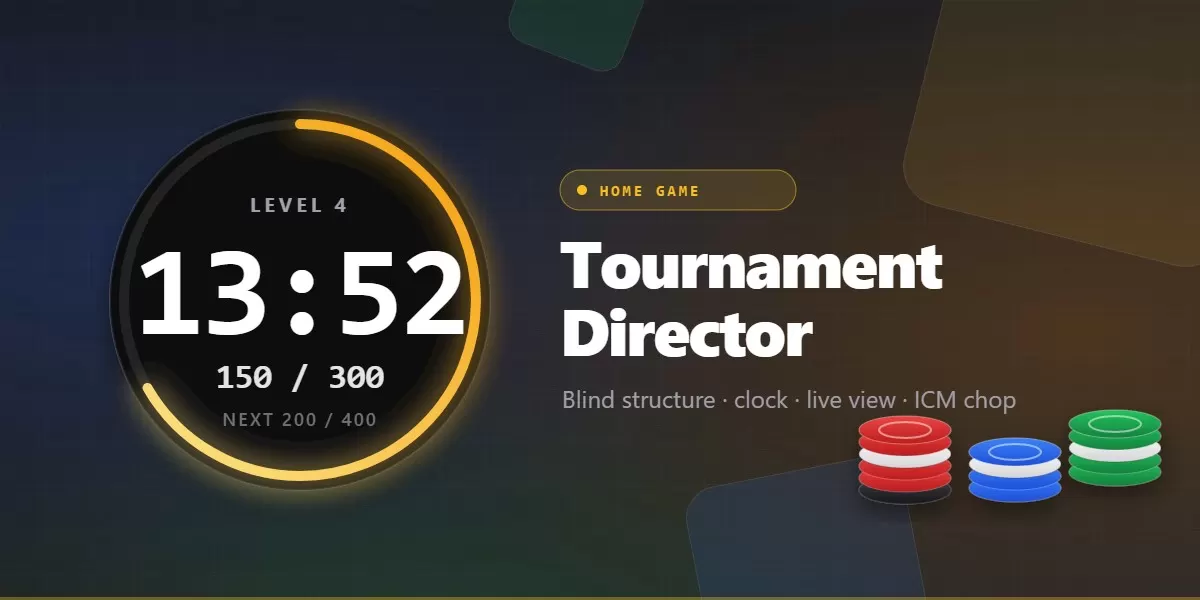
We are not here to lecture anyone about how to run a poker night. We are here because there is a very small amount of math that fixes almost all of it, and because we got tired of the same argument at our own tables, so we built a free tournament director for our readers that does the math and runs the clock. No account, no cost, no catch. The rest of this piece is why it needed building.
It Was Never Going to End at Eleven
Let us talk about why a tournament ends at all.
A tournament ends when one player holds every chip. Nobody can hold every chip until the blinds have grown large enough, relative to the total chips on the table, that the stacks are forced together. Nine players at 10,000 apiece is 90,000 chips. For heads-up to arrive with both players holding around ten big blinds, the big blind needs to be somewhere near 4,500. It does not matter how well anyone plays. Until the blinds get there, the tournament is not over, and the closer the blinds are to that number, the closer you are to going home.
So the finish time is set by one thing: how fast the blinds climb. Not skill. Not the deck. The blinds.
Now look at that printout on the fridge. It was almost certainly built for a casino field of a few hundred people with a few million chips in play. It has twenty-five levels, because it needed twenty-five levels to grow blinds from 25/50 to something that could end that field. You have nine people and 90,000 chips. You will be heads-up by level nine and playing for a while at blinds that are, relative to your stacks, nothing, or you will run out of levels and finish the night flipping coins for the pot.
A structure that finishes a 300-player field in eight hours does not finish your nine-hander in eight hours. It finishes it in ninety minutes, or never, depending on which end of it you copied.
Twenty-Minute Levels Are Not a Vibe. They Are a Contract.
Once you accept that the blinds decide the finish time, the level length becomes a promise you are making to the people at the table.
Here is the shape of it. Take the time you actually have, say four hours. Take out the breaks. Divide what is left by the level length and that is how many levels you get. Twenty-minute levels with two ten-minute breaks in a four-hour window gives you eleven levels. Those eleven levels have to carry the blinds from 50/100 all the way to about 2,500/5,000, so each level is roughly 1.45 times the last one.
Change any one number and every other number moves. Want thirty-minute levels because you like "real poker"? Fine, but now you have seven levels to make the same climb, each step is steeper, and the middle of the tournament feels like a turbo anyway. Want it gentle? Then you need six hours, and you should say so at eight o'clock, not at midnight.
The honest numbers for a kitchen table: nine players, twenty-minute levels, about four hours. Six players is closer to two and a half. Eighteen across two tables is five or six. If you genuinely have to be done by eleven, shorten the levels. Do not skip them. A tournament that runs out of levels does not end, it just stops being poker.
The 25s Are the Problem
This is the one that catches people who have done everything else right.
Every blind level has to be payable with the chips still on the table. That sounds too obvious to write down, and yet. You start with 25s, 100s, 500s and 1,000s. Around level six the 25s are worthless and you color them up, which is correct. Then the next level is 150/300 and someone realizes nobody can post a 150 small blind with 100s and 500s.
The blind ladder and the chip denominations are one problem, not two. If your structure was written by someone who never thought about your chips, it will break at exactly the moment everyone is watching, and you will spend ten minutes inventing a new level while the game dies.
Three rules, and you never have to think about it again:
Space your denominations by four to five times. 25, 100, 500, 1,000 is a clean ladder. Each chip should be a whole multiple of the one below it.
Give every player four to eight of the smallest chip. Running out of the small denomination is the single most common physical failure in a home game. Keep a quarter of the set in the box as a bank.
When you color up, round, do not race. The casino method, dealing a card for each odd chip and giving the big chip to the high cards, exists to protect a house's chip inventory across a hundred tables. At your table it costs ten minutes and produces a bad feeling. Round every player up to the next denomination. The extra chips are a rounding error against the total, and you are dealing again in ninety seconds.
The Chop Is Where Friendships Go to Die
Most home tournaments end in a deal, usually when the guy with the early shift starts doing the math on how much sleep he is going to get. And the deal is where the chip leader says the thing that starts the argument.
"I have half the chips. I should get half the money."
He should not, and the reason is not opinion. Let us talk math. It stays simple.
Say the pool is $180 and it pays $90, $55 and $35. Three left. The leader has 45,000 of the 90,000 chips, second has 27,000, the short stack has 18,000. A straight chip chop gives them $90, $54 and $36.
But prize money does not scale with chips, because the ladder has a ceiling. The leader cannot win more than $90 no matter how many chips he piles up. Meanwhile the short stack already owns a share of the guaranteed money just by still being alive. If you ask the real question, how often does each of these stacks actually finish first, second and third, and what is that worth on average, you get about $69, $59 and $52.
That is the Independent Chip Model, and that twenty-dollar gap between the chip leader's chip chop and his real equity is not a bug in the arithmetic. It is the reason experienced players insist on ICM and the reason the chip leader always wants a chip chop. He is not being greedy on purpose. He genuinely believes his chips are worth what they say on them. They are not.
Where ICM is soft: it assumes everyone left is equally skilled and that the blinds are not about to eat the short stack alive. If one of your three is clearly the best player at the table, or the short stack is about to post a big blind that is a third of his stack, the true numbers drift. That is why deals get negotiated rather than calculated. ICM is the neutral starting point everybody can agree is fair, and then people haggle from there. Everyone has to agree, not most people. Pause the clock while you talk. And if one player says no, the answer is no. Play on, and do not sulk.
If you want the numbers instead of the argument, the Tournament Director has a chop calculator on its Payouts tab. Type in the stacks, it shows the chip chop and the ICM figure side by side, and the difference column usually ends the conversation on its own.
The Phone
Now the part everyone gets wrong on the night itself.
The clock is running on someone's phone. The phone is in someone's hand, or face down on the table, or charging in the kitchen. It goes to sleep. The battery dies. Someone gets a call. Whatever it is, at some point the level changes and nobody knows, and then the level after that, and then you are arguing about what the blinds should be instead of playing poker.
The fix is not a better phone. The fix is that the clock should not depend on one screen. The Tournament Director runs full-screen on any phone or tablet, keeps the screen awake, and gives you a short link and a QR code. Every phone at the table that opens the link sees the same level, the same blinds and the same countdown, and it follows every pause, skipped level and bust-out you make. Nobody has to squint at the host's screen. Nobody has to ask.
And if the host's phone does die, there is a second link, the host link, that hands the whole tournament to any other device at exactly the level and second it was at. Text it to yourself before the first hand and you are covered for the night. Put the clock somewhere everyone can see it, plug it in, and announce the new blinds out loud at every level change anyway. The screen is not enough once people are three drinks in.
How to Do the Whole Thing in Thirty Seconds
Open the Home Game Tournament Director. Tell it how many players and how long you want to play. That is genuinely it. It works out the number of levels your window allows, sizes the blind ladder so the tournament finishes when you said it would, picks chip denominations that can pay every blind on that ladder, schedules the breaks, tells you when to color up, and gives you a one-page structure sheet to stick on the fridge in place of the one that lied to you.
Then it runs the clock, shares the live view, tracks the bust-outs if you add names, and settles the chop. No account, no sign-up, nothing to install. It is free because we play too and we were tired of the same argument.
House Rules Worth Stealing
None of this is required. All of it prevents an argument.
Late registration through level three or four. Somebody always arrives during level two. Give them a full starting stack. Do not scale it down, it is not worth the arithmetic and it makes them feel punished for traffic.
One rebuy per player in the first hour, at the starting stack. More than that and the tournament becomes a cash game with extra steps. And know that every rebuy adds chips, and chips added late make the night run longer than the structure says. For every twenty percent the chip pool grows, expect roughly one extra level.
Antes from around level four. Antes are what force action once stacks get short. Without them a short-handed table can fold for an hour. A big-blind ante, where one player posts for the whole table, is faster than everyone digging for chips and worth adopting.
Pay the top ten to fifteen percent, minimum two places. Nine players, pay three. Winner-take-all is thrilling exactly once. The people who keep a monthly game alive are the ones who occasionally leave even, and a game that pays three out of nine sends a third of the room home happy.
Write the payouts where everyone can see them before the first hand. Payout structures renegotiated at the final table are how home games end.
One person is the director and their rulings are final for the night. Decide who that is while everyone is still sober.
Do those, run a structure built for your table instead of a casino's, and put the clock where nobody can kill it. You will still lose to Dave. But you will lose to him by eleven, and you will know exactly what he is owed.
Related reading: if you are the one turning up during level two, there is a real argument that you are doing it right. And whoever wins the last hand of the night, please do not slow roll it.