New on PPPoker
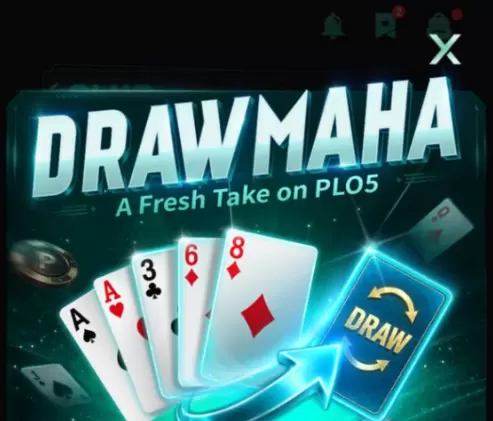
PPPoker just shipped the first draw game in the app's history, and it is not a gentle one. Drawmaha takes five-card Pot-Limit Omaha, bolts a single draw onto it after the flop, and then splits every pot between the best Omaha hand and the best five-card draw hand.
If you have ever played it in a home game under its other name, Sviten Special, you already know the deal: nobody folds preflop, nobody knows what anybody has, and the pots get silly.
The difference now is that you can play it against real traffic instead of the same four friends. Drawmaha is live in PPPoker clubs, and if you need a seat, the PPPoker clubs list on Globalpokersites.com is where to start.
This guide covers the full PPPoker ruleset, including a couple of app-specific rules that home game players will not recognize, and then gets into how the game actually plays once the novelty wears off.
What Is Drawmaha?
Drawmaha is a split-pot game built from two parents: PLO5 (five-card Omaha) and five-card Draw. Nordic players know it as Sviten Special, after the Stockholm club where it is generally credited with taking off around 2004, and an identical game was reportedly played in French Canada in the 1980s under the name Celestial Poker. It has since turned up in the mixed-game rotation at live festivals and at crypto rooms, and now on the biggest club app there is.
Everyone gets five hole cards. From that point you are playing two hands at once with the same five cards:
|
O Omaha half · 50% of pot Standard Omaha construction. Exactly two hole cards plus exactly three board cards. Half the pot goes to the best hand made this way. |
D Draw half · 50% of pot Your five hole cards, as they stand after the draw, are your hand. The board is irrelevant. The other half goes to the best five-card poker hand held in the hole. |
Win both and you scoop. Win one and you get your money back plus a bit, which after four streets of pot-limit betting is usually a disappointing outcome. The whole game lives in that gap.
PPPoker labels the two halves D and O in the client, and settles each half independently, side pots included. A player who is all-in for the main pot can win the Draw half of the main pot while someone else takes the Omaha half of a side pot they never had a claim to. It is exactly as messy as it sounds, and the app handles the accounting so you do not have to.
How a Drawmaha Hand Plays on PPPoker
Blinds and button work exactly as in Omaha or Hold'em. The game is pot-limit, which is a mercy. Nobody needs no-limit in a game where a player can turn a busted hand into a full house with one exchange.
| 1 | Preflop Five cards face down to each player, then a normal betting round. |
| 2 | The flop Three community cards, then a betting round. Up to here this is just PLO5. Note that you see the flop before you draw. That ordering is the entire strategic engine of the game. |
| 3 | The draw After flop betting closes, every remaining player exchanges anywhere from zero to five cards. Zero is called standing pat. The draw runs in order starting from the small blind, so the button draws last and sees how many cards everyone else threw away before committing. There is exactly one draw. No second chance on the turn. |
| 4 | Turn, river, showdown Normal Omaha from here. Two more streets, two more betting rounds, then the pot is cut in half and each half is awarded separately. |
The One-Card Draw Rule
This is the rule that makes Drawmaha more than "PLO5 with a gimmick." When a player exchanges exactly one card, the replacement is dealt face up, and every player at the table sees it.
The drawing player then chooses
KEEP The exposed card stays face up in their hand for the rest of the hand. Everyone knows one of their five cards.
REJECT The exposed card goes to the muck and they receive the next card face down.
So a one-card draw is effectively two shots at your out, at the cost of leaking information. If you are drawing to a flush for the Draw half and the exposed card is a brick, you toss it and take the mystery card. If it completes the flush, you keep it, and now the whole table knows you have at least a flush-adjacent hand and one specific card. If it is a marginal improvement, say a pair when you wanted the flush, you have an actual decision: lock in the small gain or gamble on the unknown.
Home game Drawmaha usually has a version of this rule. PPPoker's implementation is cleaner because the software tracks the exposed card for everyone, so there is no "wait, which one was it" argument on the river.
Standing Pat
Drawing zero cards is a stand pat. In pure five-card draw, standing pat screams "made hand." In Drawmaha it is more ambiguous, because a player might keep all five cards for Omaha reasons rather than Draw reasons. Someone holding a nut flush draw plus a wrap on the flop may simply refuse to break it up, even if their five-card hand is nothing.
Still, the draw count is a free tell that regular PLO never offers. Someone who exchanges four cards is telling you their hand was garbage a moment ago. Someone who exchanges one is either strong or drawing to something big. Watch the draw as carefully as you watch the bet sizing, because in this game they carry roughly equal information.
What Happens When the Deck Runs Out
Five hole cards each, a flop, and a draw where multiple players can pull three or four cards apiece. On a full table, a 52-card deck does not always survive.
Live and home game rule sets handle this either with a player cap, a three-card draw limit at bigger tables, or by shuffling the muck into a new stub. PPPoker reshuffles the discards back into the stub when the deck is exhausted, with one protection: you can never be dealt a card you personally discarded earlier in the hand. That lets the app run bigger tables without the draw breaking, and without the "I just threw that away" situation that ruins the point of drawing.
View Mucked Cards and Hand History
Two more app features worth knowing before you sit down, because they change how fast you can learn the game.
After a hand ends, PPPoker's View Mucked Cards feature lets you see what players who reached showdown were holding, including the hands they folded at the end. The same information sits in your Hand History, with two limits per PPPoker's in-app rules: it stores only your most recent 200 hands, and you can only review hands you played in.
For a brand new format this is a big deal. Instead of guessing what a stand pat meant, you can go check. Do that for a couple of sessions and you will have a real read on how the regs in a given club approach the draw, which is worth more than any strategy article, this one included.
Quick PPPoker Drawmaha Rules
Starting Hands: Think Two-Way or Go Home
The preflop mistake almost every PLO player makes in their first Drawmaha session is rating hands the way they rate PLO5 hands. Double-suited rundowns are beautiful in Omaha. In Drawmaha, a hand like the one on the left below is a made straight for the Draw half before the flop is even dealt, and it still has wrap and flush potential on the board. The hand on the right, which any PLO5 player would happily get it in with, is one pair for the Draw half and a one-way hand unless it improves.
|
Two-way monster J♠T♥9♠8♥7♠ Draw: made straight · Omaha: wraps + two flush draws |
One-way PLO trap A♠A♦K♠Q♦J♣ Draw: one pair · Omaha: great, but that's only half |
The hands that scoop most often fall into a few groups:
- Made straights, especially with suits attached. Already winning the Draw side against most of the field, plus real Omaha equity.
- Two big pairs with a connecting fifth card. Two pair is a strong Draw holding at showdown, both pairs can make sets for Omaha, and the fifth card gives you something to exchange without breaking anything.
- Trips with two coordinated side cards. A one-card draw to a full house or quads, plus set-over-set potential on the board. Dangerous in both directions.
- Flushes and straight flushes in the hole, rare as they are, are near locks for the Draw half and usually carry the nut flush for Omaha too.
Unpaired, uncoordinated high cards are the trap. A♠ K♥ Q♣ 9♦ 4♠ is a fold in most spots. It has no Draw hand and mediocre Omaha coverage, and the one thing you can do with it, draw three cards, tells the whole table exactly where you stand.
The Post-Flop Decision Is the Whole Game
Because the flop arrives before the draw, you evaluate your hand with real information. The question on every flop is the same: which half am I actually competing for, and can the draw get me the other one without wrecking the first?
Hand example
| Your hand | K♥K♣9♥8♥3♦ |
| Flop | Q♥J♥4♠ |
Omaha: overpair + second-nut flush draw + gutshot. Draw: one pair of kings, which will not hold up against a table that has just been offered a free exchange.
Your options:
- Draw one (dump the 3♦). Keeps every Omaha out intact. Gives you two shots at a king (trips for Draw) or a heart (which helps both sides). And you get the exposed-card option. This is usually the play.
- Draw two (dump 9♥ and 3♦). Better odds of improving the pair, but you have just thrown away a live flush draw and the gutshot. Your Omaha hand is now a naked overpair on a wet board.
- Stand pat. Only if you are pot-committed and want to disguise the strength of the flush draw. It is a bluff on the Draw side and a real hand on the Omaha side, and it occasionally makes someone fold a hand that had you crushed for the Draw half.
Now flip the spot. Same hand, flop 7♠ 6♣ 2♦. The board did nothing for you. The kings are still a pair, and for Omaha you are an overpair with no draws on a board full of straight possibilities for the low rundowns that always call in this game. This is a fold to any real pressure, and if it checks around, you are drawing three and praying. Do not fall in love with kings in Drawmaha. They are a pair, and pairs lose.
Half a Pot Is Not a Prize
The hardest habit to break coming from PLO is treating a nut Omaha hand as a green light. In Drawmaha, a nut Omaha hand with a dead Draw side is fighting for 50% of the pot, and if two other players are competing for the Draw half, one of them is also freerolling against you for the scoop on the Omaha side with whatever they backed into.
The math on a "winning" hand
You flop the nut straight for Omaha with no redraw; your five hole cards make one pair. Your opponent has a smaller Omaha hand but pat trips for the Draw. Pot is $100, you both put in $50 more. You win the Omaha half ($100 of the $200 pot) most of the time and lose the Draw half nearly always. You put in $50 and pull back $100, but half of that original $100 pot was your own money. Net result over the hand: roughly break-even, minus rake. You are not winning, you are churning. And if the board pairs, they scoop $200.
Before any large bet, ask yourself two questions. How strong am I for the Draw half? How strong am I for the Omaha half? If either answer is "hopeless," your true equity is a lot lower than your hand feels, and the pot-limit betting structure gives you no excuse for not knowing that.
The reverse holds. Pat two pair looks great for the Draw side, but if the flop comes coordinated and three players are still in, you may be a heavy underdog for Omaha and a coin flip for Draw. That is a check, not a pot-sized bet.
Reading the Draw Like a Bet
Every opponent's draw count is a tell, and on PPPoker the one-card draw comes with a bonus exposed card. Some patterns hold up well against most club players:
| Draws 4 or 5 | They flopped nothing worth keeping. They might catch a monster, but the median outcome is a pair. Attack the Draw half if you have two pair or better. |
| Draws 3 | Keeping a pair, or keeping two cards for Omaha. Their Draw hand is weak right now. |
| Draws 2 | Usually trips or a strong Omaha core they refuse to break. Respect it. |
| Draws 1, keeps the exposed card | It helped them. Look at what the card is and what it could complete alongside the board. |
| Draws 1, rejects a useful-looking card | They were drawing to something specific and that was not it. A rejected heart tells you they were not on a heart flush draw. |
| Stands pat | Either a made Draw hand or an Omaha hand they will not touch. The flop betting before the draw usually tells you which. |
None of this is a science. It is a lot of information, though, and normal PLO gives you none of it. Players who ignore the draw counts are giving away edge to the ones who track them.
Is Drawmaha a PLO Game or a Draw Game?
Both, and neither one is the boss. The two hands compete for the same five cards, and every discard improves one side while risking the other. A pure PLO player who treats the draw as an afterthought is leaving half the pot on the table every hand. A pure draw player who ignores board texture will keep standing pat with two pair into three-way pots where the Omaha half is decided by a flush.
The edge comes from learning which hands can realistically scoop, and being disciplined enough to fold the ones that cannot. That takes reps, and thanks to the mucked-cards feature, the reps on PPPoker come with answer keys.
PPPoker says Drawmaha was one of the formats players asked for through its Wishing Wall, the in-app channel for feature requests, and is billing it as the app's first draw game. Whether that means more draw variants are coming is anyone's guess, but for now this one is enough to keep a table up until sunrise.
Ready to play Drawmaha?
The PPPoker clubs reviewed on Globalpokersites.com cover traffic, rake, and stakes at each one, so you can find a game rather than an empty lobby.
See PPPoker Clubs →