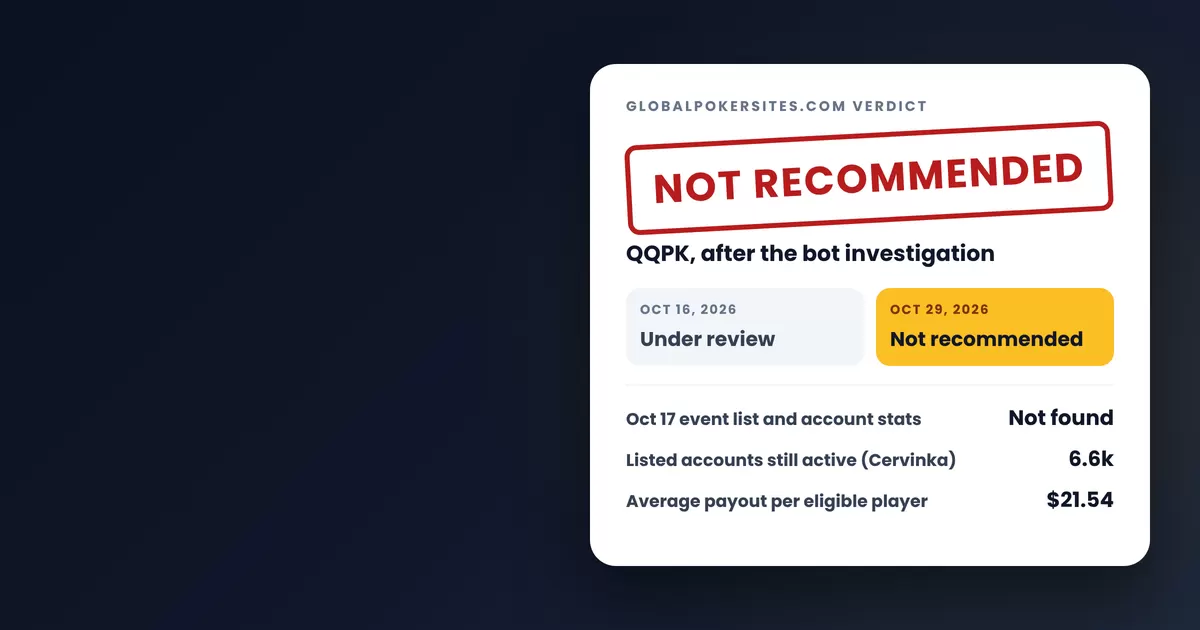

Verdict change | October 29, 2026
Before: October 16, 2026
Under review
Rating held at 6.9 while we waited for the follow-up QQPK promised for October 17.
Now: October 29, 2026
Not recommended
The review stays online with a warning. We no longer point new players to QQPK.
What moved us
1. QQPK's report came on October 15. The affected-events list and account statistics due on October 17 have not.
2. A bot researcher says 6.6k of his 11,469 flagged accounts kept playing after October 16.
3. Compensation covers tournament losers only: $300,000 across 13,928 players.
4. Reports of bots at the cash tables have gone unanswered.
QQPK's compensation notice, posted to its X account on October 16, 2026, contains a line nobody finished writing. Under "Distribution method" it says payouts are "Credited directly to the player's game account ([To be filled: cash balance / tickets / other])". A few lines further down, the space for a link to the promised compensation list is blank. We checked the notice again on October 29, 2026. Neither had changed.
An unfinished template is a small thing. It also sums up QQPK 14 days after it confirmed, on October 15, that a cheating syndicate had worked its tournaments: QQPK has published a detailed report and paid out, but the account-level detail it promised has not appeared, and the problem it described may be a lot bigger than the part it has dealt with.
So we have changed our verdict: GlobalPokerSites.com no longer recommends QQPK. Our QQPK review stays online, because players who already have accounts deserve the whole picture, but it now opens with a not-recommended notice. We are not saying QQPK rigged its games, and further down we set out why the evidence does not show that. What we are saying is that QQPK has not shown its tables are clean, and every room we recommend has to clear that bar.
The deadlines QQPK set itself
QQPK has been specific about dates, which makes it easy to hold to them. On October 10, its operations team wrote in the Two Plus Two thread where the original bot report appeared that it would publish its findings by October 17, "including methodology and enough detail for the authors and the community to check them." It beat that date. On October 15 its risk control team posted a long investigation report with a methodology appendix, summarised below. That report made a new promise: "The complete list of affected events, account statistics, and compensation details will be published by October 17, 2026". The compensation details arrived on October 16. The rest has not. On the same day QQPK set a second deadline, October 25, for an app update. Here is how the fortnight played out.
The record, October 15 to November 5, 2026
What QQPK promised, and what we could find
Oct 15
Investigation report published. 893 banned, $300,000 pledged, 2,020 more flagged accounts on a "frozen monitor list". The same day, bot hunter Vojtech Cervinka publishes 11,469 suspected bot names.
Two days ahead of its own deadline
Oct 16
Compensation rules posted. 13,928 players, three conditions, payout on October 20. A separate post admits a card-setting test tool was left in the live app.
Oct 17
Deadline for the full lists. QQPK confirms automatic payouts on X. The list of affected events and the account statistics do not appear.
Not found as of Oct 29
Oct 19
Cervinka attacks the payout rules and says nobody from QQPK has contacted him.
Oct 20
Payout day. Cervinka reports that 6.6k of his listed accounts are still active, and none of them limp any more.
Payouts made on time
Oct 21
First payout reported on Two Plus Two: $350 against losses of about $35,000.
Oct 23
Cash tables. A player reports suspected bots at 100NL and 200NL "playing as normal".
Oct 25
App clean-up deadline. QQPK said a new version would remove the test tool before this date.
No announcement found
Oct 26
Still asking. "So where are we at cash games bots investigation?" No reply from QQPK in the thread.
Oct 29
Business as usual. QQPK's X feed promotes a $150,000-guaranteed Red Packet Rain series and Triton ONE freerolls. The compensation notice is still unfinished.
Nov 5
The $3K QQPK Genesis opens Triton ONE in Northern Cyprus.
We could not search every channel QQPK uses. Logged-out X shows only part of an account's history, and the last page of the Two Plus Two thread, which holds two posts, would not load for us. But QQPK chose that thread and its X account as the places to report back, and nothing we could read in either on October 29 contained the list of affected events or the account statistics. Other outlets have noticed the gap: Deadspin noted on October 19 that the fuller report "was due on October 17" without saying it had arrived.
What QQPK's own report says
The October 15 report is the most detailed thing QQPK has published, and it concedes more than most operators would. Its central finding is a "collusive cheating syndicate" whose accounts swapped hole cards at the same tables, folding hands the shared cards made weak and moving all in when they made them strong. QQPK banned 893 accounts, 567 from the investigators' list and 326 it found itself "via device and associative leads", and put the other 2,020 flagged accounts on a "frozen monitor list" while it keeps checking them.
It did not dispute the investigators' maths. Re-running their sample on its own servers, QQPK got +192,063 big blinds above expectation, a z-score of about 14.6 (the number of standard deviations a result sits from what luck alone would produce), and said the investigators' "calculation logic is valid under their model." Its objections were about the sample. The raw data counted many hands more than once, 4,866,164 lines but only 1,757,070 unique hands, and covered 9,436 of the 24,026 tournaments QQPK ran. Two charts carry its case: Chart A shows the 893 banned accounts winning far above their all-in EV (expected value, what their hands should have won on average) over three months, while Chart B shows the 2,020 monitored accounts tracking their EV over about 1.22 million hands. QQPK also says its random number generator is certified by Gaming Laboratories International and that its review "found no system manipulation or backdoor exploits allowing visibility of unexposed hole cards."
There are gaps. The report says it is releasing anonymised all-in hand histories "(see attached files)", but the forum version carries only three images and no files we could find. It gives no z-score for the banned accounts across QQPK's full player population, which is the number yegor, a verified coach on the forum, asked for. And Chart B covers the 2,020 monitored accounts, not the thousands of other names on Cervinka's list.
$300,000, 13,928 players and three conditions
The compensation notice says the $300,000 pool will be shared by 13,928 players, with each payout scaled to that player's losses. To qualify, a player has to meet all three of its conditions: they played a tournament (MTT) in the past three months, they sat in the same hand as two or more of the banned accounts, and their buy-ins in the affected tournaments exceeded their prizes. QQPK restated the rules on X on October 20, as PlayUSA reported, adding: "Playing an MTT with a violating account alone does not establish eligibility."
QQPK compensation
As published October 15 and 16, 2026
To qualify, all three must be true
[1] Played an MTT in the past three months
[2] Two or more banned accounts in the same hand
[3] A net loss across those tournaments
Cash-game players: not covered. Queries close 23:59, November 30, 2026.
The two-account rule is the one under fire. In a post on October 19, Cervinka, the Czech pro behind the MTT Database Review account, wrote that the bots "are profitable on their own. They might collude, but they don't need to collude to win." A player who lost to one banned account at a time, in other words, gets nothing. He also took aim at the net-loss rule, arguing that "Cheaters lower everyone's EV, regardless of whether they happen to finish in profit or not." His alternative: estimate the damage in each affected tournament and pay it back as bigger prizes and extra paid places. Forum players are split, between rerunning every payout as if the bots had never sat down and paying only those who actually lost.
Real money did land on October 20. A player posting as D_Alien wrote on October 21 that he got $350 "after losing around 35k$ from 1st July till around Aug", which is $350 / $35,000 = 1% of his losses. He thought that might be close to the best his situation allowed. Another player, Dogfrost19, said he was ruled ineligible despite playing at least three tournaments a day, and that support would not show him why, because the investigation data "involve confidential internal platform information and user privacy." He filed a formal appeal. QQPK replied that it would "submit it to the relevant team for further evaluation", and he said it agreed to review six months of his play rather than three. Pushing back got him a hearing, at least.
Thousands of flagged accounts still at the tables
The weightiest reason for our change of verdict comes from Cervinka, and it needs its caveats up front. On October 20 he wrote that he had built "a small database with fresh hands played since October 16" and that "6.6k of those accounts were still active", meaning accounts from his list of 11,469. That is roughly 6,600 / 11,469 = 58% of the list. Then came the punchline. The accounts had been known for limping (calling the big blind instead of raising) with premium hands and re-raising when someone else raised. In his new sample, he said, they "are now at 0.0% limp."
He has not published that new database, his list counts nicknames rather than proven accounts, and nobody has checked his figures independently. Still, this is the researcher whose earlier reports got bots removed from ACR, and whose list contained all five example accounts named in the anonymous report that started this story. His broader estimate, reported by Poker.org on October 15, is that "roughly 17.5M of those hands (over 70%) were played by bots" across 24 million player-hands in his database. QQPK has not answered him in public, and on October 19 he wrote that "somehow I have not been contacted by anyone from QQPK yet."
If his numbers hold up, the switch matters more than the count. Human players drop a habit one at a time. Thousands of accounts dropping the same habit within days of being called out for it looks like software updated in one place. QQPK has described the problem as a syndicate swapping hole cards. A coordinated change of strategy across accounts it has not banned would point to something larger, and still running. QQPK's Chart B does not settle it either way. An all-in EV chart catches card-sharing, but a bot playing alone, without seeing anyone else's cards, runs at EV like everyone else, so a clean chart cannot clear an account of automated play. Cervinka also wondered aloud on X how much of the $300,000 "will end up going to bots that haven't been banned yet."
Cash games are a separate gap. The compensation plan covers tournaments only, and players have been asking about the cash tables since the first days of the thread. On October 23, a player wrote that "The bots at 100/200nl are playing as normal last i checked, no accounts even frozen, didn't even have to change their names." (100NL and 200NL are the cash games with $1 and $2 big blinds.) By October 26 the question had shrunk to one line: "So where are we at cash games bots investigation?" We found no answer from QQPK.
A card-setting test tool in the live app
QQPK's October 16 forum post also dealt with something players had dug out of its app: a screen for choosing which cards get dealt. QQPK called it a manual-dealing test tool and said it "was created in the early stages of the project to test the insurance feature" (insurance is a side bet on an all-in hand that pays out if the player's hand loses). It admitted that although it had disabled the way in, "we did not fully remove the associated obsolete code and UI assets from the client release, leaving them in the production version." QQPK says the screen can only be reached in a modified copy of the app, that it cannot control live dealing, and that its deck check would expose any tampering. It apologised and promised that "The cleanup of client-side assets will be completed through the release of a new version before October 25."
That explanation is plausible, and nobody has shown the tool touching a real hand. It is still a basic failure for a card room, and QQPK's own diagnosis was "shortcomings in our cleanup of legacy assets and our release review process." The deck check has critics too. Before each hand, QQPK's app receives all 52 cards in order, each locked with AES-256, the encryption standard banks and governments use, and the keys arrive after the hand. yegor accepts the encryption cannot be cracked but says the design "adds attack surface": most rooms only generate the turn and river when they are dealt, so there is no finished deck to leak, and "a bug or vulnerability in key release could expose one without anyone intending it." We have not seen QQPK announce the promised update in the thread or in the X posts we could view.
What the evidence does not show
None of this proves QQPK rigged its random number generator or runs the bots itself. Some players have suggested the room is behind them. Nobody has produced evidence of that, and we are not repeating claims we cannot check.
The 14.6 figure also deserves less weight than it got, even though QQPK reproduced it. Anything past five standard deviations is already far beyond plausible luck, but the accounts were picked by filters, and any filter with a minimum hand count favours accounts that ran well. Cervinka made the same point about his own 1,000-hand cutoff: "if they run bad, they are a little bit less likely to pass the 1,000 hand threshold." Card-sharing can explain at least part of the gap, as our own equity tests found on October 15, though yegor argues it cannot explain all of it under QQPK's own EV method.
QQPK also deserves credit. It banned 893 accounts, published a detailed report two days ahead of its own deadline, put $235,373 of its own money into the pool, or 235,373 / 300,000 = 78.5% of it, apologised in writing, paid out on the day it promised and is hearing appeals. Poker pro Patrick Leonard made the point in a post quoted by PlayUSA: "The industry is still waiting for some sites to post about one player whilst in less than a week a much smaller site posts this." Fast and partial beats slow and silent. It just is not enough to keep our recommendation.
Why our verdict changed
We recommend a room when we would be comfortable with a reader depositing there today. On October 16, QQPK had just published its report and promised the account-level detail by the next day, and that was worth waiting for. By October 29, that detail had not appeared, the best-documented outside analysis said the problem was still at the tables, cash games had not been examined, and compensation reached only tournament players who passed a narrow test.
QQPK's background makes that weigh more. Deadspin reported that the site "only turned up on the industry's tracking databases back in April." It is licensed in Anjouan, one of the Comoros islands off East Africa, and as our review notes, that licence comes with no independent dispute-resolution scheme. When no regulator is acting as referee, the operator's own openness is most of what a player has to go on. That is the part QQPK has not delivered.
It is also about to be very visible. PokerNews reports that "The Triton ONE schedule gets underway on November 5 with the $3K QQPK Genesis" at the Merit Royal Diamond Hotel in Northern Cyprus, and QQPK's freerolls to that event run until November 1. Players chasing those seats are playing in the same tournament pool everything above describes.
The road back
What QQPK would need to do before we re-review it
Publish the October 17 detail: the list of affected events, the account statistics and the hand-history files its report says are attached.
Answer the 11,469-name list, including the 6.6k accounts Cervinka says are still active.
Investigate the cash games and publish what it finds.
Post the compensation list by masked player ID, as its own notice says it will, and explain the two-account rule.
Show the test tool is gone, ideally through an outside security review of the app.
If QQPK does those things, we will review it again from scratch and report what we find. Until then, our review carries the warning, and new players looking for a room should look elsewhere.
Rooms we do recommend
Find a site that has earned your deposit
Every room we review, compared on rake, traffic, payout speed and security.
Compare poker sitesSources: Two Plus Two investigation thread (October 10 to 26, 2026, including QQPK's October 15 investigation report, its October 16 statement and the player reports quoted); QQPK compensation notice on X (October 16, 2026, checked October 29); MTT Database Review on X, October 19 and October 20, 2026; PlayUSA (October 23, 2026); Poker.org (October 15, 2026); Deadspin (October 19, 2026); PokerNews Triton ONE schedule (October 22, 2026). Averages and percentages are our own calculations from those figures.