

Three pitches landed in your Telegram this week. All three clubs run on the same app, all three lobbies look busy, and all three agents type like your oldest friend. Below are the pitches, stripped down to the facts that matter. Pick the one that gets your first deposit before you read another line.
Got your pick? Hold on to it. The answer, and the score each club earns, is waiting at the bottom of the page. Everything between here and there is the method: twelve checks that turn "the vibes seem fine" into a decision you can defend.
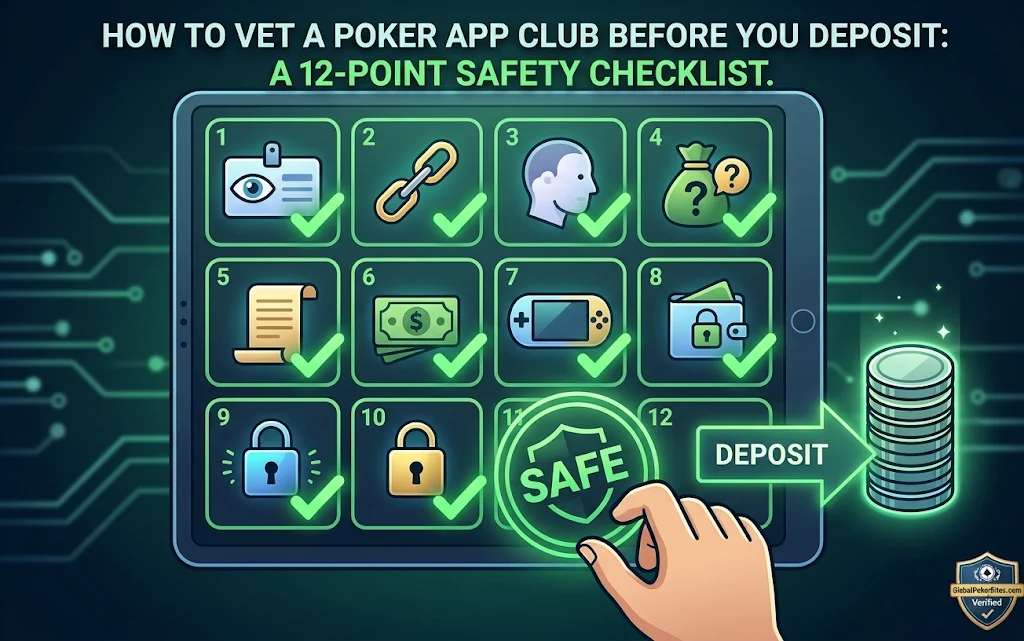
None of this is about scaring anyone off app clubs. They have carried a big share of American recreational poker for years, and the people running them are mostly poker people keeping a good game alive. The method exists for the minority who are not, and it is the same one we use before any club lands on the GlobalPokerSites.com club directory. Four checks happen at your desk, four in the chat, four at the tables. Tap any line to jump to it.
PART 1 OF 3 · DESK · CHECKS 1-4
Homework before the first hello
The first four checks cost ten minutes and a search bar. Run them before you talk to anyone, because the moment someone is being friendly in your DMs, your judgment softens. That is not a character flaw. It is how being sold to works, and good salesmen know it better than you do.
1. The club ID matches a listing the agent does not control
Club names are not unique on any of the big apps. Anyone can open a club called "Diamond Elite" or clone a popular club's name and logo over a coffee. The number is the identity, so the club ID is the first thing you verify, against something the recruiter has no hand in: a directory, the union's own announcement channel, a forum post from a player with years of history behind the handle.
The favorite impersonation trick is the near-match. Same name, same avatar, two digits swapped:
ON THE LISTING
Northside Poker
468 486
The ID the directory and union channel show
IN YOUR DMS
Northside Poker
468 468
Same name, same logo, different owner
When the ID in your app and the ID on the listing disagree, there is no innocent version of the story, including "we moved to a new ID last week". Clubs do move occasionally, but a real move gets announced where the regulars already look, and the old ID usually points to the new one.
2. The union has a name, an age and no recent collapse
Quick primer if you are new to app clubs: a union is an alliance of clubs sharing one lobby, which is what keeps a 2 a.m. table full. A single club may count its members in the hundreds; the alliance counts them in the thousands. Once per cycle, usually weekly, the member clubs net out their results against each other through the union. Our explainer on how agents move deposits and cashouts covers the plumbing.
For vetting, the union matters because it is the layer that disciplines clubs. A club that stiffs players can be expelled, and expulsion cuts off its traffic overnight. That threat only works if the union itself is stable, so ask three things: what is it called, how long has it run under that name, and has it rebranded in the past year. If the first answer is "big union, don't worry", you can skip the other two. Unions that fold tend to resurface with a fresh name and the same people, and a name with no history is the cheapest disguise in the business.
Independent clubs are not automatically worse. Some excellent ones run solo because they have enough regulars to fill their own tables. With no layer above them, though, checks 3, 4 and 8 carry extra weight.
3. The agent has a past you can search
Search the agent's handle, the club ID and the club name on TwoPlusTwo and Reddit, then the handle on X and Telegram. You are hunting for two things: complaints and age. Complaints are obvious. Age is underrated. An agent whose handle turns up in threads from three years ago, answering questions and settling arguments, has a reputation worth more than your deposit. An agent whose whole online existence began this month has nothing to lose but a burner account.
A big name is not a substitute for the search. In February 2025, high-stakes pro Charlie Carrel publicly accused British Poker Series director Shaun Johnston of owing him $60,000. According to PokerNews, Johnston had been working as an agent for an online club Carrel was part of, and had "hard-vouched" for a player who then lost the sum and never paid. Carrel said he trusted Johnston because of his standing in the industry, and only found the forum chatter about Johnston's past afterwards. Johnston gave PokerNews no comment. However the full story ends, the sequence is the part that applies to everyone: the search comes before the trust, not after the loss.
4. Something stands behind your balance
The app companies do not hold your money and do not pretend to. Your balance is backed by a person, a club or a structure above them, and before you deposit you want to know which. Protection stacks up like this, from thinnest to thickest:
Who is behind your chips
Five levels of backing. The fuller the bar, the safer the balance.
Two footnotes on the ladder. Escrow only means something if the person holding it is more trustworthy than the agent, which rules out "my cousin will hold it". And any guarantee worth the name covers settled funds, not results. The GlobalPokerSites.com Funds Guarantee, for example, protects a settled balance at a listed club and spells out what it excludes: table losses, uncleared bonuses and accounts closed for cheating. That is how a real guarantee reads. One that sounds like it covers everything usually covers nothing.
PART 2 OF 3 · CHAT · CHECKS 5-8
What gets settled in the DMs
Checks 5 to 8 happen in conversation with the agent or the club's support account. Good hosts answer all four before you ask twice. Bad ones give themselves away within a dozen messages, and usually in the same handful of ways. Here is roughly how a chat with Club A goes, condensed so every tell lands in one thread:
5. The terms arrive in writing before the chips do
Before the first deposit you want seven numbers in the chat, where you can screenshot them: the chip rate (the cash value of one chip), the minimum deposit, the minimum and maximum cashout, any deposit or withdrawal fee, the rake and cap at your stake, the rakeback percentage and how often it pays, and the settlement day. A tightly run club has these pinned in a channel already. A club that has to "check with the boss" on the chip rate is a club where the chip rate is whatever suits it on cashout day.
Look hard at the cashout maximum. A weekly cap is normal in smaller clubs and protects the float. A cap so low that a good winning week takes a month to withdraw describes a club that cannot afford its winners.
6. Payment details never wander
The deposit address should be the same week after week, and it should belong to the person or club you are dealing with. A new wallet every Tuesday, a "partner" on deposits, a request to pay a friend's account so it "doesn't look like poker": each one breaks the paper trail that check 12 depends on. It also helps to know which rail you are on:
Crypto
USDT, BTC and friends
REVERSIBLENo. Once sent, it is gone.
WHY CLUBS LIKE ITNo chargebacks, no frozen accounts
YOUR CHECKConfirm the address twice, every time
Card or P2P apps
Card-funded and peer-to-peer
REVERSIBLESometimes, by the sender, after the fact
WHY CLUBS ARE WARYA paid-out winner can claw back a deposit
YOUR CHECKExpect slower cashouts, ask why if not
Neither rail is suspicious on its own. Silence about which one the club uses is. And the hard rule from the Club A chat: no legitimate club charges a "verification fee", "unlock fee" or "tax" that you pay in before a cashout is released. Fees come off a withdrawal, never on top of one.
7. The credit policy is stated plainly
Plenty of clubs extend credit to regulars they trust: chips go on the account now, and the money is collected when the cycle closes. Among long-time regulars it works the way it has worked in back rooms forever. The real question is not whether you would take credit yourself. It is how much of the money on your table is credit. If the players you beat never pay their agents, the club owes you chips it never collected, and a club with a fat credit book can be insolvent while the lobby looks packed. That is the exact chain in the Carrel story: one vouch, one unpaid loss, one unpaid winner.
So put three questions to the host: is there credit at this club, who signs off on it, and what is the ceiling per player. An honest host answers in one message. A vague one is telling you the book is bigger than he would like to admit.
8. There is a name above the agent
Disputes happen in every card room: a disconnect mid-hand, a botched tournament registration, a chip count nobody agrees on at settlement. In a regulated room you escalate to the operator. On app clubs, the operator steps back by design. ClubGG's terms of service say members are "playing against each other and not against us", and that the company may look at disputes between members but has no obligation to. That is standard for the category, and it means the escalation path has to live inside the club and the union.
Before depositing, get a name that is not the agent's: the owner's support account, a union admin, anyone a level up. Then ask what happens to a player's settled balance if the agent quits. A good answer sounds like "the club takes over his players and pays the balances". A bad answer is a laughing emoji.
PART 3 OF 3 · TABLE · CHECKS 9-12
Proof at the felt, and the week after
The last four checks are about what the club does rather than what it says. Most of them take a single session.
9. The security switches are actually on
Every major club app hands hosts per-table integrity settings: GPS and IP restrictions that stop two accounts in the same room or on the same connection from sitting together, device restrictions, and on PokerBros an optional photo-rotation check that makes players level an image with a slider before taking a seat, aimed squarely at bots. None of it costs the club a chip to switch on. Open the table info before you sit and look.
A big-game table with every restriction off is a choice someone made. Maybe laziness, maybe a crew of the club's best customers who like sitting together. Either way, you are the one paying for it. While you are asking, find out what the club does when it catches a cheat: do the winnings go back to the players at his tables, or into the club? Clubs that refund victims tell you so proudly.
10. The rake you are charged is the rake you were quoted
Rake in app clubs is set per table by the host: a percentage of the pot, up to a cap measured in big blinds. Both numbers should be visible in the table settings and both should match what you were told in check 5. Then verify on a real hand. Find a big pot in your hand history, one that should have hit the cap, and see what came out of it.
One 250-chip pot, two rake bills
Stakes 0.5/1, quoted 6% rake with a 4bb cap
Quoted: capped at 4 big blinds
4 chips
Charged: 6% with no cap
15 chips
Cap 4 x 1 = 4 chips. Uncapped 0.06 x 250 = 15 chips. Gap: 11 chips on one pot.
For the small pots the cap never touches, the math is the same either way: a 50-chip pot pays 0.06 x 50 = 3 chips. The cap only shows up in the big ones, which is exactly why a quiet mis-setting can run for months. While you are in the settings, look for a jackpot or insurance fee on top of the rake. Those can be perfectly fair, as long as they were in the terms rather than discovered at the table.
11. You have cashed out a winning session, not just a losing one
Plenty of players run a test withdrawal after a small losing session, watch it arrive, and relax. That test proves very little. A club in trouble can usually afford to send back a loser's leftovers. What it cannot afford is a winner. The test that counts is a cashout after a session where you booked a profit, even a modest one. Time it against the window you were quoted, and pay attention to the tone of the chat when money flows your way. A host who was all emojis on deposit day and suddenly mentions a "review" on your first winning cashout has told you everything.
One honest delay around settlement day is normal. A second delay with a fresh excuse, especially paired with a nudge to keep playing until it clears, is not.
12. Keep a small balance and save your receipts
Write down every deposit and withdrawal: the date, the amount, the wallet address and the transaction ID. Take a screenshot of your balance after each settlement. If there is ever a dispute, these records are your proof.
Don't leave a big balance in the club. Two or three buy-ins is enough to play with. Your rakeback is the same no matter how much you keep there, so a bigger balance only means more to lose if the club or agent stops paying. Cash out anything extra after each settlement.
The answer to the three pitches
Back to the opening. The table checks need a session, so score the three clubs on the eight you can run before a single chip moves:
Club A fails all eight, and it is the pitch most players pick, because a 60% bonus on a 24/7 PLO game is built to be picked. Club C is the interesting one: a clean agent, a real ID and an owner you can reach, undone by a fresh rebrand, an owner who cannot say what stands behind your balance, rake that "depends" and a partner on deposits. It might be fine. It has not earned your money yet. Club B is the boring pitch with no bonus and a smaller game, and it is the only one that has already answered every question you would have asked.
That is usually how it shakes out. The clubs that pass are not the loudest ones in the group chat, because they do not need to be.
Where listed clubs start
Every club on our list has been through these checks. We play real sessions in each one, test the cashouts, check the union and the anti-collusion settings, and post the club's ID, union, rake and cap on its own review page. Should a listed club hold back a settled balance from a player who joined through us, the Funds Guarantee kicks in, and any club we confirm has scammed players gets named in public. You can still run all twelve checks yourself. You will just find most of the answers already written down.
REVIEWED CLUBS
Skip the Club A pitches. Start in a club we review.
Verified club IDs, named unions, posted rake and caps on ClubGG, PokerBros and PPPoker, with settled balances covered by the GlobalPokerSites.com Funds Guarantee.
Sources: PokerNews on the Carrel and Johnston dispute (12 February 2025); ClubGG Terms of Service; GlobalPokerSites.com Funds Guarantee. The three club pitches are composites written for this guide, not real clubs. 18+. Check the law where you live, and never deposit money you cannot afford to lose.