
The game closed on Sundays. Everything else at Poker Alice's table was negotiable: the stakes, the company, the hour, the brand of cigar. But from Leadville to Deadwood, the story goes, the woman the Black Hills called the Queen of the Western Gamblers would not turn a card on the Lord's day. She would take your money on Saturday night and see you at Mass the next morning.
That is the rule everybody remembers. It is not the only thing worth remembering. Alice Ivers Duffield Tubbs Huckert, to give her the full set of surnames she collected along the way, dealt cards in Bob Ford's saloon, shot a knife-wielding miner off her future husband, hauled that husband's body to town through a Dakota winter, married her hired hand to get out of paying his wages, ran a gambling house and brothel next to an army post, killed a soldier through an upstairs window, and was pardoned by the governor at 77. She also taught Sunday school to the women who worked for her. These days you can sit down in a Sunday major on any of the US poker sites we review before you have finished your coffee. In the 1890s Black Hills you could find a game on Sunday too. Just not hers.
Posted above the table
House Rules at Alice's Game
I
No cards on the Sabbath. Saloon owners liked her for it. A dealer with a church schedule made the whole room look respectable.
II
The dealer does not cheat. She said so herself, which in the mining camps was either reassuring or exactly what a cheat would say.
III
Win in the West, spend in the East. The profits went to New York dressmakers. The dresses came back to the table as a weapon.
IV
The .38 stays within reach. Nobody who saw her use it asked twice.
V
Grace before the deal. "Praise the Lord and place your bets. I'll take your money with no regrets."
Assembled from her own interviews and the legend that grew around them. She never actually hung a sign. Probably.
The Schoolmaster's Daughter
By her own account she was born on 17 February 1851 in Sudbury, England, the daughter of a schoolmaster. Other versions move the birth to Devonshire, and at least one has her born in Virginia two years later to Irish parents. This will be a theme. Alice told her life story to a lot of reporters in her old age, and she told it the way a good player tells a bad beat: the outline is accurate, the details improve with each retelling.
What the accounts agree on is that the family crossed to the United States while she was young, that she was educated in the East as a proper young lady, and that the proper young lady then went west and married a mining engineer named Frank Duffield. Whether the newlyweds settled in Leadville or Lake City, Colorado, depends on which biographer you open. Frank liked the gambling halls and took his bride along. She watched. She learned faro, the banking game that ruled the frontier, where players bet against the house on the order cards slid out of a dealing box. She learned poker. And then, inside the first few years of the marriage, Frank was killed in a mine when a dynamite charge went off.
A widow in a Colorado mining camp in the 1870s had a short menu of options, and most of them paid badly. Alice tried a few, teaching among them, and found them all wanting. The one thing she was clearly good at was sitting across from men who thought they were better at cards than she was. The Denver Public Library's biography puts it simply: she carried a gun, smoked cigars and played poker in gambling halls, none of which a respectable woman of her upbringing was supposed to do. She did all three for the next fifty years.
Years later she explained the appeal in one line that every reader of this site will recognise. "It was the thrill of it," she said, "to buck the game and beat the game."
Riding the Boomtown Circuit
The professional gambler of the 1880s followed the silver the way a modern grinder follows the soft games. A strike meant miners, miners meant wages, and wages meant a game. Alice went where the money went, and by her own reckoning she went almost everywhere.
The circuit · one card player, six boomtowns
c. 1880 · COLORADO
Leadville
Roughly 15,000 people and 82 saloons. The poker face gets its first real workout, cigar clamped in the corner of the mouth.
1880s · COLORADO
Central City, Georgetown, Silver Plume
Dealing for the house by night, gambling on her own account the rest of the time. She also claimed trips to Trinidad, Alamosa and Oklahoma.
ONE BIG NIGHT · NEW MEXICO
Silver City
A big night at the Gold Dust Gambling House sends her home with around $6,000.
1891 TO 1892 · COLORADO
Creede
Deals cards in Bob Ford's tent saloon. Fire guts the town, Ford is shot dead, Alice moves on.
FROM c. 1892 · SOUTH DAKOTA
Deadwood
Bedrock Tom's saloon, a new husband and the nickname that stuck for good.
1910s TO 1930 · SOUTH DAKOTA
Sturgis
Her own house on Bear Butte Creek, down the road from an army fort, and every kind of trouble that implies.
"I was not afraid," she said of those years. "I went everywhere, the faro and stud games of the gambling halls being my chief lure." The halls were not the plush card rooms of a modern casino. Many were log buildings with a sawed floor for dancing, a bar down one side and the games set out wherever there was space. She rubbed shoulders with the other women of the trade, a roll call that sounds like a deck of novelty cards: Madame Mustache, Poker Nell, China Mary, Bowlegged Mary.
Creede is where the circuit gets cinematic. The silver camp exploded into being in 1891, and with it came Soapy Smith, a con man and crime boss recently run out of Denver, one of whose schemes, in her telling, involved stealing a fake fossil act called "the petrified man." Alice dealt in a tent saloon run by Bob Ford. For readers who skipped American outlaw history: Ford was the man who shot Jesse James in the back of the head in 1882, collected a reward, and spent the rest of his short life being hated for it. 1892 was the year fire tore through Creede and the year a man walked into Ford's saloon and shot him dead, a scene Alice described for reporters decades later. She took the hint and left.
One popular stop on the circuit she almost certainly never made: Deadwood in 1876, the summer Wild Bill Hickok was shot holding aces and eights. Colorado writer Liz Duckworth, who dug through Alice's surviving papers and old newspaper interviews for her book Poker Alice Tubbs: The Straight Story, told The Colorado Sun she does not believe it. Alice herself put her arrival in Deadwood at 1892. The legend, as legends do, preferred to have her in the room with Hickok and Calamity Jane.
Easy Come, Easy Go
If Alice had a bankroll philosophy, it fitted on a fortune cookie: easy come, easy go. She won big, cashed out, took the train east and spent the lot in New York on the latest fashions. Then she came back west and wore them to the table. The dresses were not vanity, or not only vanity. A miner trying to read a hand across from a woman dressed for a Manhattan supper club was a miner not concentrating on the hand.
Under the frills she was a technician. Accounts of her play credit her with counting cards and calculating odds at the table, which at faro, where the dealer burns through the deck in plain view, is a real edge. And she had the face for it. She credited her success to a "poker face," the blank stare and the slowly chewed cigar that told the table nothing. The cigars were long and black, and she kept smoking them into her late seventies.
She claimed to have won more than $250,000 over her career. Nobody kept the books, so treat that figure the way you treat a reg's lifetime results posted on a forum. What survives instead is a scattering of numbers from the stories, and they tell you more about her than any total could.
From Alice's account book
Every number in the legend, in one place
One big night at the Gold Dust Gambling House, Silver City
+ $6,000
Wedding ring pawned to bury husband number two
- $25
Same ring, won back at the tables
+ 1 ring
Back wages owed to the hired hand, settled by marrying him
$1,008 → $0
Bank loan to expand the Sturgis house, repaid early
$2,000
Bond posted after the 1913 shooting
- $1,000
Career winnings, as claimed by the player
$250,000+
Figures as reported in the Denver Public Library biography, True West and her own later interviews. Unaudited, obviously.
Her most famous line about the game came near the end, at a diamond jubilee celebration in Omaha, late in life. "At my age, I suppose I should be knitting," she said. "But I would rather play poker with five or six 'experts' than eat." Duckworth's version has her preferring "4 or 5 good players." Either way, the woman wanted a full table of people who thought they could beat her. Some things about poker players have not changed in 150 years.
Deadwood and the Man With the Knife
By the early 1890s Deadwood had rebuilt itself in brick after its own great fire. Alice dealt at Bedrock Tom's saloon. So did a house painter named Warren G. Tubbs, who loved to gamble and, according to Alice, was not very good at it. Poker players will recognise the type. Poker players have usually married the type, or been the type.
One night a drunk miner pulled a knife on Warren, a Bowie knife in the more dramatic tellings. Alice drew her .38 and shot the man in the arm from across the room. The marksmanship impressed the room, and apparently Warren too, because the two were married soon afterwards. Duckworth notes she favoured a ".38 on a .45 frame," which is the kind of detail you only remember if you have been on the wrong end of the conversation about it.
The Tubbses left the saloons for a homestead, and for the better part of two decades the Queen of the Western Gamblers was, by most accounts, a ranch wife. Some sources give them seven children. Others say they had none together and that Alice brought a son and a daughter into the marriage. She played cards when the family needed money and otherwise kept her hand in quietly.
Warren fell ill, with tuberculosis in some versions, pneumonia in others, and he died at the turn of 1909 into 1910 with a blizzard on the plains. Alice loaded his body into a wagon and drove it to Sturgis for burial, a trip one account puts at 48 miles and another at four days. She had no money for the funeral, so she pawned her wedding ring for $25. Then she went to a card room, won enough to redeem it, and got the ring back. It is the most Poker Alice sentence in the whole story, and the beat she probably told best.
Marrying the Help
With Warren gone, Alice kept the homestead going with the help of a sheep man named George Huckert, who worked the place and proposed to her, repeatedly. She kept turning him down. Meanwhile his unpaid wages piled up until she owed him $1,008.
Every grinder knows the feeling of staring at a debt and looking for the cheapest exit. Alice found hers. "I owed him so much in back wages," she explained later, "I figured it would be cheaper to marry him than pay him off. So I did." It was, if you squint, a very sound piece of bankroll management. She later called those years on the farm some of the happiest of her life. George's death left her a widow for the third time; most sources date it to 1924, a couple date it a full decade earlier, and once again you pick your biographer and take your chances.
The House on Bear Butte Creek
The business that made Alice locally infamous stood just outside Sturgis, on the north bank of Bear Butte Creek, between the town and Fort Meade, a US Army post that housed cavalry and infantry. A fort full of soldiers with pay in their pockets, down the road from a building full of cards, liquor and women, is not a complicated business model. The Sturgis museum describes the place plainly as a gambling house and brothel that catered to the fort.
Here the Sunday rule takes on a new shape. Alice closed the house on Sundays, according to True West, and spent the day teaching Sunday school lessons to the women who worked for her. She was, by most accounts, a practising Catholic. She would be buried in the Catholic cemetery in Sturgis with a priest at the graveside. None of that stopped her selling liquor to soldiers during Prohibition.
The best story from the Sturgis years involves a banker. Alice wanted to expand and needed $2,000 to do it, including the cost of a recruiting trip to Kansas City. The bank lent it. She paid it back well ahead of schedule, and the banker, impressed, asked how she had managed it so fast. Her answer, as True West records it: "I knew the Grand Army of the Republic was having an encampment here in Sturgis." The Grand Army of the Republic was the national association of Union Civil War veterans, and an encampment meant a town full of old soldiers with time and money on their hands. Then she added the punchline: "I plumb forgot about all those Methodist preachers coming to town for a conference."
"I plumb forgot about all those Methodist preachers coming to town for a conference."
Poker Alice, explaining an early loan repayment to her banker
The Night the Soldiers Came
The other Sturgis story is not funny. In the summer of 1913 a group of soldiers from Fort Meade who had already been thrown out of the house once came back after dark, were refused entry again, and decided to wreck the place. Someone cut the electric and telephone wires. A North Dakota paper at the time, quoted by Prairie Public's Dakota Datebook, reported what came next: "Almost immediately a volley of stones and rocks were hurled at the house, breaking nearly every window."
Alice fired a Winchester from an upstairs window. Private Fred Koetzle was hit and died soon after at the post hospital. Another soldier, Joseph Miner, was shot in the chest and survived. Alice and the women in the house were arrested, and she posted a $1,000 bond. The state's attorney eventually declined to prosecute her for Koetzle's death, finding she had been defending her property and her life. She was charged instead with keeping a house of ill fame, which by then was hardly news. A friend later said she regretted the shooting for the rest of her life. It is the one part of the legend nobody tells with a wink.
The raids kept coming through the 1920s, for gambling, for bootlegging, for running a disorderly house. By 1928 she had been convicted and was facing prison. Hundreds of people signed a petition citing her poor health, and on 20 December 1928 Governor William J. Bulow of South Dakota pardoned her. Quick arithmetic for the record, since the sources cannot agree whether she was 75 or 78: born February 1851, pardoned December 1928, so 1928 minus 1851 makes her 77.
Pick Your Version
Alice told her own story to newspapers through the 1920s, and writers have been retelling those interviews ever since. The result is a biography that shifts depending on which copy you hold. Here is where the main tellings split.
That last card is the twist. The detail everyone repeats, the one in the title of this piece, is the one Duckworth lists among the many claims about Alice that nobody has been able to prove. Reports say that as a devout Catholic she "never played poker on a Sunday." Perhaps she didn't. Perhaps she just said so to every reporter who asked, knowing it made a better story than the truth. Either way, it is a read most of us would be proud of.
Last Hand in the Black Hills
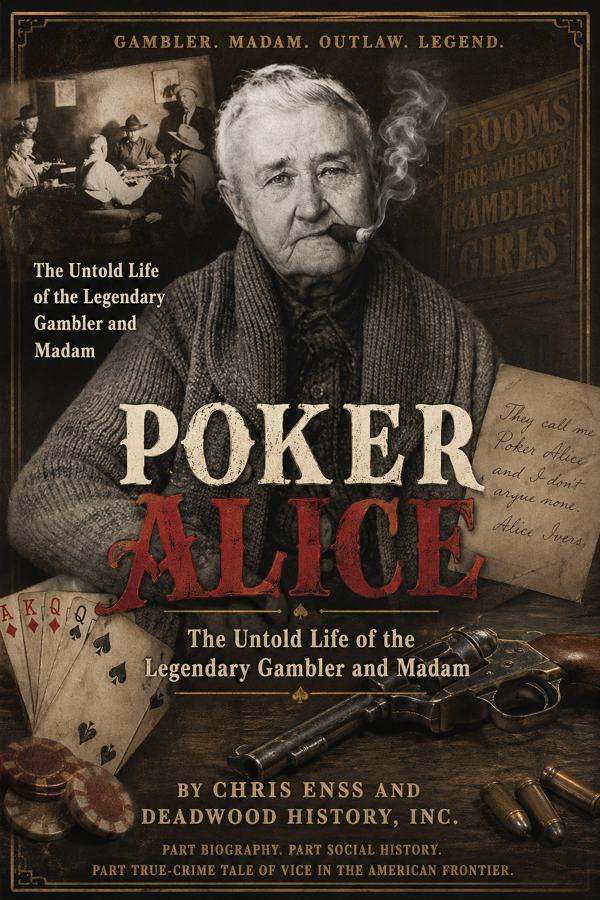
In her final years Alice became something the Black Hills had not quite expected: a tourist attraction. She appeared in Deadwood's Days of '76 parade, the annual celebration of the town's gold rush origins, dressed in a man's khaki shirt and a campaign hat, according to the South Dakota State Historical Society's journal. A 1925 celebration of Old West figures put her alongside Deadwood Dick, and the Denver library biography notes that she felt important again. The photographs from those years show a white-haired woman in a cardigan with a cigar in her mouth and an expression that suggests she is still waiting for you to act.
There is a coda in a museum. Legend says that during one rowdy night at the Sturgis house Alice fired a shotgun indoors and put a hole in a painting, a nude by A.D.M. Cooper, a painter who had been a protégé of George Catlin. South Dakota Magazine traced the canvas: she reportedly willed it to a fellow madam known as Big Hulda, a collector later found it hanging in a bar in Gillette, Wyoming, and it now sits restored in the collection of the Days of '76 Museum in Deadwood. Whether the damage came from Alice's gun the magazine could not confirm. Of course it could not.
In February 1930 she went into hospital in Rapid City for gallbladder surgery. She seemed to rally, and then she didn't. Alice Ivers died on 27 February 1930, ten days after her birthday. Born 1851, died 1930: she was 79. Her funeral was held on 1 March at St. Aloysius Cemetery in Sturgis, where she is buried. Her will cut out the relatives who had ignored her in her last years and left what she had to her friends. She played the river the way she played everything else.
Her house survived her. It was moved in the late 1980s to a prominent spot in downtown Sturgis, the town that spent decades trying to live her down, and which now fills up every August with hundreds of thousands of bikers for the Sturgis Motorcycle Rally. Most of them walk past it without knowing a cigar-smoking card sharp once ran the busiest room in the county from inside. Elizabeth Taylor played her in a 1987 TV movie. Her name even turns up in Lucky Luke, the Belgian cowboy comic. If you want more of the frontier that made her, our history of who invented poker covers the riverboats and saloons she grew up on.
And somewhere in all that, every Sunday, the cards stayed in the drawer. Or so she said. She was a poker player. You decide.
Your table is open every day of the week
Alice took Sundays off. The online game doesn't.
Sunday is now the biggest day on the online tournament calendar. We track where US players can sign up, deposit and cash out under each room's terms, and we list the private app clubs worth joining. No dynamite, no Winchester, no Methodist conventions required.
21+ (18+ where local law allows). Play for fun and only with money you can afford to lose.
Sources: Denver Public Library, "Poker Alice Tubbs (1851-1930)"; True West Magazine, "Queen of the Western Gamblers" and Jana Bommersbach, "Poker Alice" (2015); The Colorado Sun, excerpt and interview with Liz Duckworth, Poker Alice Tubbs: The Straight Story (2019); Prairie Public, Dakota Datebook, "Poker Alice" (2020), citing the Bismarck Daily Tribune, 1913; Sturgis museum, "Experience Sturgis"; South Dakota Magazine, "Art, Violence and Poker Alice" (2017); South Dakota History, vol. 40 no. 1, "Dakota Images: Alice Ivers Tubbs"; Legends of America, "Poker Alice, Famous Frontier Gambler."